

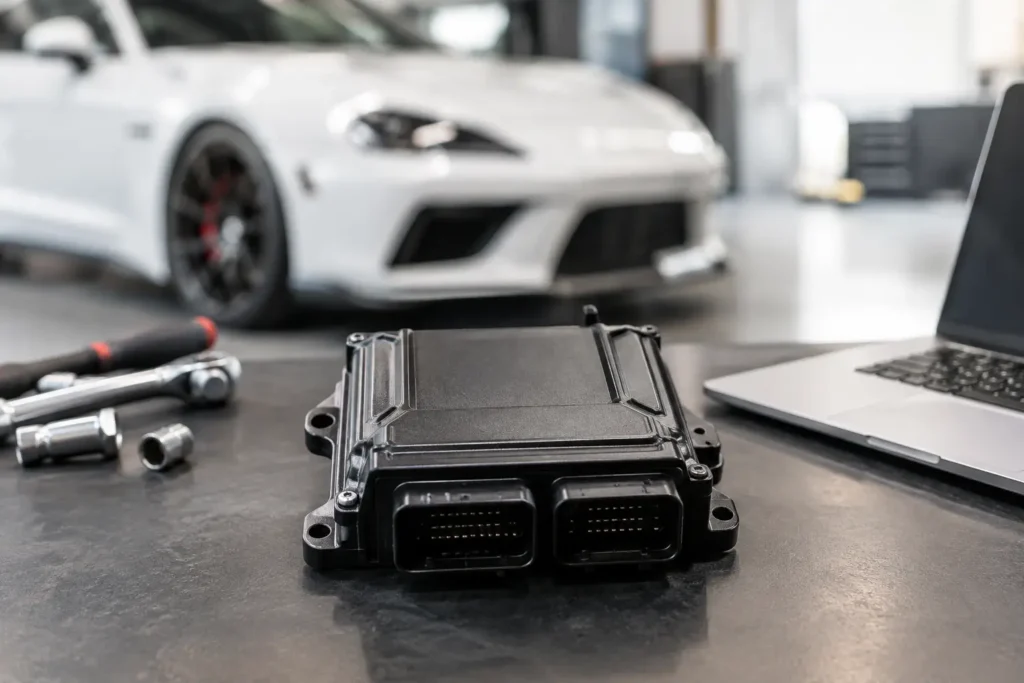
A standalone ECU is only as good as the calibration behind it. On a turbo street car, it needs to start cleanly on a cold morning, control boost predictably and keep the engine safe when fuel pressure or coolant temperature moves the wrong way. On a drift or race car, it also needs to log the problem before the next session. This Link ECU review looks at where Link earns its reputation, where buyers need to be realistic, and how to choose the right unit for the job.
What makes a Link ECU a serious option?
Link Engine Management has built its following around configurable engine control that suits modified cars rather than forcing a custom build into a narrow OEM strategy. Its ECU range covers plug-in units for selected platforms as well as wire-in ECUs for engines and vehicles that need a fully bespoke loom.
That distinction matters. A plug-in ECU can be a strong route for a relatively conventional build where the factory sensors, connectors and basic vehicle functions are worth retaining. A wire-in ECU makes more sense when the car has an engine swap, a stripped race shell, a custom harness, a motorsport dash, staged injectors, drive-by-wire or a serious amount of auxiliary control.
For the right application, Link offers the functions builders actually use: flexible fuel and ignition mapping, boost control, launch and anti-lag strategies, closed-loop lambda control, CAN communication, sensor protection and data logging on supported models. The headline feature list is not the point, though. The value is in being able to build those functions around the car instead of working around an ECU with fixed limitations.
Link ECU review: software and calibration workflow
PCLink is central to the Link experience. It is a Windows-based tuning package designed for live tuning, configuration, diagnostics and log review. It is not aimed at someone who wants an app to choose a power figure and press upload. That is a positive for professional tuners and experienced builders, because meaningful control requires meaningful access.
The layout is logical once the ECU has been configured correctly. Fuel, ignition, boost, compensations, limiters and inputs are accessible without hunting through consumer-style menus. A competent calibrator can set up multiple fuel, ignition and boost strategies, then use logging to validate what the engine is doing under load.
The trade-off is clear: PCLink rewards technical understanding. A base map is a starting point, not a finished calibration. Injector characterisation, trigger setup, timing verification, sensor calibration and failsafes must be right before chasing boost or power. If you are fitting the ECU yourself but have not tuned standalone management before, budget for professional mapping. It is cheaper than a damaged engine.
Logging is another major reason to consider Link. A clean data log can show whether a misfire is linked to dwell, battery voltage, fuel pressure, boost control, wheel speed or a sensor issue. For drift and circuit work, this turns fault-finding from guesswork into a process. The usefulness depends on the ECU model, installed sensors and how well the channels have been configured, but the platform is built with this work in mind.
Inputs, outputs and the hardware around the ECU
Do not buy an ECU by engine cylinder count alone. The correct choice depends on the trigger pattern, ignition arrangement, injector staging, throttle type and the number of systems you need to control. A basic turbo four-cylinder may need far less I/O than a drive-by-wire six-cylinder with dual fuel pumps, a fan control strategy, intercooler spray, flex-fuel sensor, pressure sensors and CAN dash.
Before ordering, make an I/O plan. List every sensor and actuator, then add the functions that are likely to be fitted later. These commonly include oil pressure, fuel pressure, ethanol content, wheel speeds, clutch switch, gearbox or transmission signals, exhaust gas temperature modules and additional boost solenoids. Running out of inputs after the loom is built is a frustrating and expensive way to save money.
Link ECUs are particularly attractive for custom turbo builds because they can support the control strategies that make high-output engines usable. Boost-by-gear, boost-by-speed, fuel-pressure protection and sensible torque management can do more for consistency than a peak-power number. On a rear-wheel-drive drift car, that can mean the difference between a controllable run and tyres going up in smoke before the corner exit.
Compatibility still needs checking at component level. Confirm sensor calibration, connector type, trigger compatibility, drive-by-wire support where applicable, and whether the ECU has enough high-current or low-side outputs for the devices in your system. If CAN accessories are involved, confirm the communication plan before the wiring begins. A CAN dash, wideband controller or power distribution module may be compatible in principle, but correct setup remains essential.
Street manners versus motorsport control
A Link ECU does not automatically make a car unpleasant on the road. With proper calibration, a modified street car can idle properly, start reliably, manage closed-loop fuel correction and run sensible engine protection. The ECU can also make flex-fuel operation and multiple boost settings far more practical than improvised add-on solutions.
However, a standalone ECU is not always the easiest answer for a modern road car. Factory systems may be deeply tied into immobilisers, dashboards, automatic transmissions, climate control, stability systems and body modules. A plug-in solution can reduce the complexity on supported vehicles, but it does not remove the need to verify what functions will be retained.
For road use in Great Britain, legal compliance and MOT implications should also be considered before changing engine management. Emissions equipment, warning lights and diagnostic functions are not details to ignore. A track-focused ECU installation may be perfect for a competition car but unsuitable for a road car that must meet its original obligations.
This is where a Link ECU is strongest when specified honestly. It suits owners who want calibration freedom and are prepared to support that freedom with correct wiring, proper sensors and capable tuning. It is less suited to someone expecting a plug-and-play shortcut around a mechanical or fuel-system problem.
Build quality, support and the cost question
Link has a strong reputation in modified Japanese, European and motorsport circles because its products are familiar to many specialist tuners. That matters when a car is booked for mapping or needs support at a circuit. A well-known ECU with accessible software is generally easier for a workshop to diagnose than an obscure unit with limited documentation or local knowledge.
The ECU price is only one part of the project. A serious installation may also require a harness, connector kit, wideband lambda system, pressure sensors, flex-fuel sensor, boost solenoid, relays, fuses, CAN hardware and dyno time. If the current fuel system has unknown injectors, tired wiring or no fuel-pressure reference, deal with those weaknesses before expecting the ECU to protect the engine.
There is no benefit in buying a high-spec ECU and pairing it with poor electrical work. Use correctly sized cable, proper shielding where required, sound grounding, reliable connectors and a serviceable fuse and relay arrangement. For race and drift cars, label the loom and leave enough access to inspect it quickly between sessions. ProSpeed Parts can help source the supporting fuel, cooling, turbo and engine-management hardware that makes the ECU installation work as a complete system.
Which Link ECU setup suits your build?
A plug-in unit is normally the practical choice for a supported platform with a conventional upgrade path. It can preserve a tidy installation and reduce loom work, provided its I/O and feature set meet the final specification. It is well suited to street cars moving to larger injectors, forced induction, flex fuel or a more serious turbo setup.
A wire-in ECU is the better route for engine swaps, race cars and builds that have already outgrown the factory electrical architecture. It gives the freedom to place sensors and controls exactly where they are needed, but it demands more planning and better workmanship. In this category, choosing the ECU is only the start – the loom design is part of the engine package.
For any build, choose capacity for the finished car rather than the engine in its current form. If drive-by-wire, staged injection, additional pressure monitoring or CAN expansion is on the future list, specify for it now. Buying twice costs more than selecting the correct I/O, logging and control capability at the outset.
A Link ECU is a capable, tuner-led platform, not a magic box. Match it to a clear wiring plan, quality sensors, a healthy fuel system and a mapper who understands your engine combination, and it becomes one of the most useful parts of the build long after the first dyno sheet is printed.