

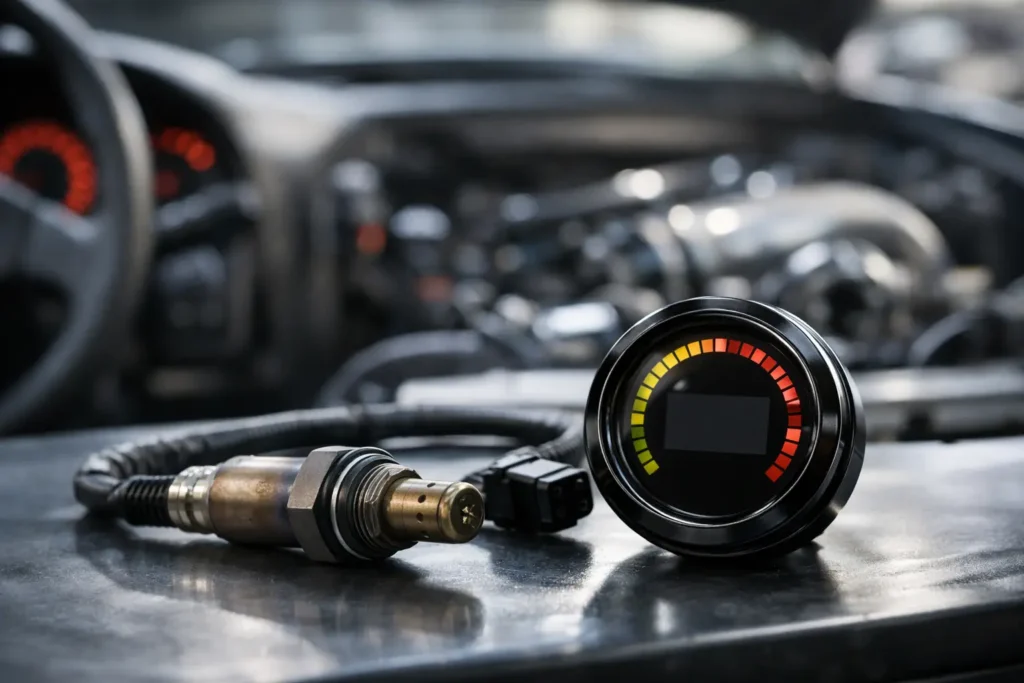
A wideband is not a cosmetic gauge for a modified car. It is one of the fastest ways to see whether the engine is receiving the fuel it needs under boost, at full throttle, or during a hard drift run. This AEM wideband sensor review focuses on what matters once the car is actually being used: reading stability, installation quality, sensor life, ECU integration and whether AEM is the right choice for your build.
For turbocharged street cars, circuit machines and drift builds, an AEM wideband system is a proven, sensible purchase. It is not a substitute for a proper calibration or dyno time, but it gives the driver and tuner live air-fuel ratio data that can prevent expensive mistakes.
What an AEM wideband sensor does
An AEM wideband gauge and controller measures the oxygen content in exhaust gas and translates it into an air-fuel ratio, usually shown as AFR or lambda. Unlike a narrowband oxygen sensor, which is primarily designed to confirm operation around stoichiometric fuelling, a wideband can measure across a far broader range. That makes it useful when the engine is rich under boost, lean during a transient, or being mapped for an alternative fuel.
Most current AEM wideband kits use a Bosch LSU 4.9 sensor. This is a major positive. The Bosch sensor is widely supported, familiar to experienced tuners and capable of reliable results when it is installed correctly. AEM packages that sensor with an easy-to-read gauge, controller electronics and an analogue output that can be connected to many aftermarket ECUs, data loggers or engine management systems.
The gauge is therefore only part of the purchase. The value is in having a consistent measurement that can be displayed to the driver and supplied to the ECU for logging, safety strategies or closed-loop fuelling where the calibration supports it.
AEM wideband sensor review: accuracy and response
AEM widebands have earned their reputation because they provide useful, stable data without requiring an overcomplicated installation. On a healthy system, the gauge warms up quickly and settles into a believable reading at idle. Under load, it reacts quickly enough to show a lean spike, a boost leak-related change or a fuel delivery issue before it becomes a damaged piston, valve or turbocharger.
Accuracy depends on more than the brand name printed on the gauge. Any wideband sensor is affected by exhaust placement, wiring, heat, sensor condition and contamination. AEM’s Bosch-based system gives a solid reference point, but do not expect it to diagnose every engine issue on its own. A lean reading may be genuine, but it may also point to an exhaust leak ahead of the sensor, a failing sensor, a poor earth or incorrect scaling in the ECU.
For most tuned petrol engines, the displayed AFR is clear and practical. Lambda is often the better format for workshops and tuners working across petrol, ethanol blends and race fuels, since lambda is fuel-independent. If your ECU and calibration are configured in lambda, keep the whole system in lambda where possible. It reduces confusion when comparing logs, targets and dyno data.
Gauge visibility and daily use
The AEM X-Series style display is one of its strongest points. It is compact, bright and easy to read at a glance, which matters far more than fancy screen graphics when you are accelerating through the gears or watching temperatures during a track session. The display can normally be configured to show AFR or lambda, and the warning function adds another layer of protection if the engine moves outside the range you expect.
That warning should be treated as an alert, not an engine protection strategy by itself. If you run serious boost or a high-value race engine, use the wideband signal in the ECU and configure appropriate failsafes. Depending on the ECU, that may mean boost reduction, ignition retard, a lower rev limit or fuel and spark cut when a defined lean condition occurs under load. Set sensible delays and operating conditions so a quick gear-change transient does not cause an unnecessary intervention.
Installation determines whether it works properly
The best wideband controller cannot compensate for a badly positioned sensor. The weld-in boss should usually be installed downstream of the turbocharger on forced-induction applications, after the exhaust gases have mixed, and away from a point where condensation can collect in the sensor element. Positioning the sensor around the upper half of the exhaust pipe is common practice, rather than pointing it straight down.
Do not install it immediately at the turbine outlet where heat can be excessive, and do not place it so far downstream that outside air can enter through joints or leaks. On a typical road car, a location in the downpipe after the turbo, or in the front section of the exhaust on naturally aspirated engines, gives a useful balance between response, temperature control and representative gas flow.
A few installation details deserve the same attention as the sensor boss:
- Weld the boss properly and check for leaks before relying on the readings.
- Keep the sensor wiring away from manifold heat, downpipes and moving driveline parts.
- Use clean, dependable power and earth connections, following the AEM wiring instructions rather than sharing an unsuitable circuit.
- Confirm the analogue output scaling matches the selected input configuration in the ECU.
That final point catches out plenty of otherwise well-built cars. A gauge can show the correct AFR while the ECU logs nonsense because its analogue voltage table does not match the AEM output. Check the displayed value against the ECU log at idle and during controlled running before using the signal for correction or protection.
Sensor life: the trade-off buyers should understand
The Bosch LSU 4.9 is a consumable motorsport component, not a fit-and-forget item for every build. Normal use on a well-tuned, unleaded petrol engine can provide a long service life. However, leaded race fuel, silicone contamination, excessive oil consumption, coolant entering the combustion chamber and sustained extreme exhaust temperatures can shorten that life sharply.
This is where the AEM system has the same limitations as other Bosch LSU-based widebands. If the engine is burning oil or water, replacing the sensor may restore the reading temporarily, but it does not solve the underlying fault. Likewise, repeated rich running can contaminate the sensor and hide the real tuning problem.
For a dedicated race car, it can be sensible to keep a known-good spare sensor in the trailer or workshop. That is particularly true for endurance use, cars running harsh fuel combinations, or any build where the wideband feeds a protection strategy. A spare is cheaper than guessing whether a suddenly strange reading is a mapping issue or a tired sensor.
Is it suitable for turbo, drift and track builds?
For a turbo street car, AEM is an excellent fit. It gives you a clear indication of fuelling under boost and a valuable input for ECU logging. It is also straightforward enough for an enthusiast fitting a first standalone ECU, provided the wiring and sensor placement are done correctly.
Drift cars benefit for a different reason. Long high-load runs, rapid throttle changes and heat soak make live data useful, especially when a car has been altered between events. A visible gauge helps the driver spot a problem, while data logging lets the team review what happened after a run. Protect the wiring carefully, as drift cars are often subject to hard vibration, heat and frequent under-bonnet work.
For circuit and time-attack applications, an AEM wideband works best as part of a complete data picture. Pair AFR or lambda data with boost, fuel pressure, oil pressure, coolant temperature and intake air temperature. A lean condition only becomes truly actionable when you can see whether fuel pressure fell, boost climbed beyond target or inlet temperatures rose beyond the calibration’s safe operating range.
It is less compelling if you only want a dashboard accessory on a standard engine that is serviced correctly and retains an operating factory oxygen sensor system. In that case, the benefit may not justify the fitting work. On any modified engine, though, especially one with upgraded injectors, fuel system changes, forced induction or a standalone ECU, the case is much stronger.
AEM versus cheaper wideband kits
Cheaper wideband kits can look attractive, particularly when a build budget is already being consumed by injectors, pumps, intercooler pipework and fabrication. The issue is not simply whether a low-cost gauge displays a number. The question is whether that number remains trustworthy when exhaust temperature, vibration and electrical noise increase.
AEM sits in the sensible middle ground for many performance builds. It uses a respected sensor platform, offers a clean display and provides the output options most tuners need. More advanced motorsport systems may offer extra channels, CAN communications, higher-end data integration or specific ECU ecosystem advantages. Those features are worthwhile when the rest of the car is built around them, but they are not essential for every 400 bhp street car or weekend drift machine.
Choose the wideband that matches the engine management, intended fuel, data requirements and budget. Do not choose solely on gauge appearance.
The verdict for serious modified cars
An AEM wideband is a dependable tool for anyone who wants to monitor fuelling rather than assume it is correct. Its strengths are clear readings, Bosch LSU 4.9 sensor support, practical ECU integration and a format that suits real street, drift and race use. Its limitations are the normal limitations of wideband technology: it needs correct fitting, clean wiring and a healthy engine to deliver meaningful data.
For builds receiving new injectors, more boost, ethanol capability or standalone management, this is the sort of component that earns its place quickly. ProSpeed Parts customers building reliable performance cars should treat it as part of the engine’s monitoring package, then use the data properly. Fit it well, scale it correctly and let it confirm the tune before the engine tells you something is wrong the expensive way.