

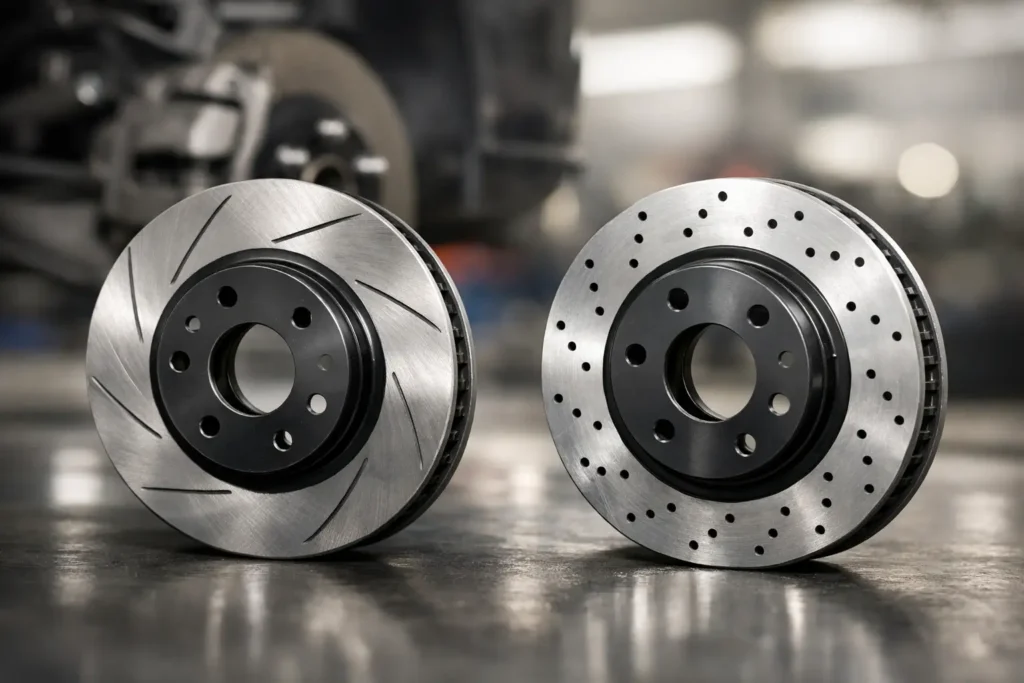
A brake upgrade can look right behind the wheel and still be wrong for the job. In the slotted vs drilled brake discs debate, the best choice is not the disc with the most aggressive appearance. It is the one that matches the car’s weight, tyre grip, pad compound, driving temperature and how often it will be punished.
For a fast-road car, drilled discs can be a sensible, clean-looking upgrade when paired with quality pads and correctly sized calipers. For repeated hard stops on circuit, a slotted disc is usually the more durable performance choice. Drift cars sit somewhere between the two, depending on whether the front brakes see long, high-speed entries or the car is mainly used for shorter events and street driving.
What Slots and Holes Actually Do
Brake discs turn kinetic energy into heat. Their primary job is to absorb that heat and shed it without distorting, cracking or allowing the pad material to lose friction. Slots and drilled holes change the disc surface, but neither design can compensate for undersized discs, poor-quality pads, old brake fluid or inadequate cooling.
Slots sweep across the friction face of the disc. As the rotor turns, their sharp edges lightly refresh the pad surface, helping remove debris, worn friction material and gases produced under extreme heat. Modern pad compounds do not suffer from “outgassing” in the same way older materials did, but slots can still maintain a consistent pedal feel when brakes are being worked hard.
Drilled discs use holes through the rotor face. These reduce a small amount of mass and give dust, water and gases a path away from the pad surface. They also offer strong visual appeal and can improve wet-weather initial bite. The trade-off is simple: every hole creates an area of stress concentration in a component exposed to repeated heat cycles.
Slotted vs Drilled Brake Discs Under Hard Use
A slotted disc generally has the advantage where stopping performance must stay consistent lap after lap. The disc retains more of its original structure than a cross-drilled design, so it is better able to deal with high temperatures and frequent thermal cycling. That is why slotted rotors are common on track cars, time-attack builds and heavier performance vehicles that repeatedly brake from high speed.
The slot pattern also matters. Curved or directional slots are designed to clear the pad surface efficiently while limiting noise. Straight slots can provide a sharper cleaning action, although they may be more noticeable in normal road use. Whichever design is fitted, the disc must be installed in the correct left- and right-hand orientation where applicable. Directional vanes and directional slots are not decorative details.
The compromise is pad wear. Because slots continually abrade the pad face, they can use pads faster than a plain disc. With an aggressive track pad, expect more brake dust and potentially more noise. For a car that spends most of its life commuting, this can be unnecessary wear for a benefit you will rarely use.
Drilled discs perform well on a fast-road car that gets occasional spirited use. They can reduce weight slightly, offer good wet braking behaviour and suit drivers who want an upgraded appearance without building a dedicated circuit car. High-quality OEM-style drilled discs are often cast with the holes in place, rather than drilled afterwards. That distinction matters because a properly engineered casting distributes stress more effectively around each hole.
Even a well-made drilled disc has a limit. Repeated heavy braking can initiate cracks at the edge of the holes, especially with high-friction pads, a heavy vehicle, sticky tyres and insufficient airflow. Small surface marks are not automatically a failure, but cracks that propagate towards the disc edge, across the friction face or into multiple holes mean the disc should be replaced. A drilled disc is a consumable item, not a forever upgrade.
Drilled, Dimpled or Slotted?
Dimpled discs are worth considering if you want part of the appearance and pad-cleaning benefit of drilled rotors without fully perforating the friction surface. The dimples do not pass through the disc, leaving more material in place and reducing the likelihood of hole-related cracking. They are a practical middle ground for hard-driven road cars and occasional track-day builds.
That said, dimpled discs do not create the same open path for water and debris as a fully drilled design. They also do not turn a standard braking system into a track-ready setup. If brake temperatures are already excessive, focus first on disc diameter and thickness, caliper piston area, pad selection, fluid boiling point and cooling ducts.
Choose by Application, Not by Appearance
For a daily-driven performance car, a quality plain, drilled or lightly dimpled disc paired with a suitable street-performance pad is often the strongest package. Plain discs should not be dismissed. They offer maximum thermal mass, quiet operation and excellent durability, particularly when the vehicle has a well-designed factory brake system.
For fast-road use and occasional track days, slotted or dimpled discs make sense when combined with a pad that works from cold but tolerates elevated temperatures. A very aggressive race pad can be frustrating on the road: it may squeal, create heavy dust and deliver weak bite until it reaches working temperature.
For dedicated track work, use slotted discs where available for the platform. Add high-temperature fluid, appropriate track pads and cooling improvements before chasing cosmetic rotor designs. A disc that stays cooler will last longer and is less likely to transfer uneven pad deposits, which are commonly mistaken for a warped disc.
For drift, the front axle deserves the most attention. High-speed entries, left-foot braking and repeated transitions can generate serious front brake temperature, particularly on a heavier turbocharged car. Slotted front discs are normally the sensible choice for a competition-focused drift build. Rear disc selection depends on the handbrake arrangement, brake bias and whether the rear brakes are used heavily for foot braking as well as hydraulic handbrake control.
Before ordering, check these four areas:
- Disc diameter, thickness, centre bore, offset and ventilation type must match the exact hub and caliper setup.
- Pad compound must suit the disc material and the temperatures the car will actually see.
- Brake fluid condition matters as much as rotor choice. Flush aged fluid before any track event.
- Wheel clearance, cooling ducts and tyre grip all affect brake temperature and should be considered as one system.
Heat Management Is the Real Upgrade
Brake discs do not create grip. They allow the braking system to manage heat while the tyre converts braking force into deceleration. Fitting a drilled disc to a car with unsuitable pads and old fluid can make the brakes look more serious while the pedal still goes long after a few hard stops.
Start with the duty cycle. A 20-minute track session on semi-slick tyres creates a completely different load from a quick road blast. Vehicle mass also changes the answer sharply. A lightweight hatchback may be perfectly happy with drilled discs and performance road pads, while a large, powerful saloon can overwhelm them in a single hard session.
Cooling is often the best value improvement once pads and fluid are correct. Proper backing plates and ducts feed air into the centre of a vented disc, allowing the internal vanes to pump it through the rotor. This reduces peak temperatures across the disc, pad and caliper, helping protect seals, fluid and wheel bearings as well as the rotors themselves.
Fitment and Bedding-In Matter
New discs should be installed on a perfectly clean hub face. Rust, paint, dirt or a raised burr behind the disc can create run-out, leading to pedal pulsation and uneven deposits. Use the manufacturer’s torque specification and tighten wheel bolts evenly. Do not spray lubricants onto friction surfaces.
Bedding-in is equally important. Follow the pad manufacturer’s process, which normally involves a series of controlled stops to transfer an even layer of pad material to the disc. Parking with the brake pedal held down immediately after a heavy stop can imprint pad material onto a hot disc and create vibration later.
Buy the disc that supports the way the car is driven, then build the rest of the brake package around it. For most serious track and drift applications, a quality slotted disc is the safer long-term bet. For a fast-road build where looks, wet-weather response and occasional hard use matter, drilled or dimpled discs can be a strong fit. The useful upgrade is the one that still delivers a firm, repeatable pedal when the next braking zone arrives.