

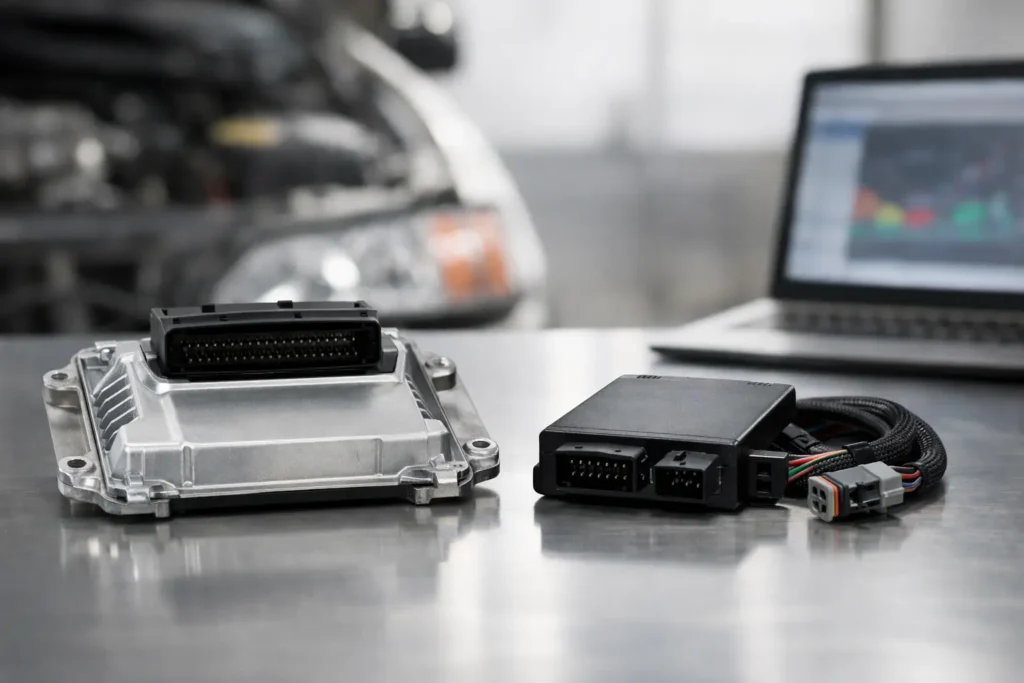
You do not choose engine management in the same way you choose an air filter or a set of silicone hoses. Get this wrong and you can spend good money twice, first on the shortcut, then on the proper solution. When people ask about ecu standalone vs piggyback, what they usually mean is simpler – how much control do I actually need for this car, this power target, and this budget?
That question matters because both options can work brilliantly or be completely wrong. A mild turbo conversion on a modern road car has very different needs from a drift build running larger injectors, flex fuel and boost-by-gear. The best answer is not the cheapest box or the most advanced one. It is the system that gives enough control without creating avoidable limits later.
ECU standalone vs piggyback: the real difference
A piggyback ECU works alongside the factory ECU. It intercepts, alters or offsets signals such as airflow, manifold pressure, injector or ignition references so the original system still handles much of the car’s logic. That makes piggybacks attractive for lightly modified builds where you want added fuel or boost control without stripping out the OEM brain.
A standalone ECU replaces most or all of that factory control. Instead of persuading the standard ECU to accept new conditions, a standalone runs the engine directly using its own maps, strategies and inputs. On the right platform, that means full control over fuelling, ignition, boost, idle, launch, knock strategies, sensor calibration and far more.
On paper, the choice looks obvious. More control sounds better. In reality, more control also means more setup time, more wiring work, more calibration effort and, in some cases, more compromise in factory features if the installation is not properly planned.
When a piggyback makes sense
Piggybacks still have a place, especially on road-based builds that are not trying to reinvent the car. If the factory ECU is fundamentally capable, and the modification level is moderate, a piggyback can be a sensible route.
A typical example is a car running intake, exhaust, slightly higher boost and supporting fuel upgrades, where the OEM ECU can still manage cold start, driveability, dash integration and fault logic effectively. In that case, using a piggyback to adjust fuelling or boost may give enough headroom without turning the project into a full electronics job.
Cost is one reason people start here, but installation simplicity is often the bigger advantage. Less wiring, less fabrication of sensor strategies and less time chasing OE functionality can make a piggyback appealing for street cars that still need to behave properly in traffic, on cold mornings and during MOT-style reality checks.
The catch is that piggybacks work by influencing a system that was never designed for your final setup. That can be perfectly acceptable within limits, but once injector size, turbo size, airflow model or fuel type move too far from standard, the workaround starts showing its weaknesses.
Where piggybacks start to fall short
The biggest issue is not peak power. It is control resolution. If you are manipulating sensor signals to get the factory ECU to do what you want, you are always working around the logic rather than owning it outright.
That can create problems with closed-loop corrections, load calculation, ignition authority and safety strategies. The factory ECU may fight your changes, pull values back, or respond unpredictably when conditions differ from the dyno session. Add bigger cams, staged injection, ethanol content changes or serious boost targets, and a piggyback can become a patch rather than a system.
There is also the matter of diagnosis. When a car has a standard ECU making one decision and a piggyback trying to shape another, fault finding becomes less straightforward. For a workshop or tuner, that means more time. For an owner, it can mean chasing issues that are not obvious from a quick scan.
Why a standalone ECU is the better tool for serious builds
If the build has moved beyond bolt-ons, a standalone ECU usually stops being a luxury and starts being the correct foundation. This is especially true for forged engine builds, larger turbo setups, motorsport use, engine swaps and anything that needs proper strategy control rather than signal manipulation.
With a standalone, the tuner has direct access to the core tables and compensations that matter. Injector data can be entered properly. Sensor scaling can match the hardware actually on the car. Ignition and fuelling can be mapped for real operating conditions rather than hidden behind factory logic. Boost control, flat shift, launch control, fan control, flex fuel and multiple engine protections can be built into one coherent package.
That matters on track, in drift, and on any car where consistency is worth more than a headline dyno number. A standalone lets the engine management match the hardware rather than forcing the hardware to stay inside factory assumptions.
It also gives more room to grow. If your build plan already includes bigger injectors, a different manifold pressure range, upgraded turbo hardware and fuel system changes, buying a piggyback first can be false economy. The standalone may cost more upfront, but it avoids paying twice when the car outgrows the interim solution.
Standalone trade-offs most people ignore
A standalone is not automatically the smart buy. It can be overkill on a mild road car, and on some newer platforms the integration work is considerable. You need to think about CAN communication, dash functions, air conditioning behaviour, DBW throttle control, immobiliser interactions and how much OEM refinement you are willing to keep or lose.
A well-supported plug-in standalone on the right platform is very different from a universal ECU fitted to a modern car full of interconnected modules. One can feel almost factory when tuned properly. The other can become a wiring-heavy compromise if the package has not been thought through.
There is also tuner dependence. A good standalone ECU tuned badly is still a bad result. The extra control only pays off if the calibration is competent and the hardware package is matched correctly. For workshops and serious enthusiasts, that is not a reason to avoid standalone management. It is a reason to choose components and tuning support carefully.
Cost versus value
If you only compare purchase price, piggyback systems often look attractive. But purchase price is not build cost. You need to consider fitting, dyno time, additional sensors, loom work and whether the solution will still suit the car twelve months from now.
For a modest fast-road setup, a piggyback can absolutely represent good value. It may deliver the gains you want while retaining standard behaviour and keeping installation straightforward. If the target is limited and realistic, there is nothing wrong with that.
For a more ambitious car, value shifts towards standalone. The ability to control the engine properly, support future hardware and apply proper protections often outweighs the initial spend. When an engine, turbo kit, fuel system and fabrication bill are already significant, skimping on the control system is usually the wrong place to save money.
Which is better for street, drift and race use?
Street cars sit in the grey area. If the car remains close to standard and you want sensible gains with good manners, a piggyback may be enough. If the car is becoming a genuine performance build with larger injectors, serious boost or alternative fuels, standalone starts making more sense even if the car still sees daily road use.
Drift cars generally benefit more from standalone management because they rely on repeatable torque delivery, strong transient response and features such as launch, limiter strategies and flexible boost control. They also tend to evolve quickly, which makes future-proofing valuable.
Race applications are where standalone ECUs usually justify themselves without much debate. Data quality, engine protection, consistency and precise control matter more than retaining every OEM nicety. Once reliability under load is a priority, direct control wins.
The right way to decide
Start with the end goal, not the current modification list. If you know the car will eventually get a larger turbo, proper fuel system upgrades and track use, buy for the final stage. If the car is staying as a responsive road setup with minor supporting mods, keep the solution proportionate.
You should also assess platform support. Some cars have excellent standalone options with clean integration, strong software and proven tuner familiarity. Others are better suited to more limited intervention unless the budget includes serious electrical work. Product choice matters as much as category choice.
For buyers sourcing parts, this is where a specialist supplier earns its place. Matching ECU choice with injectors, sensors, boost control hardware, fittings, fuel components and supporting electronics saves time and avoids mixed-spec builds. That matters whether you are building at home or ordering for customer cars through a workshop.
The shortest answer to ecu standalone vs piggyback is this: piggyback suits controlled, moderate upgrades where the factory ECU still does most of the heavy lifting; standalone suits builds that need genuine authority over how the engine runs. Be honest about your power target, your future plans and how much compromise you can tolerate. The right ECU is the one that still makes sense when the build gets faster.