

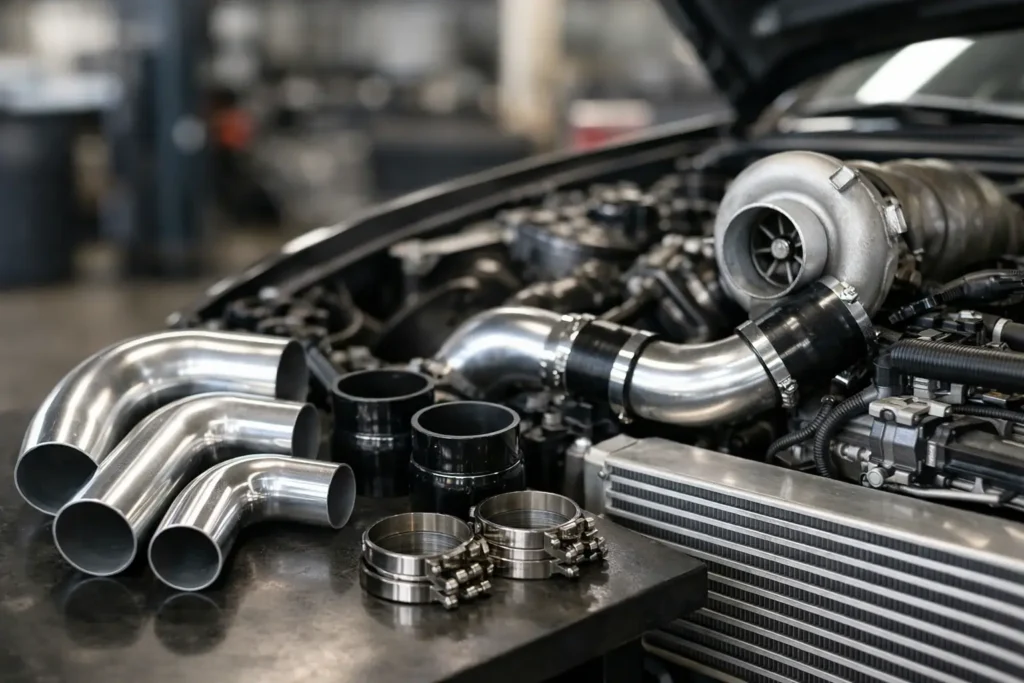
A turbo setup can make strong power with the wrong intercooler pipe size, but it rarely makes good power everywhere. Too small and you build restriction, heat and pressure drop. Too large and the system gets lazy, harder to package and slower to recover between shifts. If you are working out how to size turbo intercooler piping, the target is not the biggest tube you can fit. It is the smallest pipe that supports your airflow and boost target without becoming a choke point.
That matters whether you are building a fast road car, a drift car that lives on repeated transitions, or a race setup where consistency lap after lap matters more than dyno-sheet headline numbers. Pipe diameter changes volume, velocity, response, coupler choice, bead roll options and how cleanly the whole charge path can be routed. Get it right and the car feels sharper, the turbo works less hard for the same manifold pressure, and packaging stops fighting the rest of the build.
How to size turbo intercooler piping without guessing
The simplest mistake is sizing from the turbo outlet alone or copying whatever another build used. Pipe size should be matched to airflow demand, intercooler core size, power target and layout length. A short-route setup on a 300 bhp street car does not need the same dimensions as a front-mounted, long-run system on a 700 bhp track car.
For most builds, diameter is chosen from proven ranges rather than a full fluid-dynamics exercise. That is practical and it works. As a starting point, 2.0 to 2.25 inch pipe suits many low-to-mid power street turbo builds. Around 2.5 inch is the common sweet spot for a large share of performance road, drift and club motorsport setups. Once power climbs further and airflow demand becomes serious, 3.0 inch may make sense, usually on the cold side, sometimes across the full system depending on the package.
The key point is that hot side and cold side do not always need to match. The section from turbo to intercooler sees hotter, less dense air. After the intercooler, the air is cooler and denser, so the same mass flow can sometimes be carried differently. That is why many well-sorted systems use a smaller hot side and a slightly larger cold side.
Start with power and airflow, not pipe catalogue sizes
If you want a practical rule, tie your decision to realistic bhp rather than marketing claims. A modest 1.6 or 2.0 litre turbo road car aiming at 250 to 350 bhp will usually be happy on 2.25 inch piping, often with excellent response. Step into the 350 to 500 bhp range and 2.5 inch becomes the default choice for good reason. It balances flow capacity and manageable charge volume. Above that, especially from 550 bhp onwards, 3.0 inch starts to earn its place if the turbo, intercooler and throttle body can actually use it.
That said, bhp alone is not enough. A high-revving four-cylinder making 500 bhp can behave differently from a 500 bhp six-cylinder with a broader torque curve. Turbo sizing, compressor efficiency, boost pressure and intended rpm window all affect what the charge pipe sees. A drift car that needs fast transient response may benefit from staying slightly tighter on diameter than a drag-oriented build where top-end flow is the priority.
This is where experienced builders make better decisions than internet averages. They look at the whole combination: compressor outlet size, intercooler end tank size, throttle body diameter, route length and packaging limits around radiator support, slam panel, headlamps and crash bar.
Typical diameter ranges that work
For a lot of UK and European turbo builds, these ranges are a solid starting point. Up to roughly 350 bhp, 2.0 to 2.25 inch usually works well. From about 350 to 550 bhp, 2.5 inch is often the right answer. Beyond that, 3.0 inch becomes more common, particularly on the cold side or on full race applications with longer pipe runs.
Those are not hard limits. If the layout is extremely short and the intercooler is efficient, a 500 bhp setup may still perform very well on 2.5 inch throughout. If the route is long, the core is large and the engine spends its life near peak flow, a move to 3.0 inch could be justified earlier.
Velocity versus volume – where most builds go wrong
Bigger pipe reduces restriction, but it also increases system volume. More volume means more air to pressurise before manifold pressure stabilises, which can soften throttle response and make boost recovery feel less immediate. On a road or drift car, that trade-off is very noticeable.
This is why oversized charge piping is so often disappointing. A 3.0 inch system on a moderate-power street car may look serious, but if the turbo is only moving enough air for a 2.25 or 2.5 inch setup, you have added bulk and lag without a real flow benefit. The turbo now works to fill more space, and the pipe run is harder to route cleanly.
On the other side, undersized piping can force higher airspeed and create more pressure drop across bends, couplers and the core itself. The compressor may need to work harder to achieve the same boost at the manifold, which raises charge temperature and reduces efficiency. So the answer is not tiny pipe for response. It is appropriate pipe for the airflow.
Hot side and cold side sizing
If you are deciding how to size turbo intercooler piping on a custom build, split the system into sections. The hot side runs from compressor outlet to intercooler inlet. The cold side runs from intercooler outlet to throttle body.
The hot side can often stay slightly smaller because the air is hotter and less dense, and because keeping that run compact helps packaging around the manifold, downpipe and radiator area. A 2.25 inch hot side with a 2.5 inch cold side is a very common and effective combination.
The cold side is where airflow stability into the throttle body matters. If the intercooler outlet and throttle body both support it, stepping up here can make sense on stronger builds. But do not create abrupt diameter changes for no reason. A clean transition with proper reducers is better than random size jumps just because a part was in stock.
Match the supporting hardware
Charge pipe diameter should not be chosen in isolation. Intercooler end tank size, throttle body size, turbo outlet size and coupler availability all matter. If your turbo has a 2.0 inch outlet and the intercooler inlet is 2.5 inch, that does not mean the entire system should be 2.0 inch or 2.5 inch. It means you need a sensible transition.
The same goes for clamps, joiners and sensor bungs. A good layout with quality aluminium or stainless pipe, proper bead rolls and strong clamps will outperform a badly assembled oversized system every time. Boost leaks, coupler blow-off and ugly internal step changes ruin more builds than being a quarter-inch off on pipe diameter.
Layout matters as much as diameter
You can lose a lot of performance with the right size pipe routed badly. Tight-radius bends, unnecessary length, repeated direction changes and poorly aligned couplers all add restriction and create turbulence. A shorter 2.5 inch route often works better than a longer, messier 3.0 inch route.
Try to keep the path direct without forcing impossible fabrication. Every bend should earn its place. If the intercooler location creates a long scenic tour around the front end, rethink the package before automatically increasing diameter to compensate.
For drift and circuit cars, reliability matters as much as flow. Pipes that sit too close to heat sources, rub through on bodywork or flex against the engine under load will become a problem. Proper support, sensible coupler lengths and enough clearance for movement are part of sizing the system properly.
When to choose 2.5 inch and move on
If you want the honest answer for most serious fast-road and club motorsport turbo builds, it is 2.5 inch. That size works across a huge range of applications because it supports useful airflow without making the system unnecessarily bulky. It is easy to source, easy to package, and compatible with a wide range of intercoolers, bends, joiners and clamps.
That does not mean it is always correct. It means it is very often the best compromise. For many builders, compromise is not a dirty word. It is how you get a car that starts, fits together properly and performs consistently rather than one that only looks good with the bumper off.
At ProSpeed Parts, that is the kind of decision serious builders tend to make. Not the flashiest option, just the one that works.
Common sizing mistakes to avoid
The worst mistake is buying pipework based on appearance. Huge diameter charge piping can look aggressive, but airflow does not care about style points. Another common error is ignoring the throttle body and intercooler connections, then ending up with a stack of reducers that interrupt flow and complicate assembly.
There is also a habit of blaming pipe size for issues caused elsewhere. If response is poor, check turbo sizing, boost control, cam timing, intercooler pressure drop and tune quality before assuming the charge pipes are the main fault. Piping matters, but it is one part of the system.
If you are stuck between two sizes, choose based on the car’s real use. Road and drift setups usually benefit from preserving response and manageable packaging. High-power time attack or drag builds can justify more diameter when airflow and rpm demand are genuinely there.
Good intercooler piping is not about chasing the biggest number on the shelf. It is about building a charge system that matches the engine, the turbo and the job the car actually has to do. Size it for airflow, keep the route clean, and leave yourself enough margin for the power you plan to make rather than the power you post about.