

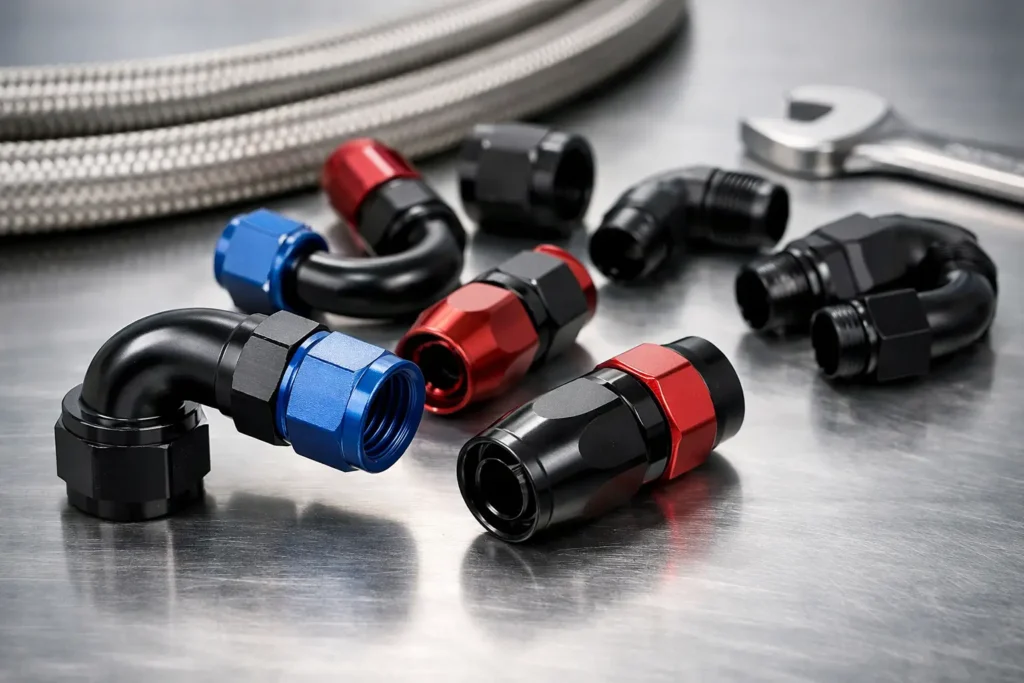
A fuel leak at idle is annoying. A fuel leak at full load, with heat in the bay and a turbo glowing, is a different conversation. If you are working out how to choose AN fittings, you are not just picking shiny hardware. You are deciding how reliable your fuel, oil, coolant or breather system will be when the car is under real pressure.
AN fittings are simple once you break them down, but they are also one of the easiest places to get a custom build wrong. The usual mistakes are ordering by guesswork, mixing thread types, choosing line size by what looks right, or buying a straight fitting where a 45 or 90 degree part would actually protect flow and hose life. Get those details right and the whole system becomes easier to route, easier to service and far less likely to fail.
How to choose AN fittings for your system
Start with the job the fitting needs to do, not the fitting itself. A return fuel line, a high-pressure feed, a turbo oil drain and a coolant crossover may all use AN-style hardware, but they do not want the same size, material or hose construction.
Pressure and temperature come first. Fuel systems, especially EFI setups, need fittings and hose that can handle constant pressure and modern fuels. Oil systems need temperature resistance and clean sealing. Coolant lines usually see less pressure than fuel, but they still need dependable sealing and sensible routing around heat. Breather and catch can setups are more forgiving on pressure, yet poor sizing can still cause restriction.
Then look at fluid volume. Bigger is not always better. An oversized line can make routing awkward and add unnecessary bulk. An undersized line can create restriction, unstable pressure or drainage issues. On a street and track build, the correct line size is the size that supports the system properly without creating packaging problems.
Understand AN sizing before you order
AN sizing refers to the outside diameter of the rigid tube the fitting standard was based on, measured in sixteenths of an inch. That is why -6 AN is 6/16in, or 3/8in, and -8 AN is 8/16in, or 1/2in. In practice, most buyers think in common applications rather than raw tube maths.
For many performance cars, -6 AN is common for fuel feed and return on moderate power setups, -8 AN often appears on higher-flow fuel systems, -10 AN is typical for oil return, breather and some coolant applications, and -12 AN is common where very high flow or low restriction is needed. That said, there is no universal answer. A 500bhp road car on petrol, an ethanol-fuelled drift car and a dry-sump race engine will not all want the same layout.
If the component manufacturer specifies a line size, use that as the baseline. Fuel pumps, regulators, filters, oil coolers and catch cans are usually designed around a sensible port and flow range. Trying to force everything into one AN size for convenience often creates more adaptors, more joints and more potential leak points.
Thread type matters more than most people expect
This is where plenty of builds go sideways. AN flare fittings seal on the 37-degree flare, not on the thread. The thread simply draws the two sealing faces together. NPT threads seal differently. BSP threads seal differently again. Metric ports add another layer.
If you remember one rule, make it this: matching thread size does not mean matching thread type. A fitting might screw in a few turns and still be completely wrong.
When checking compatibility, identify the port on the component first. Is it male AN flare, female AN flare, NPT, BSPP, BSPT or metric? Once you know that, choose the correct adaptor to AN if needed. Do not rely on eyeballing it. If you are plumbing a fuel pressure regulator, filter head, sandwich plate or turbo core, confirm the actual port specification before adding anything to the basket.
Thread sealant is another area where people overdo it. AN flare connections do not need PTFE tape on the flare seal. Tapered pipe threads may need an appropriate sealant, but only where that thread type calls for it. Too much tape or paste can contaminate the system, especially in oil and fuel circuits.
Hose type and fitting type need to match
Knowing how to choose AN fittings also means knowing what hose you are using. A fitting for braided stainless hose is not automatically correct for nylon braided CPE hose, PTFE hose or push-lock hose. The hose construction determines the fitting design.
PTFE hose is a common choice for fuel systems because it handles modern fuels and ethanol better than many rubber-based alternatives. It also needs the correct olive or ferrule-style fitting design. Standard reusable AN hose ends for rubber-lined braided hose are not interchangeable with PTFE hose ends.
Push-lock systems can work very well on lower-pressure applications when the hose and fitting are designed to work together, but they are not the answer for everything. Braided hose with reusable hose ends gives a more traditional motorsport-style setup and usually suits higher-pressure or higher-heat applications better. Pick the hose first based on fluid, pressure and temperature, then match the fittings to that hose.
Choose the right angle for flow and packaging
A straight fitting is not automatically the best fitting. It is just the simplest shape. In a tight engine bay, a well-placed 45 degree or 90 degree hose end can reduce stress on the hose, improve clearance and make the whole install cleaner.
The trade-off is flow and complexity. Every change in direction adds some resistance, and every extra fitting adds another joint. For low-flow systems this may be minor. For fuel feed, oil supply or any application where pressure drop matters, avoid adding bends just because they look tidy in photos.
Think about service access too. Can you get a spanner on it with the manifold fitted? Will the hose rub on the body, fan shroud or rocker cover under engine movement? A fitting that technically fits on the bench may be useless once the engine rocks under load.
Material choice is not just about appearance
Most aftermarket AN fittings for performance use are aluminium, and for good reason. They are light, corrosion-resistant and suitable for most fuel, oil, coolant and breather systems. Good-quality aluminium fittings are the standard choice for the majority of street, drift and race builds.
Steel fittings may make sense where extra strength is needed or where specific OEM-style interfaces are involved, but they add weight. Finish matters less than manufacturing quality. A black anodised fitting can look sharp, but if the machining is poor, the finish will not save it.
This is one area where buying purely on price can cost you later. Poorly machined threads, inconsistent flare seats and weak anodising create leaks, galling and premature wear. On a serious build, dependable hardware is worth more than saving a few pounds on the least expensive option.
Common AN fitting mistakes
Most problems come from rushing the planning stage. Mixing AN and JIC assumptions, using the wrong hose ends on PTFE, forcing a pipe thread into the wrong port, or choosing line size based on internet folklore are all common.
Another regular mistake is ignoring the full route. Buyers often focus on the end connection and forget bulkhead fittings, Y-blocks, reducers, banjo adaptors, port adaptors and hose separators. If the system crosses a firewall, passes through a boot floor, or needs to split to dual rails or coolers, plan the whole path before ordering.
Measure twice as well. Count the male and female ends, check whether each component port is straight thread or tapered, and think about clocking on angled hose ends. That extra ten minutes usually saves a second order.
How to choose AN fittings without overcomplicating the build
The cleanest approach is to build from the component ports outward. Confirm each port specification, choose the correct adaptor if required, choose the correct hose type for the fluid and pressure, then select the AN hose ends in the angles that suit the route. After that, verify line size against the system demand.
If you are building a straightforward EFI fuel system, for example, you may only need one or two AN sizes across the whole setup. If you are plumbing a turbocharged race car with fuel, oil feed, oil drain, coolant and breather lines, expect multiple sizes and thread adaptors. That is normal. Trying to make every subsystem use the same fittings usually creates compromises you do not need.
For enthusiasts and workshops buying regularly, consistency matters. Using reliable, properly specified fittings across builds makes servicing easier and reduces surprises during installation. That is why specialist suppliers such as ProSpeed Parts matter more than generic parts sellers. When the catalogue is built around performance applications, it is much easier to source fittings by function, not guesswork.
The best AN fitting is not the most expensive or the most polished. It is the one that matches the port, suits the hose, supports the flow requirement and fits the car without stress. If you approach it that way, your plumbing will work hard, stay dry and look right for the long term. That is exactly what you want when the car finally goes from mock-up to full load.