

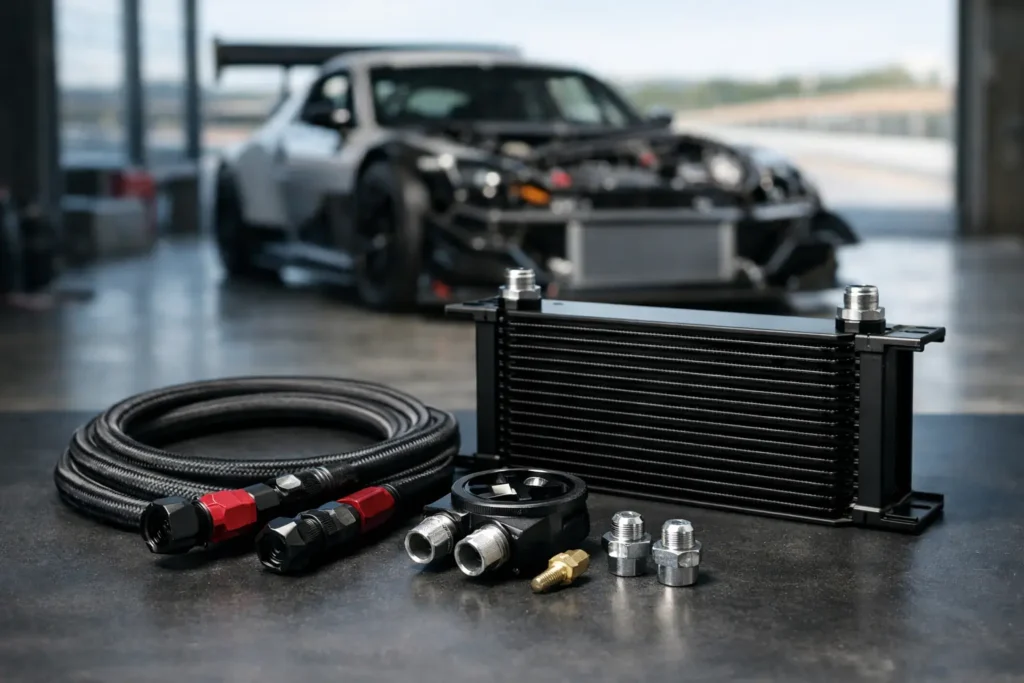
One bad session is usually all it takes to learn the lesson. Oil gets hot, pressure starts to move around, power falls away, and the car that felt sharp on lap two starts feeling expensive by lap six. If you are looking for the best oil cooler kit for track car use, the right answer is not the biggest core you can physically squeeze behind the bumper. It is the kit that keeps oil temperature stable without adding restriction, leak points, or fitment headaches.
What actually makes the best oil cooler kit for track car use?
For track work, an oil cooler kit is not just a radiator with a few hoses. It is a system, and the weak point usually decides how well it performs. A quality core, proper hose specification, reliable fittings, secure mounting, and the right thermostat arrangement matter more than a flashy product photo.
The best setups keep oil in a controlled window rather than chasing the lowest possible temperature. Too hot and the oil thins, oxidises faster, and leaves the engine under more stress. Too cold and you are not getting the viscosity behaviour the engine was built around. Most track cars want consistent temperatures, not extreme cooling.
That is why a proper kit needs to be matched to the engine, the power level, and the way the car is used. A lightly modified hot hatch doing occasional sprint events needs something very different from a turbocharged drift car or a time attack build on sustained high boost.
Core size matters, but bigger is not always better
This is where many buyers get it wrong. They assume a larger core automatically means a better result. Sometimes it does, but only if the rest of the system supports it and the car can get enough airflow through the cooler.
A small, efficient 13-row or 16-row cooler can be enough for many club-level track cars, especially lighter naturally aspirated setups. Once you move into heavier cars, turbo conversions, long session running, or repeated summer abuse, 19-row and larger cores start to make more sense.
The trade-off is pressure drop, packaging, and warm-up time. If you fit an oversized cooler with poor ducting and no thermostat, you can easily create a car that takes too long to get oil into the proper operating range. For a dual-use road and track build, that is not ideal. For a dedicated race car that is prepped and warmed carefully, the compromise is different.
A stacked-plate style cooler is usually the smart choice for performance use. It is generally stronger, more efficient, and better suited to motorsport vibration and heat cycling than cheaper tube-and-fin alternatives.
Thermostatic or non-thermostatic?
For most buyers, thermostatic wins.
A thermostatic sandwich plate or inline thermostat helps the engine reach operating temperature before sending full flow through the cooler. That means less wear on cold starts, more stable behaviour on the road, and better control in changeable British weather. If the car sees any road mileage at all, a thermostat should be high on the list.
A non-thermostatic setup can still make sense on a dedicated competition car where warm-up is controlled and the cooling demand is constant. Even then, it depends on the engine and event format. Short hillclimb runs and long circuit sessions do not place the same demand on the oil system.
The best oil cooler kit for track car builds that still drive to events is almost never the cheapest universal kit with no thermostat. That route often looks good until autumn arrives and oil temperature never quite settles where it should.
Hose and fittings are where reliability is won or lost
The cooler core gets the attention, but hose and fittings decide whether the system survives repeated heat cycles, vibration, and paddock abuse.
For a proper track setup, braided hose or high-quality motorsport-grade oil hose is the standard. Cheap hose with unknown temperature and pressure tolerance is not worth the risk. The same applies to fittings. Good AN fittings with clean machining and proper sealing surfaces are far less likely to become a problem after a few hard weekends.
Size matters here too. -10AN is common for many performance applications and works well on a wide range of builds. Higher-output engines or applications with known oiling demands may justify -12AN. Go too small and you create unnecessary restriction. Go too large without planning the routing and available space and you can make installation harder than it needs to be.
Routing should be short, secure, and away from exhaust heat. If a hose can rub, melt, or kink, eventually it will. P-clips, heat protection, and sensible routing are not extras. They are part of the job.
Vehicle type changes the answer
There is no universal winner because track cars do not all generate heat in the same way.
Turbocharged cars usually need more cooling headroom. Sustained boost, higher exhaust temperatures, and tighter engine bays all push oil temperatures upwards. A larger stacked-plate core with a thermostat and careful ducting is often the safe direction.
Naturally aspirated track builds can sometimes run a more compact setup, especially if the engine already has decent factory oil control and the car has strong front-end airflow. The key is not to assume an N/A engine does not need oil cooling. Many rev-happy builds spend enough time at high load to need it.
Drift cars add another layer. They spend time at high load but often with airflow conditions that are less ideal than a circuit car. Angle, reduced direct airflow, and repeated transient load mean cooler placement and ducting become especially important.
Heavier saloons and GT-style builds usually demand more from the oil system simply because they carry more mass and often run longer, faster sessions. Lightweight track toys can get away with less cooler capacity, provided the rest of the package is sorted.
Fitment is not a side issue
A kit can be perfect on paper and still be wrong for the car if the mounting and routing are poor.
The cooler needs clean airflow, but it also needs protection from debris and a location that does not create a nightmare during servicing. Putting it in front of every other heat exchanger is not always the best move. If you choke the radiator or intercooler to help the oil cooler, you have just shifted the problem elsewhere.
Good fitment means balancing airflow across the full cooling package. In many builds, a properly ducted cooler in a sensible location works better than a larger core mounted wherever there happened to be space. Air should be guided through the cooler, not left to wander around it.
Also pay attention to sandwich plate clearance, filter access, and whether the chosen plate suits your engine thread and sealing arrangement. Too many universal kits leave buyers solving basic compatibility issues after the box turns up.
What to look for in a quality kit
If you are comparing options, focus on specification rather than marketing. A worthwhile kit should include a proven stacked-plate core, hoses rated for oil temperature and pressure, properly machined fittings, and either a thermostatic solution or a clear reason why it is omitted.
Mounting hardware matters. So does whether replacement fittings and hose ends are easy to source later. On a serious build, serviceability counts. It is one reason experienced workshops prefer systems built from standard motorsport sizes rather than odd proprietary parts.
Brand reputation also has value here, not because logos make power, but because established motorsport brands tend to publish realistic specs and maintain consistent quality control. That said, well-specified specialist hardware can offer excellent value if the materials and tolerances are right. That is where a supplier with genuine performance catalogue depth, such as ProSpeed Parts, makes the buying process easier for builders who know what they need.
Common mistakes when choosing the best oil cooler kit for track car builds
The first mistake is buying by row count alone. Row count helps, but core design and airflow matter just as much. The second is ignoring the thermostat. The third is underestimating the importance of hose quality and routing.
Another common issue is treating the oil cooler as a cure for every temperature problem. If the engine has poor baffling, weak oil control, a marginal radiator setup, or no ducting, an oil cooler alone may not fix the larger issue. Track reliability comes from the full package working together.
Finally, do not forget to monitor results. If you fit a cooler and never check actual oil temperatures and pressure behaviour, you are guessing. A proper gauge or data logging setup tells you whether the system is doing its job.
The smart way to choose
Start with how the car is really used, not how you imagine it might be used later. Be honest about session length, ambient temperature, power level, and whether the car still sees road miles. Then choose a stacked-plate core size that suits that duty, pair it with a thermostat unless the car is strictly competition-only, and use quality hose and fittings in the correct size.
That approach may not be the cheapest, but it is usually the one that saves engines, saves time in the paddock, and lets you focus on driving instead of watching temperatures climb. The right oil cooler kit should disappear into the background and do its job every lap, every session, every time you ask more from the car.