

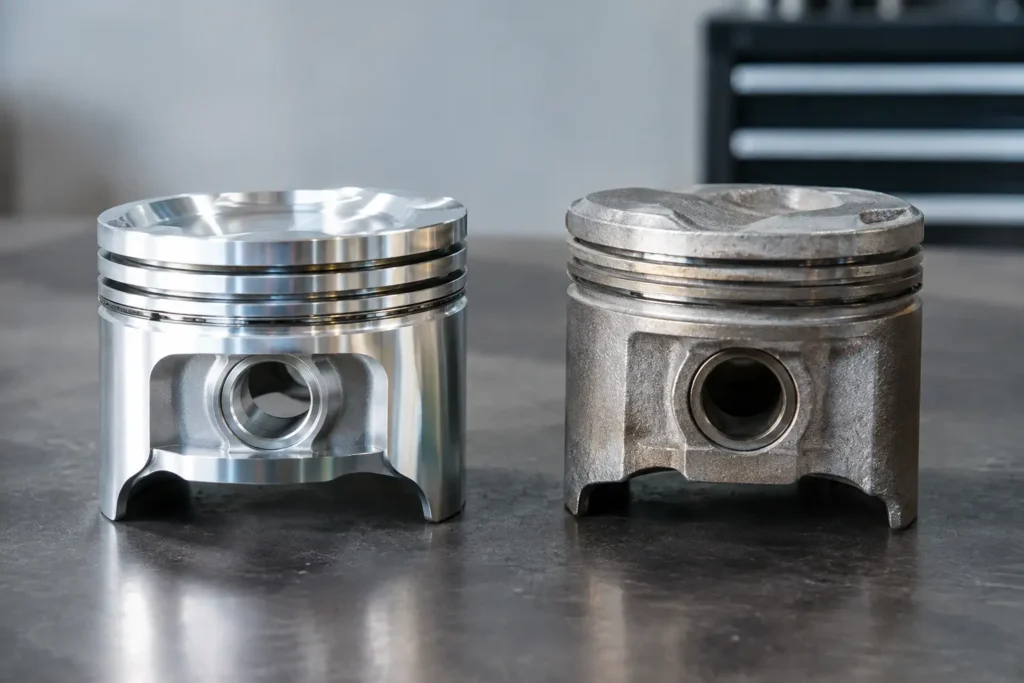
A piston decision can make or break an engine build long before it sees its first full-throttle pull. The forged pistons versus cast question is not about choosing the most expensive part by default. It is about matching piston material, design and clearances to cylinder pressure, engine speed, fuel, cooling control and how the car will actually be driven.
A mild naturally aspirated street engine does not need the same piston as a high-boost drift car that spends long periods at high load. Fit the wrong type and you can end up paying for unnecessary cold-start noise, excessive oil consumption or, at the other extreme, cracked ring lands when boost and ignition timing catch up with a piston never designed for that duty.
Forged pistons versus cast pistons
The basic difference is in how the aluminium is formed. Cast pistons are made by pouring molten alloy into a mould. Forged pistons begin as a solid billet or forging that is compressed under immense pressure before machining. That process aligns and densifies the material structure, giving a forged piston substantially greater toughness under severe heat and cylinder pressure.
That does not mean every forged piston is automatically better for every engine. Cast pistons are economical, dimensionally stable and very effective within their intended operating window. Modern OE and quality aftermarket cast pistons can deliver long service life in standard or lightly modified engines.
The problem starts when the combination moves beyond that window. More boost, a larger turbo, aggressive ignition timing, high exhaust gas temperature, nitrous or sustained circuit use all increase the load on the crown, pin bosses and ring lands. A forged piston provides a far bigger safety margin when tuning conditions become demanding or imperfect.
Cast piston strengths and limits
Cast pistons suit stock replacement builds, daily drivers and sensible naturally aspirated upgrades. Their lower production cost makes them attractive where the target is reliable factory-style performance rather than major power gains. They also tend to run with tighter piston-to-wall clearances, which helps cold operation remain quiet and controlled.
Many cast pistons use high-silicon aluminium alloys. Silicon reduces thermal expansion, allowing close clearances and good wear behaviour. For an engine that needs to start quietly on a cold morning, commute reliably and see only modest tuning, that is useful.
However, casting creates a material that is less tolerant of extreme detonation and repeated high-load heat cycles. The ring lands are commonly the first area to suffer. A brief knock event that a forged piston might survive can crack a cast piston between the rings or damage the crown edge. There is no material choice that makes detonation acceptable, but forged construction gives you more room when operating near the limits.
Why forged pistons handle hard use
Forged pistons are the normal choice for serious turbocharged, supercharged, nitrous and competition engines. Their denser grain structure is better able to tolerate high combustion pressure, elevated piston temperature and the shock loads that come with rapid torque rise.
They also give engine builders more options. Forged pistons can be specified with a dish, dome or flat-top crown, revised compression height, stronger pin bores, upgraded wrist pins, valve reliefs and ring packs suited to the cylinder head and camshaft combination. This makes them far more than a strength upgrade. They are a way to set compression ratio, quench behaviour and piston-to-valve clearance correctly for a custom build.
For a drift, drag or circuit engine, that control matters. Boost pressure alone does not tell the full story. A responsive turbo setup with strong mid-range torque can produce punishing cylinder pressure well before peak horsepower. Pair that with ethanol fuel, a large injector set, standalone ECU calibration and proper charge-air cooling, and the piston needs to match the complete package.
Alloy choice matters as much as forging
Not all forged pistons behave the same way. The two alloy families most commonly discussed are 2618 and 4032 aluminium. Choosing between them is another application-led decision.
2618 forged pistons
A 2618 piston has very low silicon content. It is highly ductile and exceptionally tolerant of detonation, high heat and extreme cylinder pressure. For high-boost engines, motorsport applications and builds where failure resistance is the priority, 2618 is often the preferred choice.
Its trade-off is expansion. A 2618 piston needs greater piston-to-wall clearance than a comparable 4032 or cast piston. When cold, that can mean audible piston slap until the engine reaches operating temperature. It may also require closer attention to warm-up procedure and oil choice. This is normal for a correctly built high-performance engine, not proof that the piston is faulty.
4032 forged pistons
A 4032 forged piston contains more silicon and expands less than 2618. It can run tighter clearance, offering quieter cold running, improved street manners and reduced blow-by potential. For a fast road engine with moderate boost, disciplined tuning and regular use, 4032 can be an excellent solution.
Its compromise is lower ductility at the absolute limit. If the build will live on anti-lag, high boost, sustained track temperatures or a fuel and calibration package that leaves little margin, 2618 remains the safer option. The correct answer depends on the engine’s intended abuse, not on internet claims that one alloy is universally superior.
Compression ratio and piston design
Piston selection changes compression ratio, and compression ratio changes how the engine responds to boost, fuel octane and ignition timing. A deeper dish can lower compression for a high-boost petrol build, while a flatter crown may improve off-boost response in a naturally aspirated configuration.
Do not select compression ratio from boost pressure alone. Combustion chamber volume, head gasket thickness, deck height, camshaft timing, intake air temperature, fuel type and ECU control all matter. A well-calibrated engine on high-quality fuel can often use more compression than a poorly managed build at the same boost level.
Crown design matters too. Valve pockets must suit the actual valve size, cam lift and timing. Ring land thickness, top-ring placement and coating options should match the heat level of the application. A turbo engine that sees high exhaust backpressure may benefit from a piston designed specifically for forced induction rather than a generic forged replacement part.
Clearance, rings and machining are part of the answer
A forged piston will not compensate for poor machine work. Bore finish, bore geometry, deck condition, ring end gap and piston-to-wall clearance must all be set to the piston manufacturer’s specification and the engine’s intended use.
Ring gap is especially critical on boosted engines. As cylinder temperature rises, rings expand. If the end gap is too tight, the ring ends can touch, scuff the bore and damage the piston ring land. Builders sometimes chase quiet running with tight clearances, then create a much more expensive problem on the first hard pull.
Cylinder bores should be measured with proper equipment, not judged by appearance. A block may need boring, honing with a torque plate, decking or checking for distortion before any new piston is installed. The piston, pin, rod small end and ring set should be treated as one engineered assembly.
This is also why tuning and supporting hardware matter. Adequate fuel delivery, correct injector data, stable fuel pressure, effective cooling and knock control protect pistons more than simply fitting a stronger part. A forged piston can survive more punishment, but it cannot survive endless lean running or severe detonation.
Which piston is right for your engine?
For a standard rebuild or mild naturally aspirated daily driver, a quality cast piston is often the sensible, cost-effective option. It offers quiet operation and proven durability when the tune and power target stay close to factory intent.
For a street turbo build with sensible boost and a strong calibration, a 4032 forged piston may provide the balance of strength and refinement many owners want. For serious boost, competition use, nitrous, anti-lag or repeated high-temperature running, a 2618 forged piston is usually the better foundation.
The cost difference should be viewed in the context of the full build. Pistons are only one line in the budget, but changing them after a failure means stripping the engine, inspecting the crank and rods, machining the block again and potentially replacing far more than four or six components. Where the power target is ambitious, build the short block for the real target rather than the first conservative map.
Before ordering, confirm bore size, deck height, rod length, pin size, combustion chamber volume, gasket thickness, valve configuration, intended fuel and realistic power goal. Give those figures to your engine builder or parts supplier. The right piston is not simply forged or cast. It is the one specified correctly for the pressure, heat and driving your build will genuinely see.