

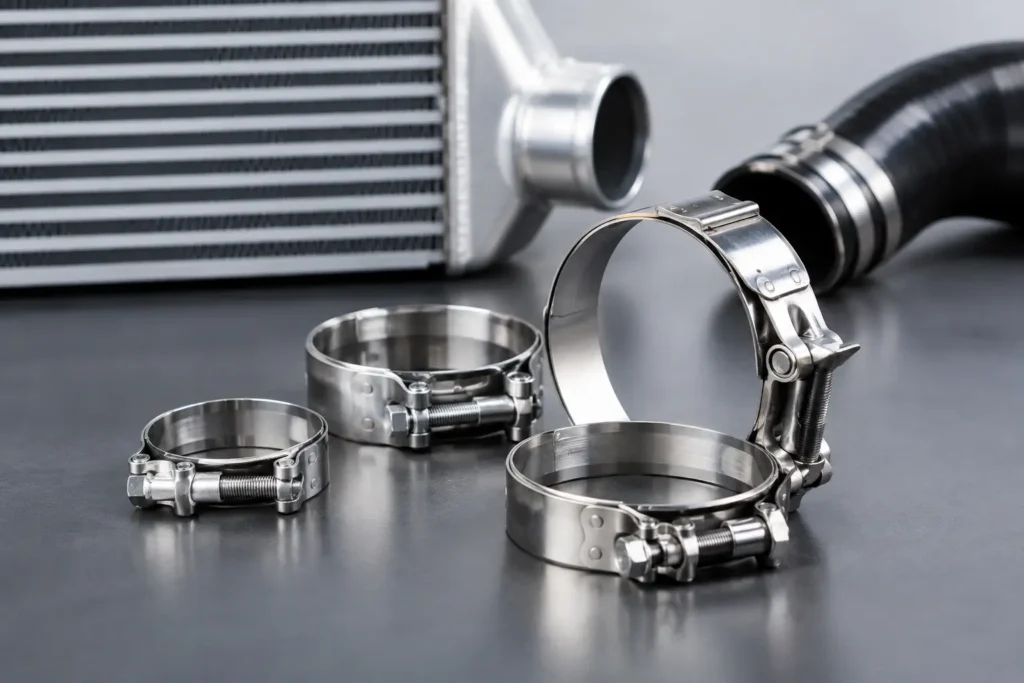
A charge pipe blowing off halfway through a pull is rarely caused by a lack of horsepower. More often, it comes down to poor clamp choice, incorrect sizing, a smooth pipe end, or an overtightened worm-drive clamp cutting into silicone. The best intercooler clamps available are the ones that suit the pressure, temperature movement and packaging of your specific boost system – not simply the clamp with the biggest quoted torque figure.
For a mild road car, a quality T-bolt clamp can be all the hardware required. For a hard-used drift car, track build or high-boost turbo conversion, clamp load consistency matters just as much as outright clamping force. Getting this detail right protects hoses, keeps intake air where it belongs and prevents a small hardware failure from ending a session early.
Why intercooler clamp choice matters under boost
An intercooler joint has to manage more than pressure. Silicone hose expands slightly when hot, aluminium pipework transfers heat, and the engine moves on its mounts under acceleration, lifting off and gear changes. A clamp needs enough even force around the hose to hold the joint without distorting the coupler or damaging its reinforcement layers.
The familiar worm-drive hose clip has a place on low-pressure breather, coolant and general-purpose plumbing, but it is not automatically the right answer for charge pipework. Its slotted band can concentrate load, while the screw housing creates an uneven clamping area. Cheap versions also have weak threads and bands that deform before the connection is properly secure.
A properly specified intercooler clamp works with the rest of the joint. That means a correctly sized silicone reducer or straight coupler, clean pipe surfaces, adequate overlap and a bead-rolled pipe end. No clamp can fully compensate for a pipe with no retaining bead and only 15 mm of hose engagement.
Best intercooler clamps available by application
Stainless T-bolt clamps for most performance builds
For the majority of street, drift and fast-road turbo cars, stainless T-bolt clamps are the strongest all-round choice. Their wider band distributes pressure more evenly than a standard hose clip, and the T-bolt and nut assembly delivers repeatable clamping force. They are suited to silicone intercooler hoses, alloy charge pipes and fabricated boost systems where space around the connection is reasonable.
Look for a smooth inner band, rolled edges and corrosion-resistant stainless construction. A liner or bridge arrangement can be useful on softer silicone hoses because it reduces the chance of the band biting into the material. The trade-off is packaging: the nut and bolt section is bulkier than a conventional clip, which can cause clearance issues near fans, radiators, chassis rails or tightly routed pipework.
T-bolt clamps are not all identical. Band width, bolt size and adjustment range affect how they perform. Avoid choosing a clamp that sits at either extreme of its stated diameter range. A clamp should tighten close to the middle of its adjustment range when installed, giving enough thread engagement and room for later checks.
Constant-tension clamps for heat-cycle stability
Constant-tension clamps add a spring element that helps maintain load as temperatures rise and fall. This is especially useful where a car sees repeated heat cycles – track days, endurance work, heavy road use or boost systems located close to a hot turbocharger.
As silicone and aluminium expand at different rates, a fixed clamp can lose some effective tension after several cycles. A constant-tension design compensates for part of that movement. It is not a substitute for proper pipe preparation, but it can provide a more stable joint where temperature variation is significant.
These clamps cost more and can be less compact than a basic T-bolt design. They make the most sense on demanding builds rather than every low-boost daily driver. If access is poor, also consider whether the clamp can be checked and adjusted without removing surrounding components.
V-band assemblies for fabricated charge pipework
V-band joints are a serious option for custom intercooler systems, particularly where pipework needs to be removed regularly or where a silicone join is impractical. A properly welded male and female V-band flange creates a positive mechanical connection that is compact, strong and quick to service.
They are common on motorsport fabrication because they remove the risk of a coupler sliding off a plain tube. They also make it easier to split a complex pipe run into serviceable sections. The compromise is cost and fabrication accuracy. Flanges must be aligned before welding, the joint needs sufficient room to release, and poor welding distortion can create a frustrating fitment problem.
A V-band is generally excessive for a simple front-mount intercooler upgrade using standard silicone joiners. On a fully fabricated race car, however, it may be the cleanest and most dependable answer.
High-quality worm-drive clamps for low-pressure duties
Not every connection needs a T-bolt or V-band. Premium stainless worm-drive clamps remain useful for low-pressure intake plumbing, catch-can hoses, coolant lines and auxiliary connections. They are compact, economical and easy to fit in restricted spaces.
For primary boosted intercooler joints, treat them with caution. They can work on modest boost applications when the pipe has a strong bead and the hose fit is excellent, but they offer less even loading than a suitable T-bolt clamp. If a worm-drive clip is the only option due to space, choose a quality smooth-band version and inspect the joint regularly.
Choosing the correct clamp size
Measure the outside diameter of the hose once it is fitted over the pipe, not the bare pipe diameter. A 63 mm alloy tube, for example, will be considerably larger once a 4-ply silicone coupler is installed. Measure with vernier callipers or a flexible tape around the finished joint, then select a clamp range that places the measurement near its centre.
The clamp should sit behind the bead roll, not directly on top of it and not at the very edge of the hose. If the pipe has no bead, add one. Bead-rolling is one of the highest-value jobs in any fabricated boost system, because it gives the hose a physical shoulder to resist movement before the clamp has to do all the work.
Hose overlap matters as well. Aim for enough engagement to cover the pipe end securely while leaving room for the clamp to sit in the correct position. Extremely short couplers and shallow engagement can fail even with premium hardware fitted.
Fit intercooler clamps without damaging the hose
Start with clean, dry pipework. Oil mist on the outside of a pipe, assembly grease or silicone spray can encourage a hose to move under pressure. Lightly lubricating a coupler for installation is sometimes necessary, but clean any excess from the clamping area before final tightening.
Position the coupler evenly, check that both pipes are fully seated, then place the clamp just behind the bead. Tighten gradually and alternate between both clamps on a coupler so the hose is not pulled sideways. The target is a secure, even seal – not a crushed silicone sleeve. Overtightening can distort the hose, damage the reinforcement and create a leak path rather than prevent one.
After the first full heat cycle, inspect every charge-pipe joint. Check again after a few hard pulls, a track session or any work that has disturbed the intercooler system. A pressure test is the fastest way to find marginal joints before they become a roadside or pit-lane problem.
Buy clamps as part of the complete boost connection
The best result comes from matching clamp, hose and pipework specification from the start. Quality PRO-S hardware, correctly sized silicone couplers and bead-rolled alloy pipes give a far better outcome than trying to rescue a poorly planned joint with an oversized clamp.
For most builds, invest in stainless T-bolt clamps at every main intercooler connection and reserve worm-drive clips for lower-pressure auxiliary hoses. Step up to constant-tension clamps where heat cycling is severe, or V-bands where a fabricated system needs positive location and rapid service access. A boost system is only as reliable as its smallest connection, so make each one worth trusting when the engine is on full load.