

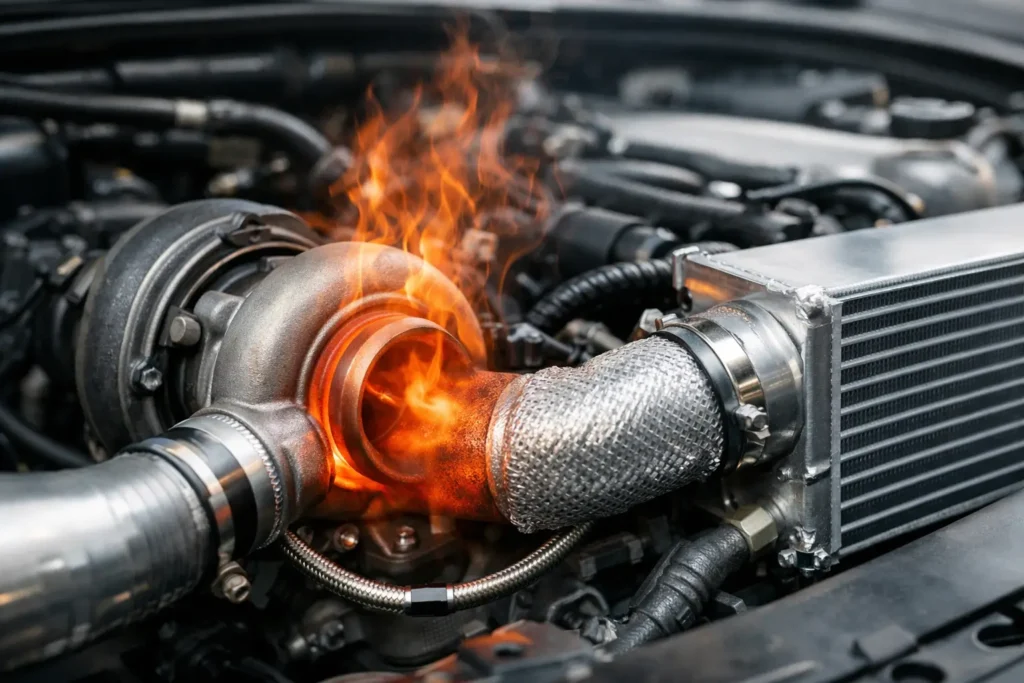
A car that feels sharp on the first pull but flat after a few hard laps usually is not short on boost. It is short on temperature control. If you are figuring out how to reduce turbo heat soak, the fix is rarely one magic part. It is the result of managing heat at the turbo, in the bay, through the intake path, and around the oil and coolant systems so the whole package stays consistent.
Heat soak is simply trapped heat overwhelming the parts around it. On a turbo car, that means the turbine housing, manifold, downpipe and nearby pipework radiate huge temperature into the engine bay. Once that heat saturates the intake, intercooler pipework, air filter area, lines, wiring and even the bonnet space itself, charge temperatures climb, ignition timing can be pulled, and repeatable performance disappears. On a street car it shows up after traffic or a hard run followed by a stop. On drift and circuit builds, it turns into a consistency problem.
What turbo heat soak actually does
The turbo itself is not the only issue. The real problem is what the turbo heats around it. Hot intake air is less dense, so the engine gets less oxygen for a given boost level. That means less effective cylinder filling and a greater tendency towards knock. Modern ECUs and decent aftermarket management will react by trimming timing, adding fuel in some areas, or reducing load targets if the calibration allows it.
You also see a secondary effect in component life. Rubber hoses harden faster, wiring insulation suffers, brake and clutch fluid reservoirs absorb more heat, and anything mounted too close to the hot side ages badly. A build that looks tidy on day one can become unreliable purely because under-bonnet temperature was treated as an afterthought.
How to reduce turbo heat soak at the source
The first step in how to reduce turbo heat soak is cutting radiant heat where it is created. That means focusing on the manifold, turbine housing and downpipe before chasing cooler charge temperatures elsewhere.
A turbo blanket is one of the most effective upgrades for many setups. A good blanket helps keep heat in the turbine housing instead of letting it flood the engine bay. That usually improves spool response as well, because hotter exhaust gas energy stays where you want it. The trade-off is quality matters. Cheap blankets can degrade, hold moisture, or fall apart under repeated heat cycles, so this is not a place to save a few pounds.
Manifold and downpipe heat wrapping can help too, but it needs some care. Wrap keeps heat inside the exhaust tract, which is good for response and bay temperature, yet poor materials or poor installation can trap moisture and accelerate corrosion on mild steel parts. On stainless setups it is generally less of a concern, but regular inspection still matters. For some builds, a fabricated heat shield is the better long-term solution.
Heat shields deserve more credit than they get. A properly mounted aluminium or stainless shield with an air gap can protect intake pipes, reservoirs, master cylinders and wiring looms without the drawbacks of wrapping every hot part. This is especially useful in tight engine bays where the hot side sits close to the chassis leg or bulkhead.
Improve airflow through the engine bay
If heat cannot escape, it will soak everything. That sounds obvious, but a lot of builds chase bigger intercoolers while leaving engine bay extraction untouched. Once the car stops moving or airflow slows, all that trapped temperature hangs around the turbo and intake side.
Bonnet vents can make a real difference on cars used for repeated hard driving. They help hot air leave the bay instead of pooling under the bonnet. On a circuit or drift car, that can improve consistency far more than owners expect. The downside is obvious – water ingress, altered looks, and in some cases extra fabrication or trimming.
Ducting also matters. If your front-end airflow is messy, the radiator, oil cooler and intercooler all compete for the same air. Proper shrouding helps force incoming air through the heat exchangers rather than around them. Just as important, the hot air needs a clear path out. Without that exit path, cooling parts work harder and under-bonnet temperature stays high.
Electric fan strategy is another overlooked area. Fan size, shroud design and ECU control settings all affect what happens after a hot shutdown or in staging lanes. A fan that pulls decent air at low speed helps reduce heat build-up when the car is not seeing natural ram air. It will not fix poor hardware placement, but it supports the whole package.
Protect the intake side from radiant heat
A front-mount intercooler helps with charge cooling under load, but it does not stop engine bay heat from cooking the intake path once temperatures climb. If the cold side piping runs close to the manifold or turbo, it can pick up a surprising amount of heat before the air reaches the throttle body.
Thermal sleeving or reflective barrier on charge pipes, intake pipes and nearby hoses can be worthwhile, especially in cramped transverse layouts or tight single-turbo conversions. This is not glamorous, but it works when applied with some logic. You are not trying to wrap the whole bay in reflective foil. You are protecting the parts that sit in direct line with the hot side.
Air filter placement is just as important. An open cone sitting in a hot engine bay will always be compromised after idling or repeated pulls. A sealed airbox or at least a proper cold-air feed from the front of the car usually beats a bare exposed filter, even if the exposed setup looked fine on the dyno with fans blasting the front of the vehicle.
If you are chasing how to reduce turbo heat soak on a street-driven car, this is often one of the best value changes. Better intake air source, proper shielding, and sensible pipe routing can improve real-world response more than another small increase in boost.
Keep oil and coolant temperatures under control
Turbochargers depend on stable oil supply, and many depend on coolant flow as well. Once oil temperature gets out of hand, the turbo sees thinner protection and the whole engine becomes less happy on repeat runs. Heat soak after shutdown is also harsh on the bearing housing, particularly on hard-used setups.
An oil cooler can be a strong upgrade, but only when properly sized and mounted. Too small and it is pointless. Too large and you may struggle to get oil temperature where it should be on the road. Thermostatic control is usually the sensible route for mixed street and performance use.
Coolant routing around the turbo matters too. If your setup is water-cooled, make sure the lines are correctly routed, protected from radiant heat and free from restrictions. A quality radiator, proper ducting and a healthy expansion system all support turbo temperature control indirectly. The engine does not care whether the heat source is combustion or a turbine housing – once the cooling system is overwhelmed, everything suffers.
After-run cooling can help on some vehicles. Some OEM and aftermarket strategies keep coolant or fans running briefly after shutdown to prevent localised heat spikes. It is not essential for every build, but on cars that see heavy use and then sit, it can reduce the worst post-shutdown soak.
Choose the right turbo setup, not just the biggest one
Turbo sizing affects heat more than people like to admit. An undersized turbo pushed beyond its efficient range generates excess heat. An oversized turbo may avoid that, but can bring lag and force other compromises in a street or drift application. The right answer depends on engine size, fuel, power target and how the car is used.
Exhaust housing choice matters as well. A housing that is too tight can drive response but raise backpressure and temperature. One that is too loose may improve top-end efficiency while dulling the car where you actually use it. This is why generic advice only goes so far. The most effective heat management starts with a combination that is not fighting itself.
Material choice plays a role too. Ceramic-coated housings and coated exhaust parts can reduce radiant heat and improve durability if the coating is done properly. Again, quality is everything. Bad coatings do not last.
Tuning and calibration still matter
No hardware package should be separated from the calibration. If intake air temperatures rise, ignition and boost strategy need to account for it. A proper map can protect the engine and keep the car more consistent in real conditions, not just on one clean dyno pull.
This is particularly relevant on pump fuel. If the fuel quality margin is narrow and intake temps climb quickly, the engine will show it. Better intercooling, improved bay heat control and sensible timing strategy work together. Trying to tune around a heat problem without fixing the hardware is usually a false economy.
Build for repeatability, not one hero run
The best approach to how to reduce turbo heat soak is to think in systems. Shield the hot side. Get heat out of the engine bay. Protect the intake path. Keep oil and coolant under control. Then match the turbo and calibration to the actual use case. A fast road car stuck in traffic needs a different balance from a drift car sitting on limiter or a time attack build doing repeated hot laps.
For most enthusiasts and workshops, the biggest gains come from stacking sensible improvements rather than chasing one expensive fix. A quality turbo blanket, proper heat shielding, cleaner airflow management, well-routed lines and realistic tuning choices will usually outperform a build that has one premium intercooler but poor thermal control everywhere else.
If your turbo car gets slower the hotter it gets, do not treat that as normal. Treat it as a packaging problem, then solve it like the rest of the build – with parts that match the job and a setup designed to keep making power after the first run.