

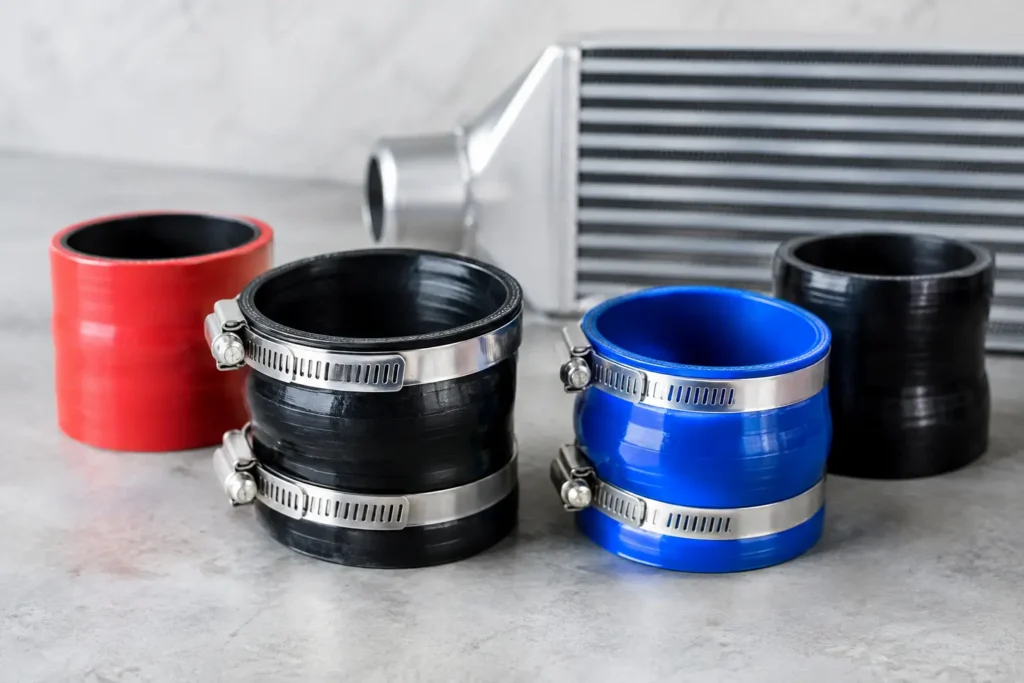
A split intercooler coupler can turn a well-mapped turbo engine into a frustrating boost-leak hunt in seconds. The best intercooler couplers are not simply the thickest silicone hoses on the shelf. They are the correctly sized, correctly shaped and properly clamped connection for the pressure, temperature and movement in your specific charge-pipe system.
On a mild road car, a quality straight silicone joiner and decent clamps may be all that is required. On a drift car that repeatedly sees heat soak, engine movement and aggressive throttle transitions, the same joiner can become the weak point if the bead rolls, clamp range or pipe alignment is wrong. Build the connection as carefully as the turbo system itself.
What Makes the Best Intercooler Couplers?
A coupler has three jobs: seal boost pressure, tolerate temperature and allow enough compliance that vibration does not crack alloy pipework or pull a joint apart. Silicone is the normal choice because it remains flexible through repeated heat cycles and handles the under-bonnet environment far better than generic rubber hose.
For most performance applications, reinforced multi-ply silicone is the sensible starting point. The plies are fabric layers embedded in the silicone wall. More plies generally mean greater resistance to swelling and ballooning under boost, but that does not make every high-ply hose automatically better. A very stiff coupler can be harder to install, less forgiving of poor pipe alignment and unnecessary on a low-boost street setup.
Material quality matters more than a headline ply count. A properly made four- or five-ply silicone coupler from a performance-focused range will usually outlast a cheaply constructed hose claiming extreme pressure capability. Look for consistent wall thickness, clean internal surfaces, accurate sizing and reinforcement that is fully embedded rather than visible through a thin outer layer.
Temperature rating deserves equal attention. Charge-air temperatures rise quickly after a hard pull, repeated launch control use or a session on circuit. Although the intercooler is intended to reduce those temperatures, the hot side pipework and sections close to the turbocharger demand additional margin. Silicone is durable, but it is not a substitute for sensible pipe routing, heat shielding and an intercooler that can actually control intake temperatures.
Choose Coupler Shape Before Choosing a Brand
The first selection is geometry. Measure the outside diameter of both pipes where the coupler will sit, not the nominal pipe size printed on a listing. A so-called 63 mm pipe may measure differently at a formed end, a welded section or a bead. Use vernier callipers where possible, and measure both sides of every joint.
A straight coupler is ideal when two pipes meet in line with minimal gap. It gives a tidy, reliable joint and is normally the easiest option to service. Leave sufficient engagement on each pipe – as a working rule, the coupler should cover a meaningful length of straight pipe on both sides, rather than barely gripping the edge of a tube.
A reducer coupler is required when the turbo outlet, intercooler inlet or throttle body uses a different diameter from the adjoining pipe. Avoid forcing a straight hose over a mismatch. It can distort the hose, create an uneven clamp load and work loose under pressure. A dedicated reducer gives the clamp a round, stable surface to compress.
Use an elbow only where the routing demands it. A 45-degree or 90-degree silicone elbow can simplify a compact installation, but a tight-radius elbow may restrict flow if it is undersized or bent further during fitting. On high-flow builds, consider whether fabricated alloy bends with short straight couplers will provide a cleaner path. That approach costs more and takes longer to fabricate, but it reduces unnecessary flex and makes individual sections easier to replace.
Hump hoses are worth considering where the engine moves relative to the intercooler or fixed chassis pipework. Their raised centre section provides extra flexibility, making them particularly useful between an engine-mounted turbo outlet pipe and front-mounted charge piping. They are not mandatory everywhere, but they can prevent repeated clamp loosening on hard-driven drift and track cars.
Ply Count, Pressure and the Real Limits of a Coupler
There is no universal answer to whether three-, four- or five-ply silicone is right. A sensible street build at modest boost does not need the same hose specification as a large-frame turbo engine running sustained high boost on track. Higher cylinder pressure, hotter charge air, more aggressive compressor behaviour and frequent heat cycles all push the coupler harder.
For a fast road car, reinforced silicone with appropriate wall thickness is normally more than capable when fitted to beaded pipes with quality clamps. For drift, time attack and race work, step up the specification where the system sees higher boost, severe temperature cycling or significant movement. Prioritise the joints closest to the turbo, throttle body and awkwardly routed sections that are hardest to inspect between sessions.
Do not use advertised burst pressure as the only buying metric. A coupler can survive a static pressure test yet fail in service because it has slipped from an unbeaded pipe, been cut by a sharp edge or softened by oil contamination. The complete joint – pipe end, coupler, clamp and alignment – determines reliability.
Oil mist is another practical consideration. A light film from a crankcase ventilation system is common in boosted engines, but heavy oil accumulation can encourage hoses to slide and can indicate a larger issue with breather control, turbo seals or excessive blow-by. Clean every connection before assembly and fix the source rather than tightening clamps until the hose is damaged.
Clamps Decide Whether the Joint Holds
Even the best intercooler couplers will not compensate for poor clamps. Worm-drive hose clips are acceptable for basic low-pressure work when they are high quality and correctly sized, but they often apply load unevenly and can bite into soft silicone if overtightened. They are a compromise, not the default choice for a serious boosted build.
T-bolt clamps offer a wider band and more even clamping force, which makes them a strong choice for larger diameter charge pipes and higher-boost applications. They are particularly useful where access is limited and a joint must survive repeated heat cycles. Select a clamp whose usable range places your assembled joint near the middle of its adjustment, rather than at either extreme.
Constant-tension clamps are valuable where temperatures swing dramatically. Their spring action helps maintain load as the pipe and silicone expand and contract. They cost more than a basic clip, but are worthwhile on endurance, track and hard-used road applications where checking every joint after each session is not realistic.
Never overtighten a clamp in an attempt to cure a badly designed joint. Excess torque can cut the silicone, distort thin-wall alloy tube and create a leak path. If a coupler keeps blowing off, inspect the pipe ends first. Properly formed retaining beads are one of the most effective upgrades in a charge-pipe system. A bead gives the hose and clamp a mechanical shoulder to work against, instead of relying only on friction.
Fitment Errors That Cause Boost Leaks
Most coupler failures are installation failures. Pipes must meet without side load. If you need to pull a pipe several millimetres sideways to get the coupler on, vibration will constantly load the joint. Adjust the bracketry, alter the pipe length or revise the route before final tightening.
Keep pipe ends clean, smooth and free from burrs. Degrease the inside of the coupler and the outside of the pipe, then assemble dry unless a specific lubricant is needed for installation. Lubricants can make positioning easier, but a slippery joint is more likely to move before the clamp has settled.
Place the clamp behind the bead, not directly on top of it or at the very edge of the hose. Check that the clamp band sits squarely around the pipe and does not foul a weld, bracket or sharp edge. After the first full heat cycle and a few boost pulls, inspect every joint again. Silicone settles, clamps bed in and small alignment problems become visible.
Pressure testing the charge system is the fastest way to find weak links before they become a trackside repair. Test only to a sensible pressure for the setup, listen for leaks and use soapy water around joints where appropriate. A small leak can cost response, make tuning inconsistent and lead you to blame the turbo, wastegate or calibration for a problem that is only a loose coupler.
Build for Serviceability, Not Just Appearance
A polished charge-pipe kit may look right in the engine bay, but a system that cannot be accessed quickly is a liability. Leave room to reach clamps, remove the intercooler pipework and inspect hose condition. Avoid routing couplers against exhaust heat, moving belts, sharp chassis edges or steering components.
For custom street, drift and race applications, keep critical sizes consistent where possible. Using a small selection of common coupler diameters and clamp ranges means you can carry useful spares rather than a box of one-off hoses. ProSpeed Parts supplies performance hardware for exactly this kind of specification-led build, where the right diameter and joint design matter more than cosmetic shortcuts.
Buy the coupler for the joint you are making, not for the highest number printed on the packaging. Accurate measurements, beaded pipe ends and correctly matched clamps will keep boost where it belongs – in the engine, not escaping into the engine bay.