

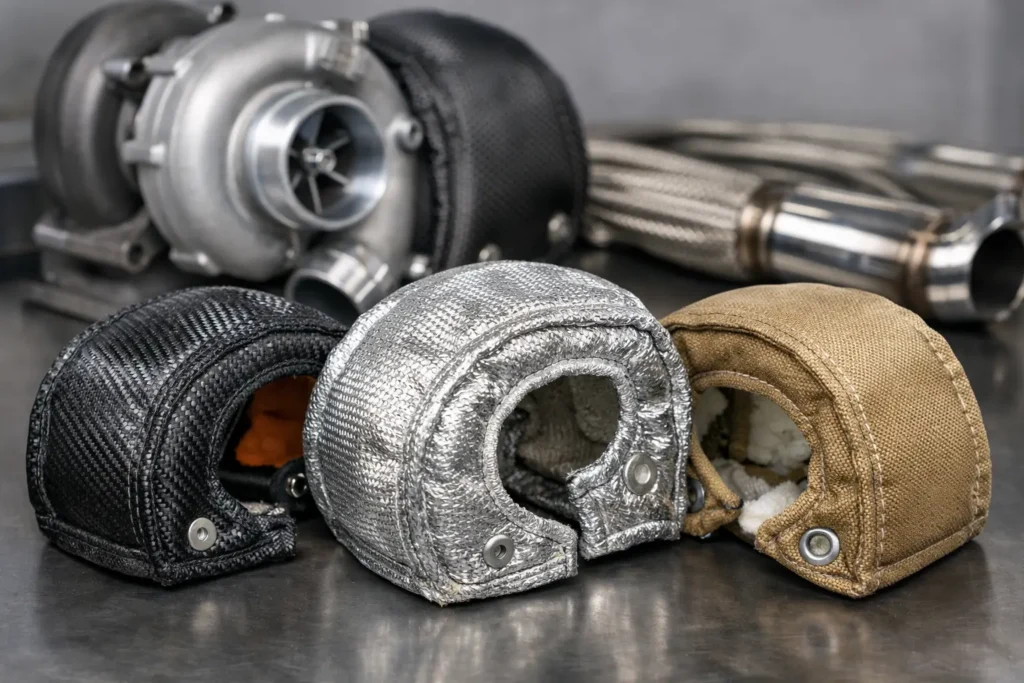
A turbocharger can turn the engine bay into a heat-soak problem long before the boost gauge shows an issue. Manifolds radiate heat into intake pipework, brake lines, wiring, reservoirs and paintwork, while under-bonnet temperatures punish every nearby component. Choosing the best turbo blanket materials is not about buying the thickest cover available. It is about matching insulation, outer-layer durability and fitment to the turbine housing, turbo position and how hard the car is used.
For a fast road build, a well-made silica-based blanket is often the sensible answer. For drift, track and high-output race applications, basalt or titanium lava rock construction usually earns its higher price. The difference matters when the turbine is repeatedly exposed to extreme exhaust gas temperatures, vibration and the kind of heat cycling that destroys cheap universal covers.
What a turbo blanket actually needs to do
A turbo blanket wraps the hot turbine housing to reduce radiant heat escaping into the engine bay. This helps protect surrounding parts, lowers under-bonnet temperatures and can improve the temperature environment around the compressor inlet and charge pipework. It may also help keep exhaust energy concentrated in the turbine housing, although it is not a substitute for correct turbo sizing, manifold design or mapping.
The blanket itself must survive three separate demands. First, its insulation must resist sustained heat. Second, its outer surface must tolerate abrasion, vibration and contact from clamps or nearby hardware. Finally, the stitching, retaining springs and any metal mesh must hold the blanket in position without becoming the weak point.
A blanket is not a cure for an oil leak, a cracked manifold or poor clearance. If oil is reaching the turbine housing, fix the leak before fitting any insulation. Trapping combustible fluid against an extremely hot housing is a serious fire risk.
Best turbo blanket materials: the main options
Silica fibre and fibreglass insulation
Silica fibre is one of the most common insulation materials in quality turbo blankets. It handles high temperatures well, is relatively light and provides strong thermal insulation for its thickness. Many blankets described as fibreglass are built around high-silica fabric or a silica-rich insulation layer, so check the actual construction rather than relying on a broad product label.
For road cars and moderate-power track builds, silica-based blankets offer a good balance of cost, heat control and service life. They are especially practical where the turbo is mounted close to plastic intake parts, a brake master cylinder or a compact wiring loom.
The trade-off is that basic fibreglass products vary massively in quality. Low-cost blankets can use thinner insulation, weak thread or poor-fitting retaining hardware. They may reduce heat initially, then fray, harden or loosen after repeated hot-cold cycles. A proper blanket needs dense insulation and secure fastening, not just a shiny outer skin.
Basalt fibre and lava rock
Basalt fibre, often marketed as lava rock, is made from volcanic rock and has become a strong choice for serious forced-induction builds. It offers excellent heat resistance and durability, particularly where the blanket sees regular high exhaust temperatures. Its darker, textured appearance is familiar on many motorsport-grade heat products.
A basalt blanket is a solid step up for hard-driven street cars, drift cars and track machines. Drift applications are particularly demanding because the turbo spends long periods loaded, then receives intermittent airflow while the car is sideways or sitting in the paddock. That repeated thermal cycling can expose weak materials quickly.
Lava rock construction is not automatically superior just because the name sounds race-ready. Check whether it is used as the insulation layer, the outer layer or both. A well-designed silica blanket can outperform a poorly made basalt one. Still, when comparing products of similar build quality, basalt generally offers greater confidence for sustained heat exposure.
Titanium lava rock outer layers
Titanium lava rock blankets usually combine a lava rock insulation core with a titanium-coloured outer fabric or mesh. The titanium layer is valued for resistance to abrasion, heat cycling and surface degradation. It is a common option for tight, high-temperature engine bays where the blanket may sit close to manifold runners, wastegate hardware or fabricated pipework.
This construction suits high-boost engines, externally gated setups and race cars where component protection is a priority. The outer layer is not there simply for appearance. It helps the blanket cope with handling during servicing and protects the insulation from rubbing against nearby components.
Expect to pay more for a genuine, well-constructed titanium lava rock blanket. The additional cost makes sense when replacing melted hoses, damaged wiring or a heat-affected brake reservoir would cost far more than the blanket. On a lightly modified daily-driven car, however, a correctly fitted silica option may deliver all the protection required.
Stainless steel mesh and metallic outer shields
Some turbo blankets use stainless steel mesh, foil-backed material or other metallic outer protection. These layers can add mechanical strength and offer a more durable surface in exposed areas. They are useful where a blanket is likely to face vibration, debris or occasional contact with adjacent hardware.
Metallic layers are not the main insulator. The thermal work is done by the material underneath, whether that is silica, basalt or another high-temperature fibre. A blanket with an impressive metal outer but thin internal padding can still be a poor thermal solution. Look at the full material stack, not the headline feature.
Temperature ratings need context
Blanket listings often quote impressive temperature figures, but those numbers can be misleading without context. Continuous temperature rating, short-duration peak rating and external surface temperature are not the same thing. The turbine housing may see far more heat than the blanket’s outside surface, and a brief peak is easier to survive than sustained load on a circuit.
A stock or mildly upgraded turbo on a road car has different needs from a high-boost competition engine running repeated full-load pulls. Petrol engines with aggressive ignition timing, anti-lag strategies or sustained track use can generate severe turbine heat. Diesel applications can also sustain significant exhaust temperatures under towing or load, though their turbo layouts and surrounding components vary.
Use advertised temperature ratings as one part of the decision, not proof by themselves. Construction quality, stitching, fitment and clearance usually determine whether a blanket lasts through a season.
Choose material by application, not marketing
For a fast road car, select a vehicle-specific or closely matched silica blanket with a secure spring or wire fastening system. Prioritise clearance around actuator arms, wastegate actuators, oil feeds and coolant lines. The goal is to reduce radiant heat without creating a service nightmare.
For a drift or track car, basalt or titanium lava rock is the stronger choice. Look for a blanket designed for the exact turbine housing size and orientation, especially if the compressor housing, actuator or external wastegate sits unusually close. Universal blankets can work on custom installations, but they need careful positioning and should not be pulled tight across sharp edges.
For a dedicated race car, choose the highest-quality material stack that fits the installation properly. Consider additional heat management around the blanket: heat sleeves for nearby hoses, reflective barriers for sensitive reservoirs and sensible routing for loom sections. A turbo blanket works best as part of a complete heat-control plan.
Fitment can matter more than the fabric
The best material cannot perform properly if the blanket leaves large gaps around the turbine housing or fouls moving parts. Before installation, inspect the turbo for oil leaks, loose studs, damaged heat shields and cracked housings. Make sure the actuator rod, wastegate linkage and any variable-geometry mechanism can move freely where applicable.
Fit the blanket around a cold turbocharger. Use the supplied springs, locking wire or retaining hardware exactly as intended, then check that it cannot contact the compressor wheel area, oil feed banjo, coolant hose or exhaust-side sensors. After the first heat cycle, inspect the fitment again. Materials settle, and a blanket that looked secure in the workshop can shift once exposed to temperature.
Do not soak a blanket with water or degreaser during engine-bay cleaning. If it becomes contaminated with oil, remove it and identify the source rather than hoping the heat will burn it off. Treat turbo heat management with the same care as fuel lines and brake hardware.
Buy for the build you are actually running
The right choice is simple once the application is honest: silica for controlled road use, basalt for repeated hard driving, and titanium lava rock construction for the hottest, most demanding installations. ProSpeed Parts customers building compact street turbos, drift engines or full race setups should also measure the turbine housing and map the surrounding clearances before ordering.
A turbo blanket should disappear into the build after installation: no rubbing, no loose springs, no cooked wiring and no unexpected heat damage after a hard session. That is the material choice worth paying for.