

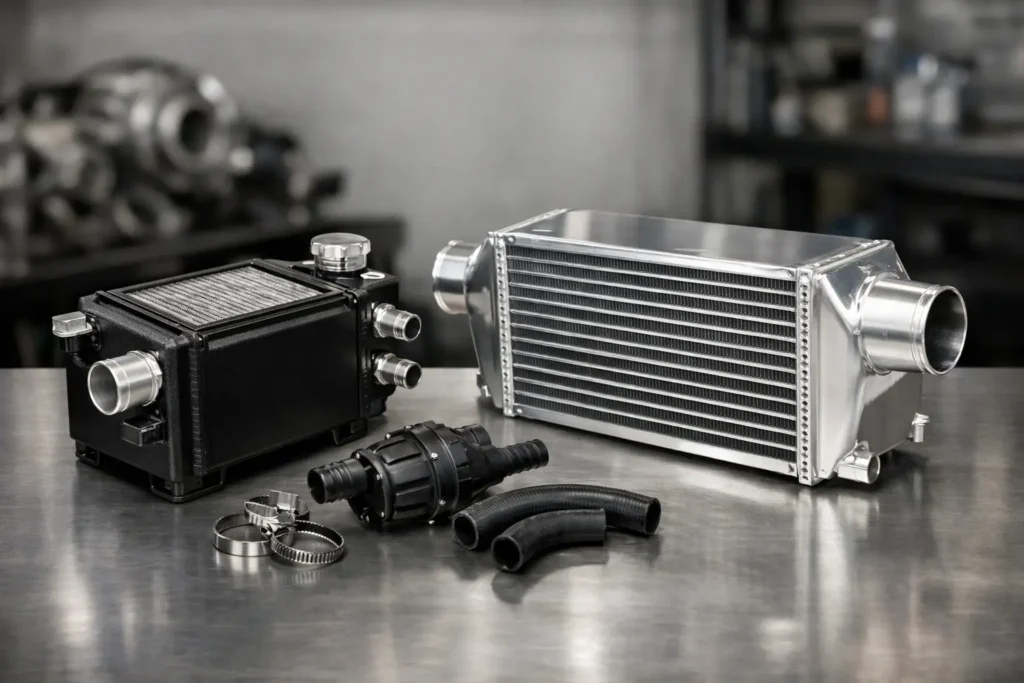
A front-mount intercooler can look the part, but it is not always the best answer once boost, restricted airflow or tight engine-bay packaging enter the equation. This air to water intercooler comparison looks at what liquid charge cooling does differently, where it wins, where it adds complexity, and how to specify a system that will survive hard road, drift and circuit use.
Air to water intercooler comparison: the core difference
An air-to-air intercooler transfers heat from compressed intake charge air directly into ambient air passing through its core. It is simple, relatively light and highly effective when it receives clean airflow at speed. That makes it the default choice for plenty of fast-road, track and high-power turbo builds.
An air-to-water intercooler, also called a water-to-air or liquid-to-air intercooler, first transfers heat from the charge air into coolant. An electric pump then circulates that coolant through a front heat exchanger, where airflow removes the heat. The system normally includes an intercooler core, pump, heat exchanger, reservoir, hoses, fittings, clamps and wiring.
The important advantage is location. The charge-cooler core can sit close to the throttle body or supercharger outlet, rather than being mounted at the front of the vehicle. That can shorten boost pipework substantially, improve packaging and reduce internal intake volume. The trade-off is that you are adding a complete cooling circuit that must be designed as carefully as any fuel or oil system.
Response and intake temperatures
Shorter pipework is the headline benefit, particularly on rear-engined cars, mid-engined cars, supercharged applications and builds where routing large-diameter alloy pipe to the front is impractical. Less pipe volume can improve transient response because there is less pressurised air to fill when the throttle opens. It will not transform a poorly matched turbo, but on a responsive street or drift setup it can sharpen the way the car comes back on boost.
Water also absorbs heat far more effectively than air over a short period. A correctly sized air-to-water core can hold intake air temperatures down during a full-throttle pull even if the car is not moving quickly. That is useful at the drag strip, during rolling anti-lag conditions, or in low-speed drift sections where front airflow is inconsistent.
But heat has to go somewhere. Once the coolant circuit is heat-soaked, its temperature rises and the intercooler becomes less effective. A system that performs brilliantly for one run can lose ground after several laps if the front heat exchanger is too small, airflow is blocked, or coolant flow is poor. Air-to-air systems can also heat-soak, especially behind a hot radiator, but they recover rapidly when the vehicle is moving and the core sees strong ambient airflow.
For repeated circuit use, judge the system by stabilised inlet air temperature rather than the first pull on a datalog. The target is not merely a low number at the start of a session. You need predictable temperatures after several hard laps, because that is when ignition correction, power reduction and engine stress become relevant.
Where liquid charge cooling makes sense
Air-to-water is particularly effective when packaging is the main limitation. Many supercharger kits position the core beneath or inside the intake manifold, making a conventional front-mounted intercooler arrangement unrealistic. It is also a strong option where a turbo sits at the rear of the car and a long front-mount pipe route would create excessive volume, pressure-drop opportunities and fabrication work.
Drift cars can benefit because airflow varies wildly between corners, while the engine may spend long periods at high load and high RPM. A well-designed coolant circuit gives the charge cooler thermal capacity during those slower moments. The front heat exchanger still needs proper airflow, however. A bumper opening, ducting and fan strategy matter more than simply fitting the largest core possible.
For drag and short-duration acceleration, an ice-capable reservoir can produce very low initial intake temperatures. This is a specialised approach, not a substitute for a proper heat exchanger on a road car. Ice water introduces condensation risk, requires repeated preparation and offers little value for a vehicle expected to sit in traffic or run a twenty-minute track session.
A conventional air-to-air intercooler remains hard to beat for a front-engined turbo road or track car with room for a large, well-ducted front-mounted core. It has fewer failure points, no pump current draw, no separate coolant to maintain and generally lower total cost. If the pipe routing is sensible and the core receives clean airflow, simple often wins.
Sizing the whole system, not only the core
Choosing an air-to-water core by horsepower rating alone is a common mistake. Power level matters, but so do boost pressure, compressor efficiency, engine displacement, intended duty cycle and acceptable pressure drop. A very small core may package neatly and respond well, but it can become a restriction or saturate quickly at sustained load.
The front heat exchanger is just as critical. It must reject the heat absorbed by the charge-cooler circuit without starving the engine radiator or oil cooler behind it. Stacking heat exchangers without ducts can create a hot, turbulent pocket where every cooling system performs worse. Seal the exchanger to the bumper opening where possible and give the exit air a clear path through the bay or undertray.
Pump selection requires the same practical thinking. A quality electric circulation pump needs enough flow and pressure capability for the system, but an enormous pump will not rescue a restrictive core, kinked hose or poorly routed circuit. Mount it low where it can be fed reliably, keep the suction side uncomplicated and avoid high points that trap air.
Reservoir size depends on the job. A small header tank can make filling and bleeding easier. A larger reservoir adds thermal mass, helping with short bursts of load, but it also adds weight and takes longer to cool once the water is hot. For most fast-road and track setups, a sensibly sized tank and an efficient front heat exchanger are a better solution than chasing maximum water capacity.
Plumbing, fittings and installation details
Treat charge-cooler plumbing as motorsport hardware, not an afterthought. Use hose rated for coolant temperature and pressure, secure it with suitable clamps, and protect lines from exhaust heat, sharp edges and moving suspension components. AN-style fittings can make custom routing clean and serviceable, provided the hose ends, seals and thread types are correctly matched.
Bleeding is essential. Air pockets reduce coolant circulation and create inconsistent temperature readings. Position the reservoir or fill point at a useful high point, run the pump during filling, and check the system again after its first heat cycle. A coolant-compatible additive can help protect mixed-metal systems, but follow the requirements of the pump, core and heat exchanger manufacturers.
Electrical work deserves equal attention. Fuse the pump correctly, use suitably sized cable, seal connectors and consider relay or ECU control. On a serious build, monitoring charge-cooler coolant temperature before and after the core gives far better information than intake air temperature alone. If the temperature difference across the core shrinks under load, you have a useful clue about saturation, flow or airflow problems.
Weight, cost and reliability trade-offs
An air-to-water system costs more than a basic front-mount arrangement once every required component is included. There is also more weight: coolant, pump, reservoir, extra hose and a heat exchanger all add up. In a competition car, where that weight sits matters as much as the total figure. A front heat exchanger and rear-mounted reservoir may suit one chassis, while another benefits from keeping the system compact around the engine.
Reliability is excellent when the parts are specified and installed properly, but there are more potential faults than with air-to-air. A leaking fitting, failed pump, damaged hose, poor electrical connection or trapped air can quickly affect intake temperature control. This does not make liquid charge cooling unsuitable for road use. It means the system needs planned maintenance and proper monitoring rather than fit-and-forget expectations.
ProSpeed Parts customers building custom turbo, supercharger and motorsport cooling systems should select each component as part of one package: core, heat exchanger, pump, hose diameter, fittings, clamps, wiring and mounting. Mixing good individual parts without considering flow path and airflow is where expensive setups underperform.
The right choice comes down to the vehicle and how it is used. Fit air-to-air when you have airflow, space and a straightforward route to the front. Choose air-to-water when compact charge routing, low-speed performance or unusual packaging outweigh the added cost and complexity. Build either system around measured temperatures and real duty cycle, then let the data – not the appearance of the hardware – decide the final specification.