

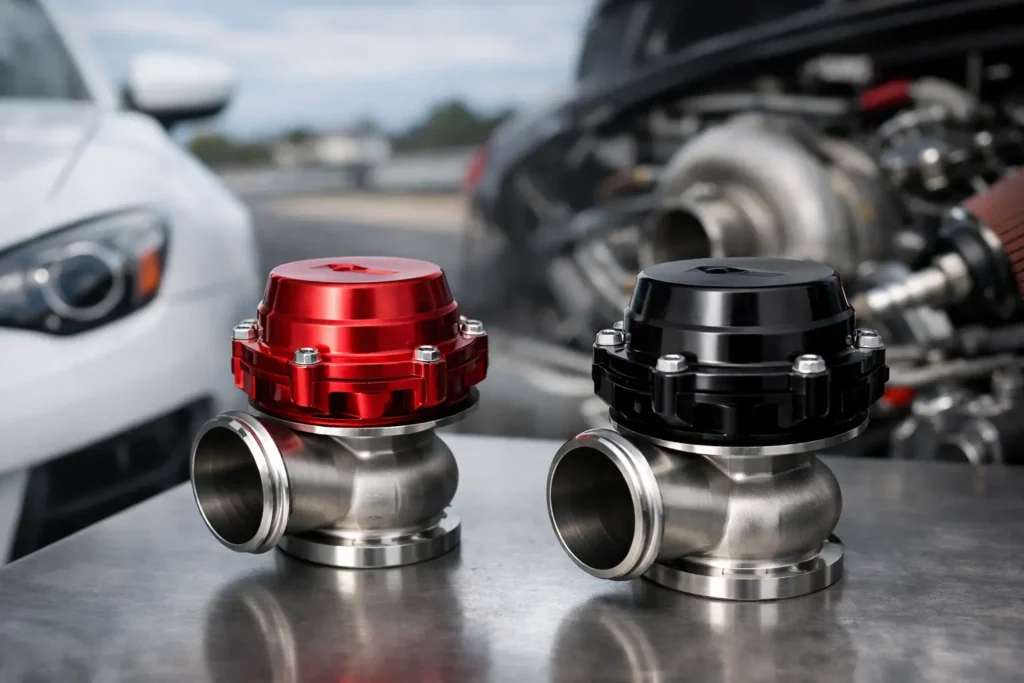
A wastegate is not the place to save money on a boosted build. When exhaust temperature, turbine speed and cylinder pressure climb together, inconsistent control can turn a strong engine package into a frustrating tuning job. This Turbosmart wastegate review looks at why the brand remains a serious choice for fast-road, drift and race applications, and where the right specification matters more than the logo on the housing.
Turbosmart wastegate review: what you are buying
Turbosmart has built its reputation around boost control hardware rather than treating it as an accessory category. Its external wastegates and internal wastegate actuators are designed for modified engines that need repeatable control, stable sealing and practical serviceability. That makes them common on everything from forged four-cylinder street cars to high-output six-cylinder drift builds and dedicated circuit machinery.
The main advantage is consistency. A good wastegate does one job: it bypasses enough exhaust gas around the turbine to control turbine speed and therefore boost pressure. It has to do that without leaking, sticking, creeping above target boost or opening unpredictably under heat. Turbosmart products are generally well regarded because their valve control and diaphragm assemblies are built for this environment, not merely for a mild remap on a standard turbo.
Machined components, quality diaphragms and heat-tolerant valve materials are part of the package, although the exact construction varies by model. Higher-spec external gates such as the Comp-Gate and Hyper-Gate families are intended for hard-use builds where temperature cycles and boost demand expose weaker components quickly. The newer GenV range also focuses on improved flow paths, compact packaging and easier configuration for modern custom installs.
That does not mean every Turbosmart gate is automatically the correct answer. Gate size, spring pressure, manifold position, turbocharger choice and control strategy all decide whether it will perform as intended.
Build quality and control under load
The first thing experienced fabricators notice with a quality external wastegate is not the anodised finish. It is the confidence that the valve will seat properly after repeated heat cycles. A leaking valve reduces control authority and can produce unstable boost, while a valve that cannot flow enough exhaust gas can cause boost creep at high rpm.
Turbosmart gates are designed with strong attention to valve sealing and serviceable internals. On a properly fabricated manifold, this gives the tuner a stable mechanical baseline before electronic boost control is added. That baseline is critical. An electronic solenoid can manipulate pressure delivered to the wastegate, but it cannot correct poor wastegate placement, an undersized gate or a spring that is wrong for the target boost.
Spring changes are straightforward on most external models, allowing the base boost level to be matched to the build. For a conventional road car using a boost control solenoid, a lower base spring may offer a wider adjustment range. For a race car where reliability matters more than maximum boost adjustment, a higher base spring can provide useful protection if a hose fails or the control system develops a fault.
There is a trade-off. More spring pressure is not always better. If base pressure is set too close to the maximum boost target, the ECU or boost controller has less authority to manage torque through the rev range. This matters on rear-wheel-drive drift cars and high-torque road cars, where controlled boost-by-gear can make the car substantially easier to drive.
External wastegates for custom turbo systems
An external wastegate is usually the stronger option for a fabricated turbo manifold, big-frame turbo conversion or engine producing power beyond the standard internal gate’s comfortable control range. Turbosmart offers several sizes, and selecting one should be based on required bypass flow rather than the idea that bigger is always better.
A small gate can work perfectly on a compact turbo and modest power target. But if the turbine housing is restrictive, the engine has high exhaust flow, or the turbo is sized for top-end power, the wastegate must bypass a significant volume of gas to keep boost on target. Too little flow capacity can lead to creep, especially in colder weather or at high rpm.
Placement is equally important. The wastegate feed should see useful exhaust flow from the collector or turbine inlet area, not be positioned at an awkward angle off one runner purely because it was easier to fabricate. A premium gate cannot compensate for poor manifold design. Use a smooth take-off, avoid a sharp dead-end branch and make sure the dump tube has room to flow without creating unnecessary backpressure.
Internal wastegate actuators for responsive road builds
Not every car needs an external gate. Turbosmart internal wastegate actuators are a practical upgrade for many OEM-frame and bolt-on turbocharger combinations. A stronger actuator can hold the internal flapper shut more reliably against exhaust backpressure, helping prevent boost taper or premature opening on tuned engines.
This is often the sensible route for a fast road car where packaging, emissions equipment and a quiet exhaust matter. It keeps the installation close to factory layout while giving the tuner a firmer, more dependable boost-control foundation.
The limitation is physical. An internal flapper system may not have enough bypass capacity for every turbo and power goal. Once boost creep becomes a persistent issue, or when fitting a high-flow manifold and larger turbo, an external wastegate setup is normally the cleaner engineering solution.
Fitment details that decide the result
Before ordering, confirm the flange standard, valve size, inlet and outlet configuration, and available space around the turbocharger. External gates generate considerable heat, so proximity to wiring, brake lines, coolant hoses and bodywork needs proper attention. A heat shield, thermal sleeving and sensible routing are not optional details on a hard-driven car.
You also need to choose between a recirculated or screamer configuration. Recirculating the wastegate outlet back into the exhaust is generally quieter and better suited to road use. It requires careful fabrication because the re-entry angle can affect flow and the surrounding exhaust section will see high heat. A screamer pipe is simpler and can reduce interaction with the main exhaust, but it is loud when the gate opens and is rarely suitable for a discreet road build.
Vacuum and boost reference lines deserve the same care as fuel and oil plumbing. Use quality heat-resistant hose, secure it away from the manifold and keep the signal source consistent. A line that softens, splits or blows off can create an immediate overboost risk. For electronic boost control, follow the solenoid plumbing diagram for the specific controller and gate configuration rather than relying on a generic internet routing sketch.
For serious motorsport use, CO2-based control can offer more precise management than a conventional pressure-only system. It can be highly effective for boost-by-gear, traction strategies and anti-lag applications, but it adds complexity. The tuning calibration, solenoid quality and fail-safe strategy must all match the vehicle’s intended use.
Is a Turbosmart wastegate worth the price?
For a stock turbo car at conservative boost, it may be unnecessary. If the original actuator holds target pressure, the turbo is within its efficiency range and the mapping is sensible, money may be better spent on cooling, fuelling or data logging.
For a modified engine where boost control is genuinely a limiting factor, Turbosmart is a worthwhile investment. The price reflects specialist hardware designed to operate repeatedly in extreme thermal conditions, with available springs, replacement parts and configurations that suit custom builds. That is valuable for workshops too: a known, serviceable part reduces guesswork when a customer car returns for further upgrades.
The best choice depends on the project. An upgraded internal actuator is often right for an OEM-plus road car. A compact external gate suits tighter engine bays and moderate-flow applications. A larger external unit makes more sense when building a high-output engine that must hold controlled boost all the way to the limiter.
Buying the right Turbosmart setup
Start with the turbocharger and manifold, then work backwards. Establish the target power, desired boost range, available mounting position and whether the car needs quiet road manners or unrestricted track-focused hardware. Choose the wastegate size and spring from those facts, not from a power figure copied from another build.
It is also worth planning the whole control system at once: gate, springs, boost solenoid, ECU strategy, reference lines, heat management and exhaust routing. ProSpeed Parts can help builders source Turbosmart hardware alongside the fittings, hose, clamps and thermal protection needed to finish the installation properly.
A correctly specified wastegate will not make a poor turbo system perfect, but it gives the tuner the control needed to make a well-designed setup safe, repeatable and genuinely enjoyable when the boost comes in.