

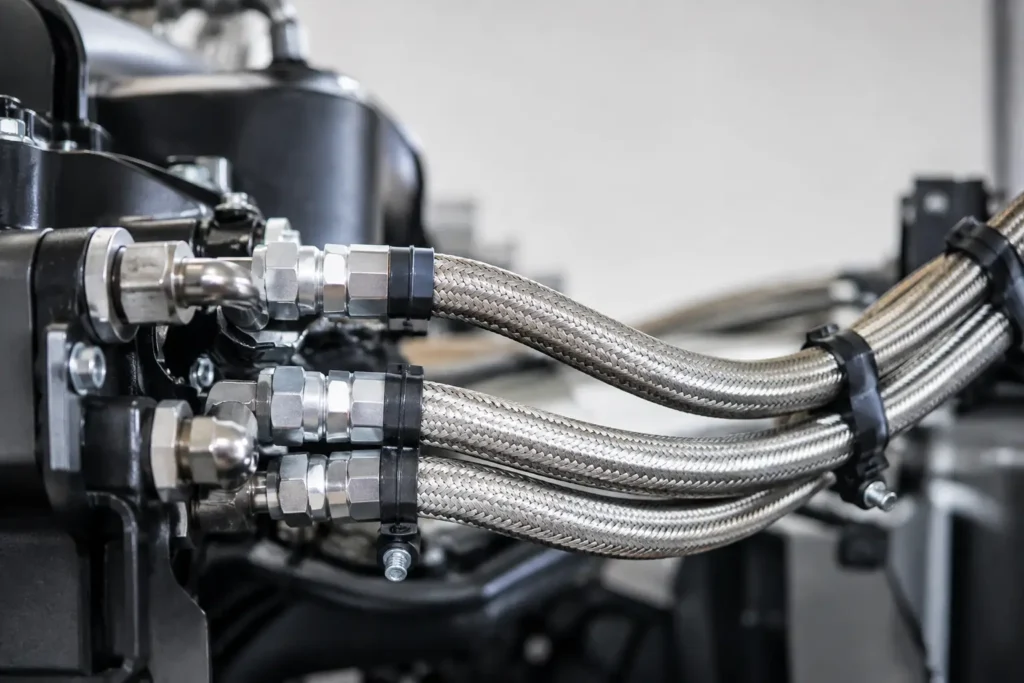
A braided line that looks tidy on the ramp can still fail on its first hard session if it is pulled tight, cooked beside a manifold, or rubbed through on an engine bracket. When you route braided oil lines, the aim is not simply to make the bay look purposeful. You are building a reliable high-pressure fluid path that must survive heat cycles, vibration, engine movement and future servicing.
For turbo feeds, remote filters, oil coolers, dry-sump systems and accumulator installations, hose routing is part of the system design. The right hose and fittings matter, but the path between them matters just as much.
Plan the oil circuit before cutting hose
Start by confirming what the line is required to do. An oil feed to a turbocharger carries a very different volume and pressure requirement from a large-bore cooler line or a low-pressure turbo drain. Line diameter, fitting style and hose construction must match the component manufacturer’s specification before routing becomes the question.
Lay out every major component first: the take-off point, filter adaptor or sandwich plate, thermostat, cooler, turbocharger and return point. This reveals the natural path of the hose and avoids the common mistake of buying a pre-cut length that only works if it is stretched across the engine bay.
Allow for the engine’s movement relative to the chassis. A line from the engine block to a chassis-mounted oil cooler needs enough controlled slack to accommodate torque reaction. A line between two engine-mounted components generally moves together, but it can still need clearance for vibration and heat expansion. Do not confuse a neat straight line with a correctly tensioned one.
Before ordering parts, measure the intended route with flexible wire, welding rod or a length of old hose. Follow the path rather than measuring point to point. Add allowance for bends, fitting engagement and a small service loop where needed. This is especially useful on custom turbo conversions, where compressor housings, downpipes and wastegate plumbing compete for the same space.
Route braided oil lines away from heat and abrasion
Exhaust heat is the first enemy. Braided stainless outer layers can tolerate more abuse than rubber hose, but the braid is not a heat shield. It can transfer radiant heat into the hose beneath, accelerate ageing and make nearby parts harder to inspect. Keep oil lines as far from manifolds, turbine housings, downpipes and external wastegates as packaging allows.
Where distance is not possible, use proper thermal protection suited to the local temperature. A reflective sleeve can help against radiant heat, while a higher-temperature firesleeve provides a more substantial barrier in severe areas. Protection should cover the vulnerable section without trapping the line against a sharp edge or leaving the hose unsupported underneath.
Abrasion is just as capable of ending a build day. Braided hose can saw through paint, wiring insulation, silicone pipework and softer alloy edges, while an untreated bracket can wear through the hose liner over time. Check the full range of engine movement and suspension travel where relevant. A line that clears at idle may touch under acceleration, braking or drift transitions.
Use insulated P-clamps or quality line separators to retain the hose at sensible intervals. Position clamps on straight sections where possible, not directly on a tight bend or immediately behind a fitting. The hose should be retained firmly enough that it cannot migrate into danger, but not crushed or pinched. Keep clamps clear of areas that will need regular access, such as coil packs, dipsticks, belts and oil filter elements.
Respect bend radius and fitting angle
Every hose has a minimum bend radius. Forcing a tight turn near the end fitting can kink the liner, restrict oil flow and place constant load on the hose end. This is a frequent issue with compact turbo feed arrangements and sandwich plates installed close to chassis rails.
Choose fitting angles to make the route work naturally. A straight fitting is not automatically the cleanest or cheapest solution if it forces the hose into a harsh 90-degree turn. A 45-degree, 90-degree or swivel fitting can reduce side-load and create a smoother path with fewer clamps. On a serviceable race or drift build, the correct angled fitting often saves more time than it costs.
Avoid stacking adaptors simply to chase an angle. Every extra threaded connection adds another potential leak point and can create clearance issues. Use the fewest connections that produce a safe, accessible route. If an adaptor is required, make sure its thread type, seal method and material are correct for the port. AN, BSP, NPT and metric threads are not interchangeable, even when they appear close in size.
For reusable hose ends, assemble the hose carefully. Trim the braid cleanly, prevent fraying, fully seat the liner and inspect the finished assembly before installation. A hose end that has not captured the hose correctly may look acceptable until pressure exposes the mistake.
Do not use the fitting as a lever
A hose should enter and leave the fitting in a relaxed line. If the hose is trying to rotate the fitting, pull a turbo feed adaptor sideways or force a cooler port out of alignment, revise the route. Tightening a fitting harder will not solve a poor hose path. It can damage threads, distort sealing washers or make later removal difficult.
Separate oil lines from moving and high-risk systems
Keep braided oil lines clear of auxiliary belts, pulleys, steering joints, gear linkages, fan blades and rotating driveshafts. On rear-mounted coolers or dry-sump systems, also account for exhaust movement and any point where the car may bottom out. The lowest, most exposed route is rarely the best route, even if it uses less hose.
Avoid running oil hoses tightly alongside fuel lines, battery cables or wiring looms. Separation makes fault-finding easier and limits secondary damage if a line leaks. Where systems must cross, create a deliberate crossing with physical clearance rather than allowing them to lie against each other.
A turbo oil drain deserves particular attention. Unlike a pressurised feed, a drain relies on gravity and a free-flowing downward route to the sump. Keep it short, large enough for the application and continuously descending where possible. Loops, rises and tight bends can restrict drainage, contributing to turbo seal problems and smoke. Braided hose is not always the right choice for every drain arrangement if a formed high-temperature drain hose provides a more direct fall.
Build for inspection, not just installation
Oil plumbing should be easy to inspect with the engine in the car. Leave enough visibility around hose ends to spot seepage, enough hand clearance to remove a filter, and enough room to check clamps after track use. A hidden line may look clean, but it is a poor choice if it requires removing half the intake system to inspect a fitting.
Before first start-up, check that each fitting is fully tightened to the manufacturer’s guidance and that any sealing washers or O-rings are new, correctly positioned and compatible with oil. Fill the system as required, then prime it where the engine configuration allows. Inspect for leaks at low pressure before exposing the car to boost, sustained rpm or track temperatures.
After the first heat cycle, let the engine cool and inspect the route again. Look for braid marks on nearby surfaces, softened sleeves, staining around joints and clamps that have shifted. Recheck after the first road drive or event, particularly on solid-mounted engines, high-vibration four-cylinder builds and cars that see kerbs or aggressive drift use.
Choose components as one system
A quality braided oil line installation is more than hose with attractive fittings. Match hose specification to temperature and pressure, use compatible fittings, retain the line correctly and protect it where the environment demands it. For a street car, that may mean a straightforward remote filter route with sensible service access. For a drift or race car, it may mean additional retention, heat shielding and frequent inspection points.
ProSpeed Parts supplies the specialist hose, fittings, clamps and oil-system hardware needed to build these systems around the vehicle rather than forcing the vehicle around generic parts. Buy by specification, measure twice, and make the final route easy to inspect after every hard run.