

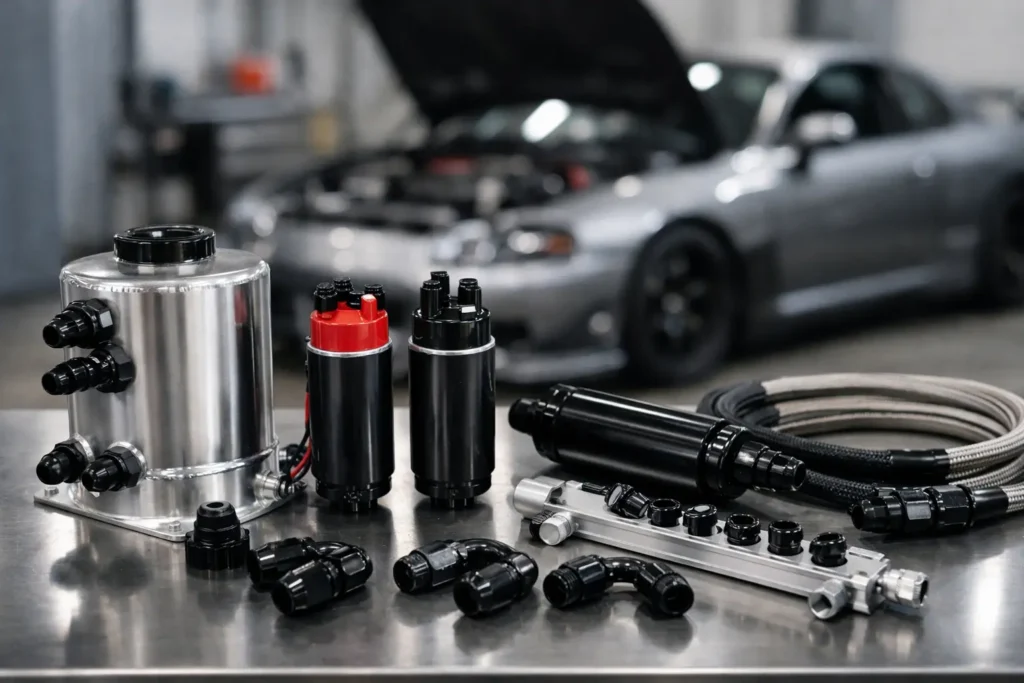
A fuel system usually gets attention right after something goes wrong. Pressure drops at the top end, injector duty climbs too far, or the car starts cutting out halfway through a pull. A proper custom fuel system guide starts before any hose is cut or any fitting is ordered, because the expensive mistakes are nearly always made on paper first.
What a custom fuel system guide should solve
For a modified street car, drift car or race build, the fuel system is not just a collection of parts between the tank and the rail. It is a matched system that has to supply enough volume, hold stable pressure, tolerate heat, vibration and fuel type, and fit the chassis without turning service work into a nightmare.
That means your parts choice depends on the real job the car needs to do. A 400 bhp road car on pump petrol needs a very different approach from an E85 turbo setup chasing four-figure numbers, even if both use aftermarket pumps, braided hose and AN fittings. The common mistake is buying for peak power alone and ignoring duty cycle, return capacity, filtration, wiring and tank control.
Start with power target, fuel type and usage
Before choosing a pump or rail, define the build properly. Be honest about the real power target, not the one you might aim for in two years. Decide whether the car will run petrol, E85, methanol blend or race fuel. Then consider how it is used – fast road, drag, drift, circuit, or mixed duty.
Fuel type changes everything. E85 needs significantly more volume than petrol for the same power, so a setup that looks generous on pump fuel can be undersized as soon as ethanol enters the plan. Circuit and drift cars also spend longer under sustained load and lateral G, which puts far more demand on surge control and pump consistency than a road car that only sees occasional short pulls.
This early stage decides whether you can keep a modified in-tank arrangement, whether you need a surge tank, and whether a single pump is enough. It also helps avoid buying a regulator, filter set and hose size that become bottlenecks later.
Pump choice is about more than headline flow
Fuel pumps are often sold on maximum flow numbers, but those figures can mislead if you ignore pressure and voltage. A pump that looks impressive at low pressure may fall away badly once boost-referenced fuel pressure climbs. On a forced induction engine, every bar or psi of boost effectively increases the work the pump must do, because base fuel pressure rises with it.
For that reason, look at pump flow at the pressure your engine will actually see under load. Also consider electrical support. A strong pump fed through weak wiring is not a strong pump anymore. Voltage drop reduces performance quickly, so proper cable sizing, relays and clean power supply matter just as much as the pump itself.
Single in-tank pumps work well for many street and moderate power builds because they stay cool, quiet and tidy. External pumps can make sense on race-oriented setups, but they are less forgiving if mounted badly or starved at the inlet. Twin or staged pump systems offer headroom, though complexity rises with them. More hardware means more plumbing, more wiring and more failure points if the install is rushed.
Tank, pickup and surge control
If the pump cannot stay supplied, the rest of the system does not matter. Fuel starvation under braking, acceleration or cornering can kill an engine very quickly, especially on a lean boosted setup. This is where many custom builds fail – not because the pump is too small, but because the tank arrangement is wrong.
A baffled tank or proper in-tank module is often enough for a capable road and occasional track car. Once grip levels, aero load or drifting angles increase, a surge tank becomes much more attractive. It gives the high-pressure pump a stable feed and reduces the risk of pressure drop when fuel moves away from the pickup.
The trade-off is packaging, heat and complexity. Surge tanks need space, extra lines and careful mounting. On a stripped race shell this is easier to manage. On a compact street chassis, it can become awkward fast. There is no point building a technically perfect system that is unpleasant to service or awkward to keep safe.
Hose and line sizing – bigger is not always better
Line size should match flow requirement, pump layout and installation practicality. Oversizing everything sounds safe, but it adds bulk, cost and routing problems, and can make a neat build look overcomplicated. Undersizing, of course, creates restriction and pressure drop.
For many performance builds, feed and return line sizing ends up somewhere between easy packaging and future capacity. The right answer depends on fuel demand and route length. Longer chassis runs, multiple pumps and ethanol use all push you towards more capacity. Shorter runs and moderate power targets may not need the largest hose in the catalogue.
Material choice matters as well. PTFE hose offers strong chemical resistance and is a smart choice for aggressive fuels and long-term durability. Traditional rubber-lined braided hose can still suit some applications, but compatibility with modern fuels should never be assumed. This is one area where saving money up front often costs more later.
Filters, rails and regulators in a custom fuel system guide
A custom fuel system guide is incomplete if it treats filters and regulators as afterthoughts. They control reliability as much as the pump does. Filtration needs to protect the pump and injectors without choking the system. That usually means one filter strategy before the pump and another after it, with micron rating chosen for the hardware being used.
Too fine a filter in the wrong place can create restriction. Too coarse a filter can let debris damage injectors or regulators. Serviceability matters too. If a filter cannot be reached easily, it will not be checked often enough.
Fuel rails rarely add power on their own, but they can improve distribution stability and support cleaner plumbing on higher-demand engines. The key is internal volume, port configuration and how the rail integrates with your injector and manifold setup. A rail that looks right but creates awkward feed routing is not the best rail for the job.
The regulator needs stable control and enough return capacity to maintain base pressure properly. Cheap regulators cause inconsistent pressure, especially on boosted setups. A boost-referenced regulator should be mounted with sensible vacuum line routing and away from excessive heat. If pressure control is erratic, the problem may not be the pump at all.
Injectors and engine management need to agree
It is pointless fitting large pumps and oversized lines if the injectors are mismatched or the ECU calibration is poor. Injector sizing should cover the target power with sensible duty cycle headroom, not run permanently on the edge. Dead time data, fuel pressure assumptions and ECU setup all need to match reality.
Bigger injectors are not automatically better on every build. Very large injectors on a modest road car can make low-load tuning less pleasant depending on the injector quality and ECU strategy. Good data and good control matter more than chasing the biggest number.
If the system is being upgraded for flex fuel or a future turbo conversion, plan that at the start. It is usually cheaper to build a coherent system once than replace injectors, rails, regulator and pump in stages because the original spec had no spare capacity.
Installation quality decides whether the parts work
Even high-end hardware will fail if the install is careless. Keep hose runs tidy, supported and away from heat sources. Avoid unnecessary adapters because every extra junction is another potential leak point. Use correct fittings for the hose type and fuel used. Do not mix incompatible components just because the threads appear close enough.
Pay attention to bulkhead pass-throughs, abrasion protection and service access. A race car can accept a more exposed layout than a road car, but both need proper safety thinking. Secure mounting, sensible routing and leak checking are not optional details. They are the job.
Electrical installation deserves the same attention. Pumps should have appropriate relays, fusing and wire size. Earths need to be solid. If twin pumps are staged, control strategy should be thought through rather than improvised at the last minute.
Common mistakes that cost engines
The usual failures are predictable. Builders underestimate fuel demand on ethanol, trust advertised pump figures without checking pressure, ignore voltage drop, fit poor regulators, or run a tank arrangement that uncovers under load. Another classic error is buying fittings and hose one order at a time, then ending up with a system full of compromises.
The better approach is to map the full system from tank to injector before ordering. Count every port, reducer, filter, bracket and electrical component. Think about how the car will be serviced six months later, not just how it will look on first assembly. That is where specialist stock and proper component choice save time. Shops such as ProSpeed Parts make sense for this kind of work because builders can source matching hardware for the whole system instead of patching together random parts from general retailers.
A strong fuel system is not glamorous, but it is one of the few upgrades that protects every other investment in the car. Build it with margin, build it with logic, and the rest of the package gets a fair chance to perform.