

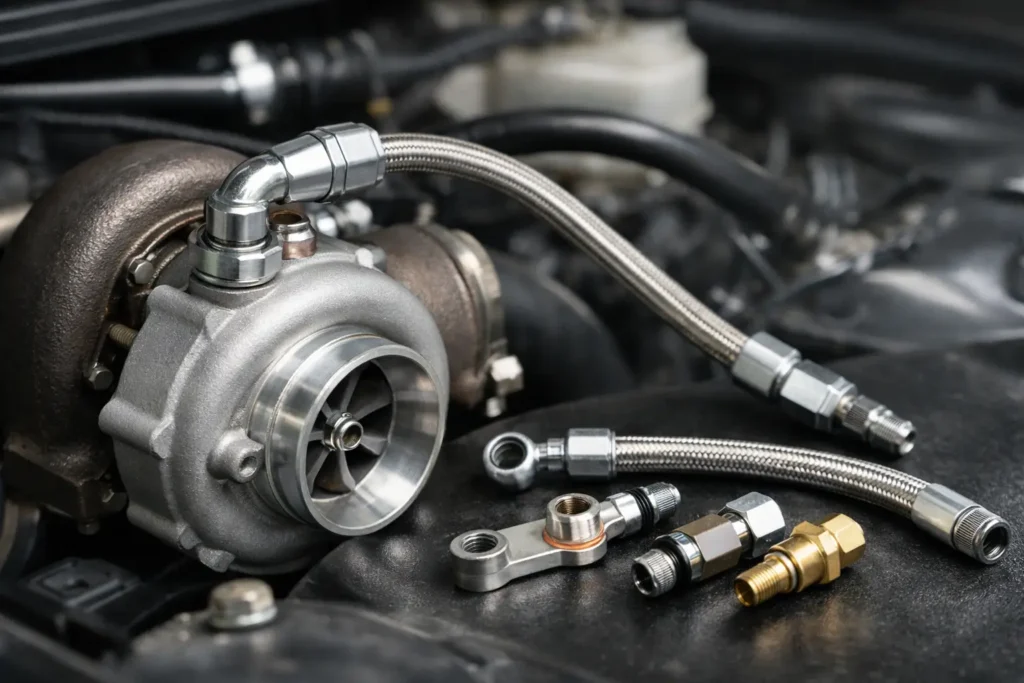
A turbo rarely fails without warning from the oil system. Blue smoke on boost, wet compressor housings, cooked bearings or a fresh turbo that lasts a few hundred miles usually point back to one thing – poor oil control. This turbo oil feed line guide is built for people who actually spec and install parts, not for anyone looking for generic advice.
On a custom or upgraded forced induction setup, the feed line is not just a hose that gets oil from A to B. Its size, pressure, routing, fittings and restrictor choice all affect bearing life, spool consistency and how well the turbo drains oil back to the sump. Get it right and the turbo lives. Get it wrong and you can ruin good hardware quickly.
What the turbo oil feed line actually does
The feed line supplies pressurised engine oil to the turbocharger centre housing. That oil lubricates the bearing system and carries heat away from the shaft assembly. On journal bearing turbos, oil volume is especially important because the shaft rides on a film of oil. On ball bearing units, the requirement is usually lower and too much pressure can create its own problems.
That is where many builds go wrong. People assume more oil is always better. It is not. The turbo needs the correct oil supply, not the biggest line you can physically fit. If pressure is excessive, particularly on a ball bearing turbo without the correct restrictor, oil can push past the seals and show up as smoking or oil contamination on the turbine or compressor side.
Turbo oil feed line guide – start with the turbo type
Before you pick hose size or fittings, check the turbo manufacturer spec. That sounds obvious, but it gets ignored all the time on mixed-brand builds.
A journal bearing turbo will often run happily with a -4 AN feed line and no additional restrictor if the oil pressure is within a sensible range. A ball bearing turbo may still use a -4 AN line, but frequently needs a built-in or inline restrictor to keep pressure under control. Some turbos are supplied with a restrictor already fitted in the inlet. Others are not. If you add another one without checking, you can starve the core. If you fit none at all where one is required, you can flood it.
That means the right answer depends on the turbo core, the engine’s oil pressure characteristics and the complete oiling layout. There is no single universal setup that suits every street, drift and race car.
Journal bearing vs ball bearing requirements
Journal bearing units are generally more tolerant, but they still do not like poor routing, debris or major pressure spikes. Ball bearing turbos are less forgiving. They often want tighter control over oil volume and pressure, especially on engines that run high cold-start pressure or sustained high rpm.
If you are building for motorsport use, where oil temperature and pressure can move around hard during a session, that control matters even more. A setup that seems acceptable on the road can become a problem after repeated hot laps or long drift runs.
Choosing the right line size and fittings
For most performance applications, a -4 AN feed line is the normal starting point. It offers enough flow for the majority of turbochargers without being oversized. Stepping up beyond that is rarely necessary for the feed side unless the manufacturer specifically calls for it.
Material choice matters. PTFE hose is a strong option where heat resistance and chemical durability are priorities. Braided stainless lines are common and durable, but they still need proper assembly and support. A cheap line kit with questionable fittings is false economy when it sits above a glowing exhaust manifold.
The fittings matter just as much as the hose. Common feed sources include a block gallery port, an oil filter sandwich plate or a take-off from the cylinder head, depending on engine design. Not every source is equally suitable. Head feeds can sometimes deliver less stable pressure than a main gallery source, and on some engines that can become an issue at high load.
Try to match the line and fitting quality to the level of the build. On a hard-used track or drift car, proper motorsport-grade hose ends, clean threads and reliable sealing are not optional extras.
Restrictors – when you need one and when you do not
Restrictors cause more confusion than almost any other turbo oil part. Some installers fit one automatically. Others avoid them completely. Both approaches can be wrong.
A restrictor is used to reduce oil flow or pressure reaching the turbo. It is most commonly required on ball bearing turbos, particularly when engine oil pressure is high. Typical restrictor sizes vary by manufacturer and core design, so using a random drilled fitting because it was in the toolbox is not a serious solution.
Too much restriction starves the turbo. Too little can overwhelm the seals. If the turbo maker specifies a restrictor diameter, use that as the baseline. If the build has unusual oil pressure behaviour, measure it rather than guessing.
Signs the setup is wrong
An over-supplied turbo may smoke despite a healthy engine, especially after idle or on lift-off. You may also see oil residue in the compressor cover or downpipe. An under-supplied turbo can show bearing noise, shaft play and rapid wear, sometimes without much warning.
Those symptoms can also overlap with poor drain line design, so diagnose the full system rather than blaming the feed line in isolation.
Routing matters more than most people think
Even a correctly sized line can cause trouble if it is routed badly. Keep the feed line away from direct exhaust heat where possible, and use proper heat protection if clearance is tight. Excessive heat can shorten hose life and cook the oil before it even reaches the turbo.
Avoid sharp bends, twisting the hose during installation and unsupported lengths that can vibrate against nearby components. A feed line should have a clean path with enough flexibility for engine movement but not so much slack that it rubs through over time.
This is particularly important on swapped engines and fabricated turbo manifolds, where the turbo position may put the inlet close to runners, screamer pipes or the bulkhead. A neat route is not just about appearance. It is about service life and consistency.
Feed line and drain line must work together
A lot of people chase the wrong fix because they look only at the pressure side. The turbo oil drain has to return oil freely to the sump. If the drain is too small, routed uphill, kinked, or enters the sump in a poor location, oil backs up inside the centre housing. The result can look like feed line over-supply even when the actual issue is drainage.
As a rule, the drain should be larger than the feed, run downhill continuously and enter above the oil level in the sump where possible. If your turbo sits low in the chassis, you may need a scavenge pump. That is common on some rear-mount and tight packaging builds. In those cases, the feed line spec still matters, but the complete oil circuit matters more.
Common mistakes on custom builds
The biggest mistake is mixing parts with no plan. A universal line kit, unknown restrictor, improvised adapters and a guessed-at feed source is exactly how expensive turbos die.
The second is ignoring contamination. Any swarf, old sealant, hose debris or damaged fitting material can go straight into the turbo core. New lines and fittings should be cleaned before installation. If an engine has had a failure, do not reuse oil lines unless you are absolutely sure they are spotless.
The third is not checking real oil pressure. Modified engines with uprated pumps, thick cold oil or high-rpm use can produce pressure the turbo was never intended to see. If you are building properly, verify the numbers.
How to spec a reliable setup
Start with the turbo manufacturer data. Confirm whether the turbo is journal or ball bearing, whether a restrictor is required, and what inlet thread or adapter type it uses. Then look at the engine’s available feed points and expected hot and cold oil pressure.
Choose a quality -4 AN line unless the application calls for something different. Use fittings you trust, keep the route short and clean, and protect the hose from heat. Make sure the drain side is correctly sized and gravity-friendly. Before first start, prime the turbo and confirm oil reaches the core.
After startup, inspect for leaks, smoke and any sign of unstable oil control. On a serious build, especially one heading for drift or circuit use, a quick check after the first heat cycle and again after the first proper session is worth the time.
For buyers putting together a parts list, this is where specialist stock matters. A supplier such as ProSpeed Parts makes life easier because you can match hoses, fittings, adapters and turbo hardware by spec rather than trying to force generic parts into a performance build.
Turbo oil feed line guide for street, drift and race use
Street cars usually need durability and clean packaging above all else. Drift cars deal with long periods of high load, heat and lateral movement, so secure routing and consistent oil control are critical. Race cars add sustained rpm and temperature, where weak fittings and poor hose quality get exposed quickly.
The hardware can look similar across all three, but the margin for error gets smaller as the use gets harder. That is why careful spec beats guesswork every time.
If you treat the feed line as a proper engine system component rather than a small accessory, the rest of the turbo setup tends to behave better too. A few correct decisions here are far cheaper than another turbo rebuild.