

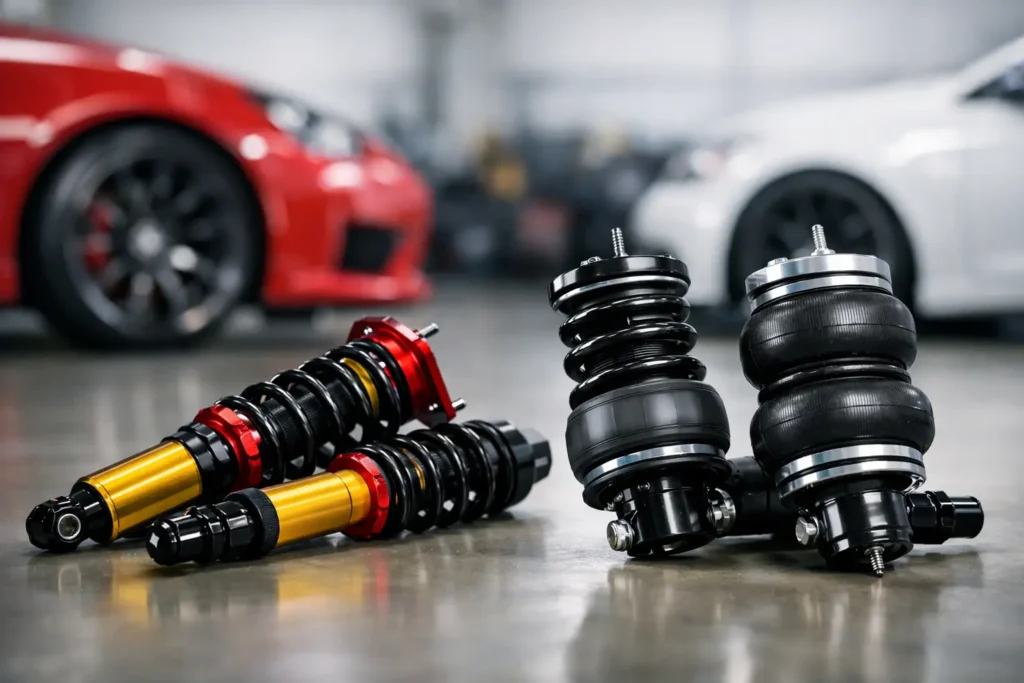
If you are building a car that needs to sit right, turn hard and actually work under load, the coilovers vs air suspension debate is not just about looks. It changes how the car reacts on the road, how consistent it feels on track, how much adjustment you really get, and how much hassle you are willing to live with.
For some builds, the answer is obvious. For others, it depends on whether the car is a daily, a drift car, a fast-road setup, or something that sees proper circuit time. The mistake is treating both systems as if they do the same job. They do not.
Coilovers vs air suspension: the core difference
A coilover uses a coil spring wrapped around a damper. On performance setups, you usually get adjustable ride height and, depending on the spec, damping and top mount adjustment too. It is a straightforward mechanical solution built around spring rate, damper control and chassis balance.
Air suspension replaces the conventional spring with an air bag or air strut, using compressed air to support the car. Height is adjusted by adding or removing pressure, typically through a compressor, tank, lines and management system. That gives you variable ride height on demand, which is the biggest reason people choose it.
That difference shapes everything else. Coilovers are generally chosen for repeatable handling, direct response and simplicity. Air suspension is chosen for flexibility, stance control and a wider operating range in ride height.
How coilovers behave on the road and track
A good coilover setup gives you consistency. That matters more than people think. When spring rate, damping and geometry stay predictable, the car is easier to place, easier to trust and easier to tune.
For fast road driving, that usually means sharper turn-in, less body roll and better support in transitions. For drift, it means stronger weight transfer control and a platform you can tune around alignment, tyre choice and driver preference. For track use, consistency lap after lap is the reason coilovers remain the default choice.
That does not mean every coilover setup is good. Cheap kits often sell adjustment without proper damper control. A car can end up low and stiff but slower, less composed and worse over rough surfaces. Spring rate matched badly to damper valving is one of the quickest ways to ruin a car. The best coilovers are not just about going lower. They are about control.
Another advantage is packaging simplicity. There are fewer components to install, fewer failure points and less to diagnose. If you are running a car hard, simple matters.
Where air suspension makes sense
Air suspension gets dismissed too quickly by people who only think in lap times. For a street-driven build, especially one that needs clearance for speed bumps, ramps, rough roads or aggressive wheel fitment, it solves a real problem that coilovers cannot.
You can raise the car when needed and drop it when parked or cruising. If the car has to work in the real world and still sit properly at shows or events, air gives you a level of versatility that coilovers simply do not offer.
Modern air systems are also better than the old stereotype suggests. Quality management, better bags, improved sensors and stronger hardware have made them more usable and more dependable than they used to be. A well-specced air setup can drive far better than a bad coilover setup. That is worth saying clearly.
But even now, air suspension is usually a compromise if your main target is outright performance driving. It adds complexity, weight and more variables. You have a compressor, tank, valves, airlines, electrical components and controls to think about. That does not automatically make it bad. It just makes it a different kind of ownership.
Handling and response
This is where the gap usually opens.
Coilovers generally deliver a more direct and connected feel. Steering response is cleaner, weight transfer is easier to predict and the chassis tends to react more consistently under hard braking and cornering. If you are trying to trim lap time, dial in a drift setup, or build a serious fast-road car, that matters.
Air suspension can be made to handle well, but it rarely feels as mechanically direct as a sorted coilover package. The spring medium is different, and as pressures change, so can the effective behaviour of the system. On a street car, that may be perfectly acceptable. On a track car where you need confidence at the limit, it becomes a bigger issue.
That is why you still see coilovers dominate race, sprint and drift applications. They are easier to tune with intent.
Ride quality is not as simple as people think
A lot of buyers assume air suspension always rides better and coilovers always ride worse. That is too simplistic.
Ride quality comes down to spring rate, damping quality, travel, tyre sidewall and how low the car is being run. A premium coilover with sensible rates and proper damping can ride very well on British roads. A badly chosen air setup can still feel unsettled, floaty or harsh depending on pressure and calibration.
Air does have an advantage in adaptability. If you need to clear a poor road surface or get extra height for everyday use, that flexibility can improve real-world comfort. But if you want one fixed, well-engineered setting that feels planted and composed, coilovers are often the better answer.
Cost, maintenance and reliability
If budget matters, coilovers usually win.
A decent coilover kit is often cheaper to buy, simpler to install and less expensive to maintain over time than a quality air suspension package. You are paying for fewer parts and less system complexity. For workshops and repeat-use builds, that can make coilovers the more efficient choice as well.
Air suspension often costs more upfront because you are buying the struts or bags, management, compressor, tank, lines, fittings and supporting hardware. That is before labour if you are not fitting it yourself. If you want a clean install with reliable components, the bill rises quickly.
Reliability also depends heavily on component quality. A proper air setup with good lines, fittings and management can be dependable, but there are more potential failure points than with coilovers. Leaks, compressor wear, wiring faults and calibration issues are all possible. For a daily that may be fine if the system is installed properly. For a car that gets hammered at events, simpler hardware often earns its keep.
Which setup suits your build?
If the car is mainly for track days, time attack, drift or serious fast-road use, coilovers are usually the right call. You get a more focused suspension package, easier setup changes and better consistency when the car is being driven hard.
If the car is primarily a road build where appearance, clearance and flexibility matter as much as outright chassis precision, air suspension starts to make more sense. It is especially useful on low cars with aggressive fitment where static ride height would create constant practical problems.
For mixed-use cars, the answer depends on what compromises you accept. If you want maximum confidence when pushing on, choose coilovers. If you need one car to handle commuting, rough roads, car meets and occasional spirited driving, air can be the more usable option.
There is also the question of how much tuning you will realistically do. Coilovers reward buyers who understand ride height, preload, damping and alignment. Air suspension rewards buyers who value adjustability in daily use and are comfortable with a more complex system. Be honest about the car and honest about yourself.
Coilovers vs air suspension for drift, street and show cars
For drift, coilovers remain the standard because the car needs predictable transitions, reliable rear grip control and consistent response run after run. For street performance, coilovers still make the strongest case if handling is the top priority.
For show-and-go builds, premium daily drivers and cars that need to clear real-world obstacles without ruining fitment, air suspension earns its place. It is not just a styling choice when the car has to function at different heights.
The right decision is not about what is more popular online. It is about what the chassis needs to do. At ProSpeed Parts, that is the same logic behind every serious build – pick the hardware that matches the job, not the trend.
If you want the cleanest answer, it is this: buy coilovers when performance consistency comes first, buy air suspension when height flexibility is part of the build brief, and avoid both if you are only choosing on appearance without thinking about how the car will actually be used.