

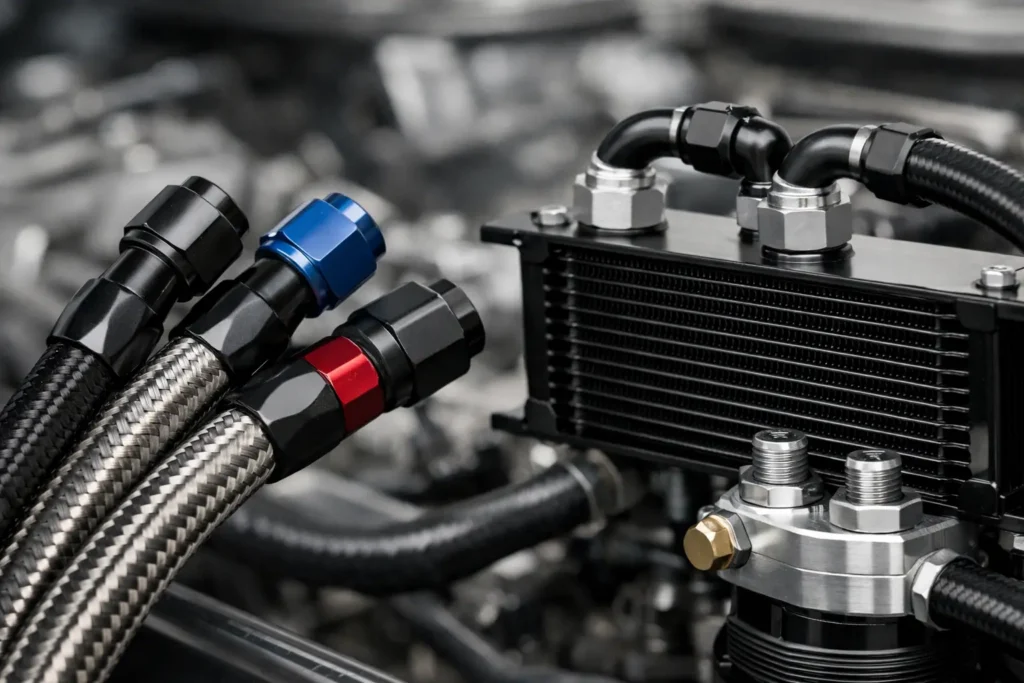
If you are asking what size AN line for oil cooler, you are already asking the right question. Get it wrong and you can end up with pressure drop, poor flow, hot oil and a system that looks motorsport but performs like a restriction. Get it right and the cooler actually does its job without creating a new problem upstream.
For most performance builds, the short answer is simple. -10AN is the common baseline for an engine oil cooler setup, -8AN can work on lower-flow or smaller-capacity applications, and -12AN is often the right move for higher-power engines, endurance use or combinations with long hose runs and remote oil filter arrangements. The catch is that there is no one-size-fits-all answer, because line size depends on the engine, pump volume, oil viscosity, fitting count, hose length and how hard the car is used.
What size AN line for oil cooler on most builds?
If you are building a fast road car, drift car or track day setup, -10AN is usually the safest starting point. It offers a good balance between flow capacity, packaging and parts availability. That is why you see it so often on aftermarket thermostatic sandwich plate kits, remote filter heads and universal oil cooler packages.
A -10AN setup generally suits a wide range of four-cylinder and six-cylinder petrol engines, especially where the cooler is mounted reasonably close to the engine and the routing is clean. It is also a sensible choice for many turbo builds where oil temperature control matters but space is still limited.
-8AN is smaller and easier to package, but it is not automatically wrong. On compact street builds with modest oil flow demands, short hose runs and sensible oil temperatures, it can work perfectly well. Where people run into trouble is using -8AN because it is convenient, not because it is actually suited to the system.
-12AN moves more oil with less restriction, which becomes valuable on larger-displacement engines, V8 applications, sustained high-rpm use and systems with more components in the circuit. If you have a remote filter, thermostat, several angled fittings and a cooler mounted far from the engine bay, stepping up a size can make sense very quickly.
Why oil cooler line size matters
An oil cooler is only useful if oil can pass through it without excessive pressure loss. The line is part of the whole circuit, and every decision adds resistance – hose diameter, hose length, bend radius, fitting style, cooler core design and even the viscosity of the oil when it is cold.
Too small a line can choke flow, especially during cold starts or on engines with a high-volume oil pump. That can increase pressure before the restriction and reduce effective flow through the rest of the system. In a hard-used car, that is not a small issue. Oil is not just cooling the engine. It is also lubricating bearings, feeding turbochargers in some setups and keeping the valvetrain alive.
Go too large and you usually will not create the same kind of risk, but you can make the install bulkier, heavier and harder to route. Larger hose and fittings also cost more, and on tighter engine bays they can complicate clearance around manifolds, intercooler pipework and steering components. Like most motorsport plumbing, the right answer is based on function first, not just maximum size.
The main factors that decide what size AN line for oil cooler systems need
Engine type matters first. A lightly tuned four-cylinder road car and a built turbo six running repeated track sessions do not ask the same thing from the oil system. Larger engines generally move more oil, create more heat and benefit from more flow capacity in the cooler circuit.
Then look at hose length. A front-mounted oil cooler on a compact chassis with short direct runs has less pressure loss than a boot-mounted or far-forward setup with long routes and multiple bends. The longer the run, the stronger the case for -10AN or -12AN.
Fittings matter more than many people think. A straight hose end flows better than a tight 90-degree fitting. Add several adaptors, reducers and sharp turns and the system starts to lose efficiency. This is why a theoretical line size on paper does not always match real-world flow once the car is built.
Oil viscosity is another factor. Thicker oil when cold is harder to move, and race engines often see heavy grades and high pump output. If the system has to cope with cold starts, thermostat bypass behaviour and hard track use, undersizing the line becomes more risky.
Finally, look at the cooler and any extra components. Some coolers are more restrictive than others, and a remote filter head plus thermostat plus sandwich plate all add complexity. Once the system stops being a simple engine-to-cooler-to-engine loop, a larger line size often becomes the more professional choice.
When -8AN is enough
-8AN is usually best reserved for smaller engines, lower-power street applications and installs where the hose run is very short and uncomplicated. Think compact naturally aspirated four-cylinder setups or mild turbo cars where the cooler is being added as a sensible upgrade rather than a solution to severe heat load.
That does not mean -8AN is a budget shortcut. It can be the correct engineering choice if the system flow requirement is modest and the packaging is tight. But on a car that sees sustained rpm, drifting, circuit work or repeated hot laps, it can become the limiting factor faster than many expect.
If you are already on the fence between -8AN and -10AN, -10AN is usually the better call. It gives more margin without becoming difficult to package on most builds.
Why -10AN is the common performance standard
There is a reason so many serious street and motorsport-oriented oil systems use -10AN. It covers a broad range of engines without introducing unnecessary restriction, and it works well with the fittings, thermostats and cooler cores commonly used in the aftermarket.
For many Japanese turbo builds, BMW six-cylinder conversions, tuned hot hatches and drift cars, -10AN is the sweet spot. It supports real oil flow, handles heat more confidently than -8AN in hard use and is still practical to route through crowded bays.
It also gives you room to grow. If the car starts as a fast road build and later gets more boost, more track time or a remote filter relocation, you are less likely to outgrow the system.
When to step up to -12AN
-12AN is not overkill when the combination justifies it. On V8s, high-power turbo engines, dry sump-adjacent style plumbing layouts, endurance applications or any setup with long runs and multiple components, the larger line can be the right answer.
This is especially true when you want to minimise pressure drop and maintain consistent oil supply under sustained load. A drift car held on limiter, a time attack build seeing repeated heat soak, or a race car with a large front-mounted cooler can all benefit from the extra capacity.
The trade-off is packaging. -12AN hose is physically larger, the fittings need more room and the routing has to be planned properly. If space is already tight around the exhaust side of the engine, forcing in oversized hose can create its own reliability issues.
Common mistakes when sizing oil cooler lines
The biggest mistake is choosing hose size based on what is easiest to buy or what a mate used on a completely different engine. Oil systems are application-specific, and copying another setup without checking the details is how poor plumbing decisions get repeated.
Another mistake is looking only at the AN size and ignoring the rest of the circuit. A -10AN hose paired with restrictive adaptors, poor-quality fittings and a small-core cooler will not flow like a well-designed -10AN system. The line size is only one part of the package.
People also forget future changes. If you are planning forged internals, more power, more cooling demand or a remote filter relocation later, building in some headroom now is usually cheaper than redoing the entire system after the car is mapped.
A practical sizing rule for street, drift and race use
If the engine is a modest street setup and the cooler circuit is short, -8AN may be acceptable. If the car is a serious performance road build, drift car or track day machine, start with -10AN unless there is a clear reason not to. If it is a larger-capacity engine, a high-output combination or a system with long runs and extra components, look hard at -12AN.
That approach is not guesswork. It reflects how these systems behave once real heat, rpm and packaging constraints enter the picture.
The best oil cooler setup is not the one with the biggest fittings in the catalogue. It is the one sized to the engine, routed properly, built with quality components and matched to how the car is actually driven. If you treat the oil circuit like a proper performance system rather than an accessory, the rest of the build usually benefits from that decision.