
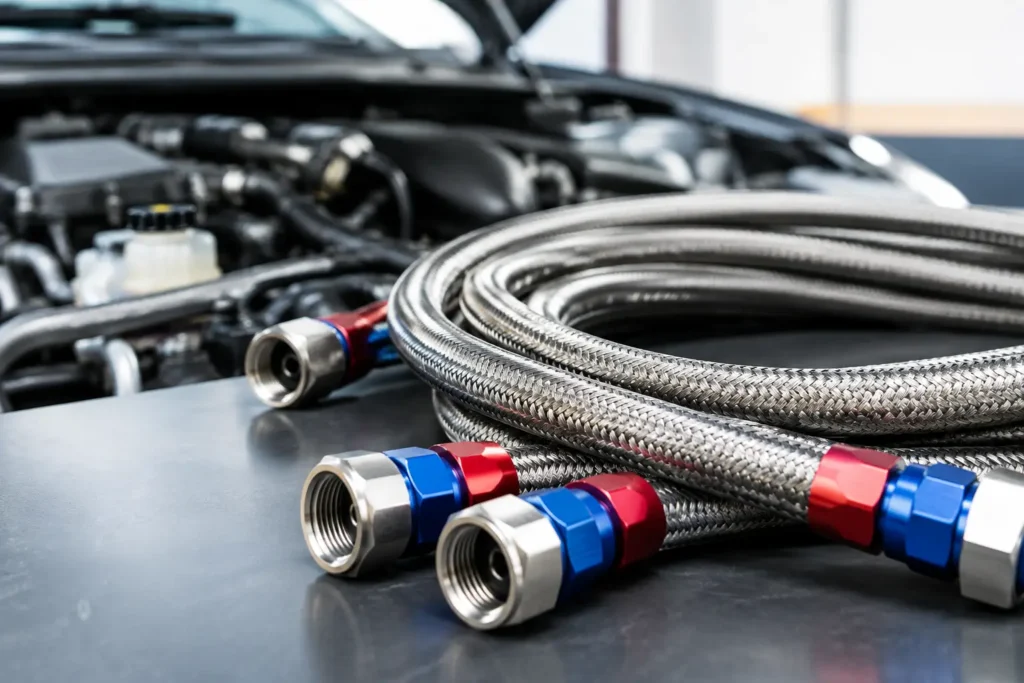
A braided line can make a fuel system, oil cooler install or engine bay look properly finished. It can also turn into an MOT failure, a fuel leak or a dangerous brake fault if it has been chosen for appearance rather than application. So, are braided hoses road legal? In the UK, there is no blanket rule that bans braided hose. Legality comes down to what the hose carries, where it is fitted, how it is routed and whether the finished installation remains safe and roadworthy.
For a street-driven modified car, the braided outer cover is only one part of the equation. The bore material, fittings, pressure capability, heat resistance and protection from abrasion matter more than the fact that the line has stainless braid.
Are braided hoses road legal in the UK?
Yes, braided hoses can be road legal when they are suitable for the system and correctly installed. A road car is not made illegal merely because its factory rubber hose has been replaced with a braided equivalent. Plenty of OEM and high-end aftermarket vehicles use protected, high-pressure hose assemblies in demanding applications.
The problem starts when a universal hose is used outside its intended purpose. A line that looks right may be unsuitable for modern pump fuel, E85, brake fluid, hot engine oil or coolant. Likewise, a correctly rated hose can still cause trouble if it rubs on a pulley, rests against an exhaust manifold, stretches under engine movement or is secured with the wrong fittings.
For UK use, roadworthiness is assessed through the vehicle’s overall condition and, for eligible vehicles, the MOT. Construction and Use requirements also apply. There is no useful shortcut such as “stainless braid equals legal” or “aftermarket means illegal”. Build it to the correct specification and install it as if a scrutineer and an MOT tester will both inspect it closely.
The system determines the hose specification
A braided hose assembly needs to be selected by fluid, pressure and temperature first. This is particularly relevant on custom turbo, fuel and brake installations, where lines often pass through areas the original manufacturer never intended to use.
Fuel hoses
Fuel hose must be compatible with the fuel being used. Ordinary rubber line may tolerate petrol for a period but degrade quickly with ethanol-blended fuel, while some hoses are not suitable for E85 at all. Permeation also matters on a road car: a fuel line that allows vapour through its wall can leave the cabin or garage smelling of fuel even without a visible leak.
For most performance fuel systems, an ethanol-compatible PTFE-lined braided hose is a strong long-term choice. It handles fuel well and offers low permeation, but it is less forgiving than rubber-lined hose when routing. Respect its minimum bend radius and use fittings designed specifically for PTFE hose. Do not force a tight bend behind a bulkhead or near a fuel rail just because the braid hides the kink.
A fuel hose must also be protected from heat and physical damage. Keep it away from exhaust components, sharp panel edges, steering joints and moving suspension parts. If it passes through a panel, use a proper bulkhead fitting or suitable grommet. A line pushed through a bare drilled hole is not an acceptable road-car finish.
Oil, turbo and coolant hoses
Oil feed, return and cooler lines need to deal with sustained heat, pressure where applicable and oil exposure. A turbo oil feed line needs a hose and fitting combination rated for the temperature and pressure involved. A turbo drain is usually low pressure, but routing and fall are critical. An incorrectly routed drain can restrict flow and contribute to turbo seal issues, regardless of how expensive the hose is.
Coolant hose has a different requirement again. It must tolerate coolant chemistry, temperature cycling and the system pressure, while being routed to avoid collapse, chafing and trapped air. Braided hose is not automatically an upgrade for every cooling application. A formed coolant hose often fits better and gives more clearance than a universal braided line with multiple adapters.
Brake hoses
Brake hoses deserve the highest level of caution. A stainless-braided brake line can improve pedal consistency by reducing hose expansion, but it must be a purpose-designed brake hose assembly from a reputable manufacturer. Do not use generic braided fuel, oil or hydraulic hose on a braking system simply because the fittings thread in.
For a road car, use brake lines supplied or assembled for the exact vehicle application where possible, with the appropriate approvals or certification for the market. Check the hose has enough length for full steering lock and complete suspension travel, and ensure it cannot contact the tyre, wheel, damper, driveshaft or bodywork. A brake line that is taut on a two-post lift may be under even greater stress once the car is on the road and the suspension is loaded.
Any hydraulic leak, damaged hose, excessive corrosion at rigid brake pipes, insecure routing or obvious risk of chafing can result in an MOT failure. More importantly, it can compromise braking when you need it most.
What an MOT tester is likely to care about
The MOT is not a modification approval certificate, and it does not certify every component on the car. But it is a practical check of whether visible safety-critical items are secure and in a roadworthy condition.
With braided hoses, an MOT tester is likely to focus on leaks, deterioration, security and interference. On brake lines, that means looking for damaged outer braid, bulges, corrosion, insecure clips, poor routing and contact with moving parts. On fuel lines, visible leaks and insecure or poorly protected pipework are obvious concerns.
A shiny braided line can be harder to inspect than plain rubber hose, especially if the braid has become stained with oil or fuel. That is not a reason to avoid it. It is a reason to keep the installation clean and accessible enough to inspect. If you cannot trace the line from fitting to fitting, you cannot confidently check it before a track day, spirited road drive or MOT appointment.
Fittings, clamps and routing can make or break the install
Most braided-hose failures are not caused by the hose itself. They happen at the ends or where the line meets another component. A mismatched fitting, incorrectly assembled reusable hose end, over-tightened taper fitting or poor clamp choice can create a leak that only appears once the system is hot and pressurised.
Use fittings designed for the hose type and system. AN-style fittings, metric adapters and OEM quick-connect conversions all have their place, but thread size does not guarantee sealing compatibility. Confirm whether the connection seals on a cone, flare, washer, O-ring or tapered thread. Never rely on thread sealant to compensate for the wrong fitting design.
Support long runs with insulated P-clips or properly positioned retainers. Leave sensible allowance for engine movement, but do not leave the hose free to vibrate against surrounding hardware. Add abrasion sleeve or heat shielding where needed, especially around turbochargers, manifolds and bulkheads. The goal is a line that remains secure under load without being pulled tight.
When braided hose is the wrong choice
Braided hose makes sense for many custom fuel, oil and brake applications, but it is not mandatory for every build. On a standard road car, an OEM-quality formed hose may offer better fitment, simpler servicing and fewer potential leak points. For coolant plumbing, a purpose-made silicone or moulded hose can also be the cleaner option.
Avoid cheap unbranded assemblies where the inner liner, pressure rating and fluid compatibility are unclear. The stainless braid can give a false impression of quality. What matters is the hose construction behind it, the accuracy of the fittings and the manufacturer’s stated operating limits.
For serious street, drift and race builds, ProSpeed Parts customers should treat hose selection as part of system design, not an engine-bay styling choice. Specify the fluid, pressure, temperature, line size, fitting style and routing before ordering components.
Before putting the car back on the road, pressure-test the relevant system, inspect every joint dry, cycle steering from lock to lock and check clearances through suspension movement where possible. Then recheck after the first heat cycle and again after a few drives. A properly specified braided hose installation is not only road legal – it is the kind of detail that keeps a high-performance build reliable when it is used properly.