

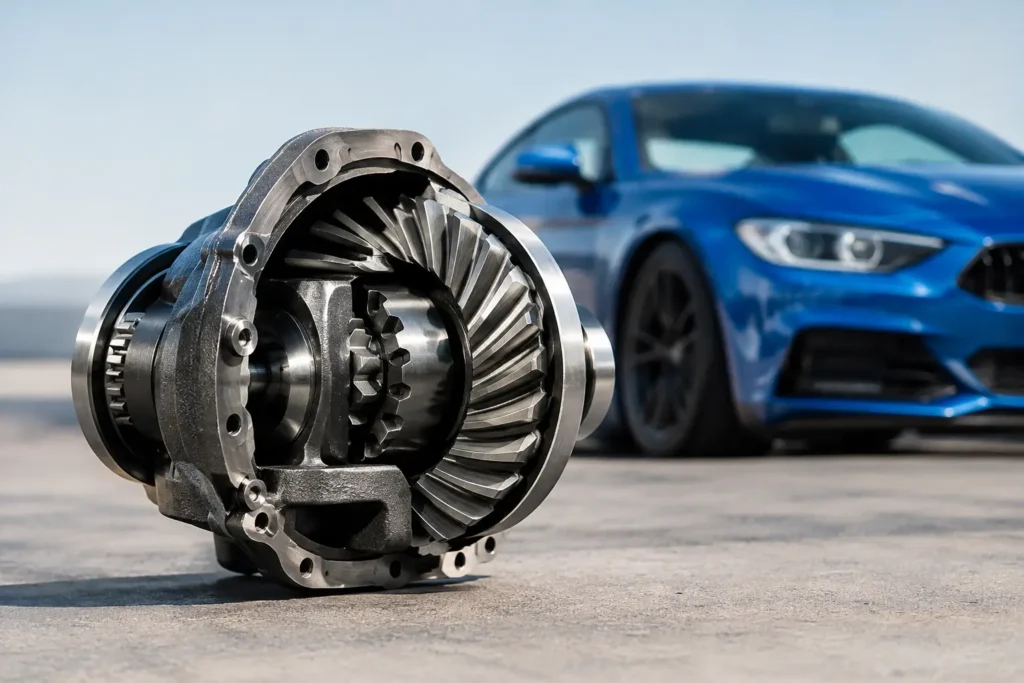
Put power down hard on the exit of a damp roundabout and an open differential will often send it to the unloaded inside wheel. That tyre spins, the car loses drive, and the engine’s torque never reaches the road properly. Limited slip differentials address that weak point by controlling the speed difference between the driven wheels and directing more torque to the wheel with grip.
For a modified street car, dedicated drift build or circuit machine, an LSD can transform how the car accelerates, rotates and behaves under trail braking. It is not a universal upgrade, though. The best unit depends on drivetrain layout, tyre choice, power level, driving discipline and how much road compromise you will accept.
What limited slip differentials actually do
A differential is needed because the left and right wheels travel different distances through a corner. The outside wheel follows a wider arc, so it must rotate faster. An open differential handles this smoothly, but it has a major performance limitation: torque is effectively capped by the wheel with the least available traction.
If one driven tyre is on paint, kerb, standing water or unloaded by suspension movement, it can spin while the tyre with grip receives little useful torque. An LSD limits that speed difference. It does not lock both wheels together all the time. Instead, it resists excessive differentiation when load and torque demand it.
The result is stronger corner exit traction, more predictable power delivery and better use of the engine, tyres and suspension you have already invested in. In rear-wheel-drive cars, it can also make throttle steering far more consistent. In front-wheel-drive cars, it can reduce inside-wheel spin and improve drive out of tight bends, although steering effort and torque steer may increase.
The main types of limited slip differentials
The word LSD covers several very different mechanisms. Choosing on the basis of a brand name or an attractive price alone is a common mistake.
Clutch-type and plate LSDs
A clutch-type LSD uses friction plates, preload springs and ramped pressure rings to transfer torque between the axle shafts. Under acceleration and, depending on its configuration, deceleration, the differential compresses the clutch packs and limits wheel-speed difference.
This is the traditional motorsport choice because it provides a strong, tunable locking action. Ramp angles, plate arrangement and preload can be selected for the intended use. A 1-way unit primarily locks under acceleration. A 1.5-way unit offers strong acceleration lock with milder deceleration lock. A 2-way locks significantly on both acceleration and deceleration.
For drift, a 2-way plate LSD is often preferred because it gives predictable lock when the driver lifts, brakes and reapplies throttle. For circuit work, a 1.5-way is frequently a better balance, helping entry stability without making the car excessively resistant to rotation. The correct answer still depends on chassis balance and driver preference.
The trade-off is maintenance and refinement. Plate units wear, require the specified oil, and may chatter or judder during low-speed manoeuvres. That is normal to a degree, but it is less civilised than a helical differential in a daily-driven car.
Helical or torque-biasing LSDs
Helical differentials use angled gears rather than clutch packs. Their internal gear geometry biases torque towards the wheel with more resistance and grip. They are quiet, progressive and usually need no special friction modifier or routine plate servicing.
For fast-road and track-day cars, a helical unit is often an excellent fit. It improves traction without the parking-speed noise, harsh engagement or frequent rebuild requirements associated with an aggressive plate differential. They are particularly popular in front-wheel-drive applications where clean, repeatable corner exit matters.
Their limitation is worth understanding. A helical unit needs some resistance at both wheels to generate torque bias. If one wheel is completely unloaded, it may not transfer enough torque to drive the other wheel effectively. Good suspension set-up, sensible ride height and brake-based traction control can reduce this issue, but a helical LSD is not the automatic choice for a car that regularly lifts an inside wheel over kerbs.
Viscous and electronically controlled systems
Viscous LSDs use fluid shear to react to a wheel-speed difference. They are generally smooth, but their response is less immediate and their characteristics can degrade with age. They are more common as original equipment than as a first-choice aftermarket solution for serious motorsport builds.
Electronically controlled differentials use clutches, motors or brake intervention managed by the vehicle’s ECU. When properly calibrated, they can offer impressive flexibility. They are also more complex, and retrofitting or replacing one is rarely as straightforward as fitting a mechanical LSD. On a modern performance platform, the factory system, its software and the rest of the car’s stability strategy must be considered together.
Choosing an LSD for road, drift or circuit use
Start with what the car actually does, not what you want the specification sheet to say. A 600 bhp rear-wheel-drive street car that sees wet B-roads has different requirements from a stripped drift car or a front-wheel-drive sprint build.
For a fast-road car, smooth engagement, low noise and reliable wet-weather manners should carry real weight. A helical LSD is often the sensible route, while a mild 1-way or 1.5-way plate unit can suit drivers who want a more positive, mechanical response.
For drifting, consistent lock takes priority. The differential must react predictably when weight transfers, wheel speed rises and throttle input changes quickly. A properly set-up 2-way plate LSD is the established solution for many builds. Welding the differential is cheaper, but it sacrifices the controlled behaviour, serviceability and street manners of a quality LSD.
For circuit driving, consider corner entry as carefully as corner exit. Too much deceleration lock can make the rear axle push the car straight on under braking. Too little acceleration lock can waste power at the apex exit. Tyre compound, aero load, spring rates, damper control and driving style all affect the ideal setting. There is no substitute for matching the differential to the complete chassis package.
Drag-focused cars need another approach. Straight-line traction and axle strength are the priorities, so a spool or locker may sometimes be more appropriate than an LSD. That comes with major compromises in turning behaviour and is generally unsuitable for regular road use.
Set-up details that decide whether it works
An LSD is only as good as its installation. Incorrect bearing preload, backlash or gear contact pattern can damage the final drive quickly. Reusing tired bearings, ignoring worn seals or fitting the unit without checking the crown wheel and pinion is false economy.
Use the oil grade and additive specification required by the differential manufacturer. Plate LSDs may need a dedicated friction-modified oil, while many helical units do not. Adding friction modifier when it is not specified can alter the locking behaviour you paid for. After initial running, inspect for leaks and follow the manufacturer’s oil-change guidance, especially on cars used for track days, drifting or competition.
For plate units, preload and ramp specification deserve attention. More preload can make engagement more immediate, but excessive preload may create low-speed bind and make the car less forgiving. Steeper or shallower ramps change how aggressively the unit locks under drive and overrun. These are meaningful chassis adjustments, not numbers to copy blindly from another build.
Also check the supporting hardware. Worn differential bushes, soft engine mounts, tired CV joints or poor wheel alignment can mask the benefit of the new unit. On high-power cars, axle shafts, propshafts and gearbox condition should be assessed before asking the drivetrain to handle more effective traction.
A performance upgrade you can feel
An LSD will not cure poor tyres, weak dampers or an undiagnosed alignment problem. What it does is let a sorted chassis use its available grip with far less waste. That is why it remains one of the most worthwhile drivetrain upgrades for drivers who care about how a car exits a corner, not just the peak number on a dyno sheet.
Choose the locking behaviour for the road or circuit in front of you, fit it with the same care as any critical final-drive component, and the car will reward every committed throttle input with cleaner, more dependable drive.