

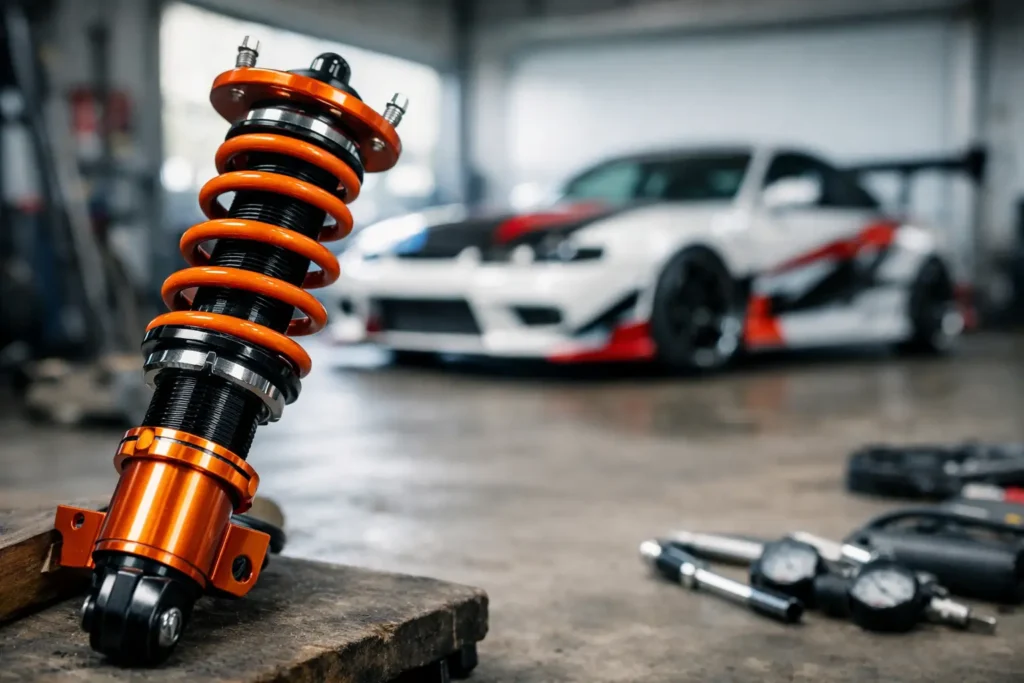
Ask any experienced drifter why a car feels lazy on initiation, nervous on transition or impossible to put power down, and suspension is usually near the top of the list. Coilovers for drift car setup are not just a ride height mod or a way to make the arches sit tighter over the wheels. They control how the car loads up, transfers weight, keeps rear grip on throttle and stays predictable when the angle increases.
That matters because drift suspension is all about compromise. A setup that feels sharp on a smooth circuit can be a handful on rough tarmac. A car built for big power and fast entries will want something very different from a lower-speed practice car. If you buy coilovers based on brand hype alone, you can easily end up paying for adjustment you do not use, or worse, a spring and damper package that works against the chassis.
What matters most in coilovers for drift car setup
For drift use, the right coilover package starts with damper quality, spring rate balance, usable adjustment range and consistency under heat. Plenty of kits offer 30-click damping adjusters and aggressive marketing, but if the damper valving is poor, those clicks do not mean much. You want control, not just stiffness.
Spring rates need to match the chassis, tyre choice, power level and intended use. A common mistake is going too stiff at both ends because the car is being built for drift. That can reduce compliance, make the rear axle skate over bumps and leave the car less predictable in real conditions. More stiffness is not automatically more control.
Ride height adjustment is useful, but it should be treated as a geometry tool rather than a styling feature. Lowering the car too far can destroy roll centre, suspension travel and bump steer. Drift cars need grip and response, and both suffer when the car is slammed without correcting the geometry.
Top mounts also matter. Pillowball mounts give more precision and better feedback, which is useful on track, but they also transmit more noise and vibration. For a car that still sees regular road miles, that trade-off may matter. For a dedicated drift build, most drivers will accept the extra harshness for sharper steering response.
Spring rates, damping and chassis balance
The balance between front and rear spring rates changes how the car initiates, rotates and exits a corner. In very broad terms, a stiffer front can improve response and support steering angle, while a stiffer rear can make transitions faster and reduce squat. But that is only the simple version. What works on one platform can feel wrong on another.
A heavier front-engined chassis may need more front support to manage weight transfer. A lighter car may respond better with more moderate rates and better tyre compliance. Rear tyre width matters too. If you are running more grip in the rear, the suspension has to support that grip without becoming vague.
Damping ties the whole thing together. Compression damping affects how quickly the chassis takes a set. Rebound controls how fast the suspension returns after loading. If rebound is too aggressive, the car can feel tied down and nervous over repeated inputs. If it is too soft, the chassis can float and lose consistency in transition. Good coilovers make these changes feel clear and useful. Cheap kits often make the car feel either hard or soft, without much nuance between.
This is why matching spring rates to damper valving matters so much. A random combination might hold the car up in the paddock, but once you start linking corners and using clutch kicks, the weaknesses show up quickly.
Ride height is not the setup
A drift car with the right stance can still drive badly. That sounds obvious, but it is one of the most common setup traps. Lowering the car reduces centre of gravity, which is useful, but only up to the point where suspension travel and geometry stay in a workable window.
If the front lower arms are pointing upwards at static ride height, you may have already gone too low for the existing geometry. The car might look aggressive, but front grip can drop off, steering feel can worsen and the suspension can hit the bump stops at the worst moment. The rear can suffer the same problem, especially on uneven surfaces where traction matters most.
For most drift applications, the goal is a practical ride height that supports steering lock, tyre clearance and suspension travel. If you need the car lower than that, the proper answer is usually geometry correction, not winding the platforms down and hoping for the best.
Front grip, rear traction and steering angle
Drifting is often described as controlled oversteer, but the control part is what separates a setup car from a social media build. The front end needs enough support to hold angle without washing wide, and the rear needs enough traction to keep the car driving forward instead of just spinning the tyres.
This is where coilovers interact with the rest of the setup. If you have added lock kits, altered track width, changed wheel offsets or moved to grippier tyres, your old suspension settings may no longer make sense. Extra steering angle changes what the front suspension sees at full lock. More front grip may require a different damping approach. More rear traction may need spring and rebound changes to keep the car settled on throttle.
The key is to treat coilovers as one part of the suspension package, not the entire answer. Alignment, bushes, arms, anti-roll bars and tyre pressures all work with the damper and spring package. If one area is badly mismatched, the car can feel wrong even with quality coilovers fitted.
Single adjustable or multi-adjustable?
For many drift cars, a well-developed single-adjustable kit is enough. If the damping range is sensible and the valving is good, you can build a fast, predictable car without chasing separate low-speed and high-speed adjustments. That is especially true for drivers who want straightforward tuning and reliable repeatability.
Multi-adjustable coilovers become more valuable as speed, grip and driver sensitivity increase. On a higher-level build, the ability to separate compression and rebound can help fine-tune initiation, mid-corner support and traction on exit. But more adjustment also means more ways to go in the wrong direction. If you do not have a method for testing changes, extra knobs can create confusion rather than pace.
There is also the budget reality. Money spent on a better-quality damper is often more useful than money spent on extra adjusters in an average-quality unit. For serious builds, buying from suspension brands with proven motorsport experience makes sense because consistency and rebuild support matter just as much as headline features.
Common mistakes when choosing coilovers
The first mistake is buying the stiffest kit available because the car is for drifting. That can make the chassis snappy, reduce grip and increase driver workload. The second is choosing purely on ride height range and ignoring travel and valving.
Another common issue is fitting coilovers without checking the rest of the suspension. Worn arms, tired bushes, poor alignment and limited steering clearance can make a good kit feel average. Some owners also install a coilover package, set the car once and never revisit it. Drift setups evolve. Tyres change, surfaces change, power increases and driver pace improves.
The last big mistake is chasing someone else’s exact settings. A setup that works on one S-chassis, BMW or MX-5 may be wrong for another car with different weight distribution, differential setup, wheel and tyre package or track conditions. Use other builds as a reference point, not a guaranteed answer.
How to make the right choice
Start with the actual use case. Is the car mainly for practice days, competition, mixed road and track use, or a higher-speed circuit programme? Be honest about power, tyre choice and surface quality. That immediately narrows the right spring and damper range.
Next, look at brand support, spare parts availability and whether the kit is built around that platform rather than adapted to fit it. Good fitment, sensible stroke length and proven drift use count for more than a long list of marketing claims. This is also where a specialist supplier such as ProSpeed Parts adds value, because the difference between a part that fits and a part that works is huge on a drift car.
Once fitted, baseline the car properly. Set ride heights evenly, corner weight it if the build justifies it, align it for the intended use and make one change at a time when testing. If the car lacks front bite, do not instantly assume the springs are wrong. It could be damping, alignment, tyre pressure or simply the car being too low.
The right coilovers make a drift car easier to trust. You get cleaner initiation, better support at angle and more repeatable transitions. That confidence is worth more than a dramatic drop or a spec sheet full of adjustments. Buy for function, tune with purpose and let the car tell you what it actually needs.