

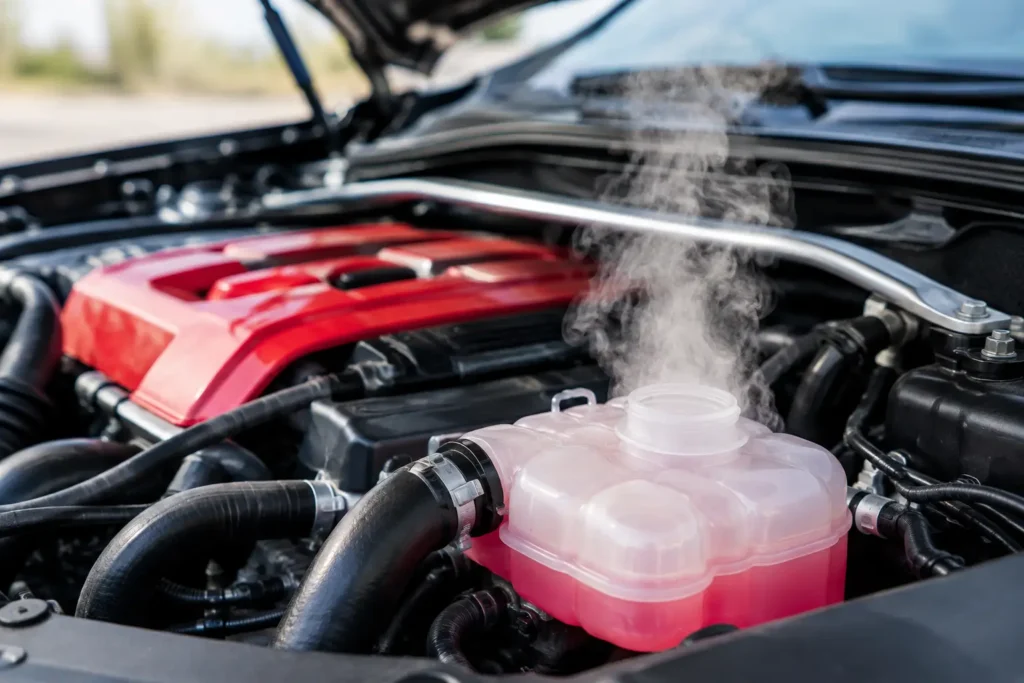
A coolant tank bubbling after a hard pull, a drift session or a motorway run is not a cosmetic issue. When coolant leaves the engine as steam or is pushed into the expansion tank, heat control has already been lost somewhere in the system. On a modified car, the cause is often not simply a radiator that is too small. Why does coolant boil? Usually because coolant temperature has exceeded its effective boiling point, system pressure is missing, coolant is not circulating properly, or combustion pressure is entering the cooling circuit.
Treat it as an engine-protection problem first. Repeated boil-over can warp an aluminium cylinder head, damage a head gasket, split old hoses and leave air pockets that make the next overheating event happen sooner.
Why coolant pressure matters
Water boils at 100°C at atmospheric pressure, but a sealed cooling system operates above atmospheric pressure. The radiator cap or expansion-tank cap is a pressure control valve. By pressurising the system, it raises the coolant’s boiling point. A typical 1.1 to 1.5 bar cap, used with the correct coolant mixture, gives useful temperature margin under sustained load.
That margin matters on turbocharged, supercharged and high-compression engines. Cylinder-head temperatures can climb sharply after boost, during repeated launches or when airflow through the radiator is limited. If the cap opens too early, its seal is damaged, the cap is the wrong pressure rating, or a hose connection leaks, the system cannot maintain pressure. Coolant can then boil even though the temperature reading does not initially look extreme.
Do not fit the highest-pressure cap available as a blanket fix. More pressure can increase boiling resistance, but it also raises stress on the radiator core, heater matrix, hoses, clamps and plastic tanks. Use a cap rating appropriate for the vehicle and the cooling-system hardware fitted.
The main reasons coolant boils
A weak cap or external pressure leak
A tired cap is one of the cheapest and most overlooked causes. Its spring may weaken, the rubber seal may harden, or the pressure valve may stick. Check the cap sealing face as well as the cap itself. Corrosion, a distorted filler neck or a cracked expansion tank can prevent a good seal.
Look for dried coolant residue around hose ends, radiator seams, thermostat housings, water-pump weep holes and AN adaptor fittings. A small leak may only show when the system is hot and pressurised. On a custom build, inspect every joint, especially connections close to turbochargers, exhaust manifolds and sharp-edged brackets. A quality clamp and properly supported hose are not minor details when the car sees repeated heat cycles.
Low coolant level or trapped air
Low coolant creates steam pockets at the hottest points, commonly around the cylinder head and turbo water lines. Air does not carry heat like coolant, and it can stop the thermostat from seeing the true engine temperature. The result is erratic gauge readings, poor heater output, gurgling behind the dashboard and sudden expansion-tank overflow.
Air locks are common after fitting a radiator, thermostat, water pump, remote expansion tank or custom hose routing. Some engines need the nose raised, dedicated bleed screws opened, or a vacuum-fill tool to refill correctly. Fill slowly, follow the vehicle’s bleeding procedure, run the heater circuit where applicable, and allow the engine to cool completely before rechecking the level.
Never remove a radiator or expansion-tank cap on a hot engine. Pressurised coolant can flash into steam instantly and cause serious burns.
Restricted coolant flow
Coolant must move through the engine, radiator and heater circuit at the required rate. A thermostat that fails closed, a slipping or damaged water-pump impeller, a collapsed lower hose, or a blocked radiator core can reduce that flow enough to boil coolant under load.
Thermostat removal is not automatically a performance upgrade. Without a thermostat or a correctly designed restrictor, some systems circulate coolant too quickly to control temperature properly, while warm-up becomes poor and ECU fuelling strategies may be affected. Choose a thermostat temperature that suits the engine calibration, intended climate and usage rather than chasing the lowest number on the box.
Radiators can also block internally through corrosion products, old sealants or incompatible coolant mixes. Externally, bent fins, road debris, mud, oil contamination and intercooler packaging reduce heat rejection. A large alloy radiator is only useful if air can pass through it rather than around it.
Insufficient airflow through the radiator
If temperature rises in traffic but settles at speed, focus on airflow. Verify that electric fans switch on at the commanded temperature, rotate in the correct direction and pull or push air through the core effectively. Check relays, fuses, fan controllers and ECU outputs instead of assuming the fan motor is the only possible fault.
For track and drift applications, fan performance at low speed matters, but ducting matters at speed. Gaps around the radiator allow high-pressure air to bypass the core. A proper shroud, sealed ducting and a clear exit path through the engine bay can outperform a larger radiator fitted with poor airflow management. Oil coolers, intercoolers and air-conditioning condensers all add heat and restriction, so their placement needs consideration.
Combustion gases entering the cooling system
A failed head gasket, cracked head or cracked block can force cylinder pressure into the cooling system. This can make coolant boil or push out even before the engine is fully hot, because combustion pressure is far greater than normal cooling-system pressure.
Warning signs include hard coolant hoses shortly after cold start, persistent bubbles in the expansion tank, unexplained coolant loss, misfires on start-up, a sweet-smelling exhaust or repeated pressure build-up after proper bleeding. Milky oil can occur, but its absence does not clear the head gasket. A combustion-gas test, cooling-system pressure test and cylinder leak-down test provide far better evidence than guessing.
On boosted engines, verify tune quality and fuel delivery as well. Detonation and excessive exhaust gas temperature can overload the cooling system and damage head-gasket sealing. Fixing the cooling symptom while ignoring lean fuelling, insufficient ignition control or boost creep is an expensive false economy.
Diagnose the problem before buying parts
Start with the simplest checks while the engine is cold: coolant level, mixture condition, obvious leaks, cap condition and fan operation. Then pressure-test the system and cap. This often reveals leaks that are invisible during a quick visual inspection.
Next, confirm actual temperature. Dashboard gauges are frequently damped and may sit in the middle across a broad temperature range. Compare ECU data with a known-good sensor input or use an infrared thermometer across the thermostat housing and radiator tanks. A large difference between radiator inlet and outlet temperature can indicate restricted flow, although readings must be taken carefully on different materials and surfaces.
If overheating occurs only under boost or only during long high-load runs, log coolant temperature, intake-air temperature, oil temperature, boost and lambda. That pattern helps separate an airflow issue from a combustion, calibration or cooling-capacity problem. For a race car, logging is more useful than stopping after one hot lap and relying on memory.
Cooling upgrades that solve the right problem
Once the fault is known, build the system around the duty cycle. A fast road car may need a healthy OE-style system, a correctly rated cap and improved fan control. A drift or track car may require a higher-capacity radiator, motorsport fan package, shroud, ducting, upgraded hoses and a properly positioned header tank.
Choose components as a system. Oversized fittings can create awkward hose transitions, cheap silicone hoses can soften near exhaust heat, and poorly routed lines can trap air. Use coolant-safe hose, appropriate clamps, heat protection near turbine housings and secure mounting that prevents vibration fatigue. For heavily modified layouts, make sure the expansion tank remains the highest practical fill and bleed point.
Coolant concentration is also a trade-off. Antifreeze raises boiling protection and prevents corrosion, but water transfers heat better. The correct mix depends on climate, freeze protection requirements, corrosion control and the coolant manufacturer’s specification. Do not run plain water long term in an engine that needs corrosion inhibitors, and never mix incompatible coolant chemistries without fully flushing the system.
A boiling cooling system is not asking for a bigger part by default. It is asking for a diagnosis: retain pressure, remove trapped air, restore circulation, control airflow and rule out combustion gas. Do that work properly before the next full-load run, and the engine will have a far better chance of finishing the session instead of finishing its head gasket.