

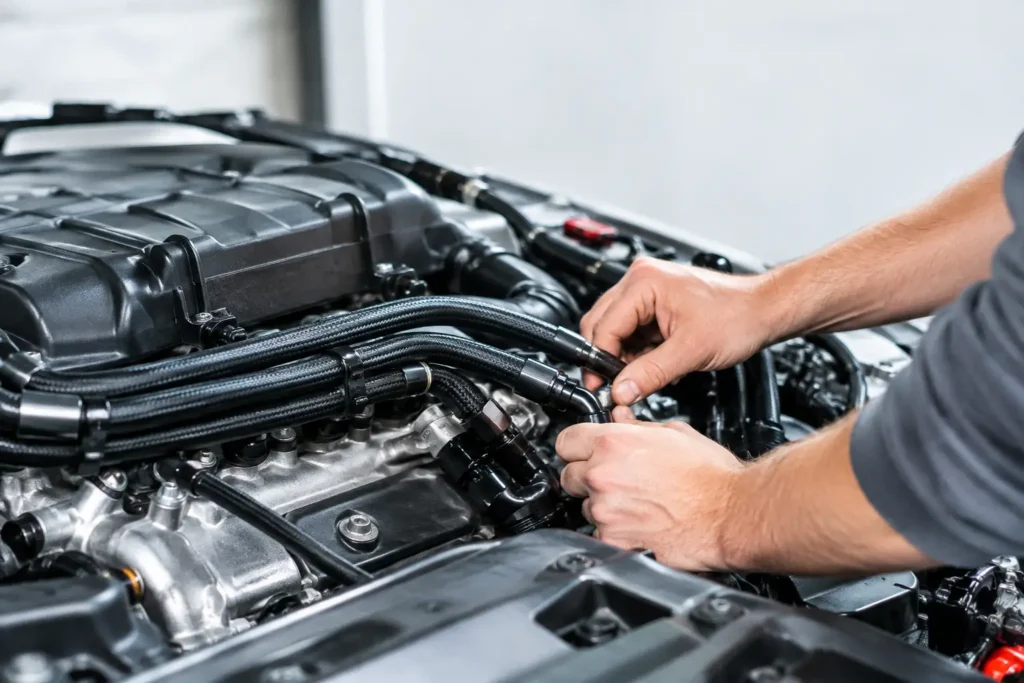
A fuel line that is one sharp edge, exhaust pipe, or loose P-clip away from failure is not a minor finishing detail. On a modified street car, drift build or race car, fuel system routing determines how safely the engine is supplied under heat, vibration and load. Knowing how to route fuel lines properly means planning the whole path before cutting hose or tightening a single fitting.
The cleanest-looking route is not always the right one. Prioritise separation from heat and moving parts, secure mounting, sensible service access and enough flexibility for engine movement. Then choose hose, fittings and clamps that are genuinely compatible with the fuel, pressure and duty cycle of the vehicle.
Start with the fuel system layout
Map the system from tank to engine before installing anything. A typical return-style EFI layout runs from the tank or surge tank to the pre-filter, lift pump where fitted, main pump, post-filter, fuel rail, pressure regulator and back to the tank. A returnless system has fewer external lines, but still needs a protected feed route and careful filtration placement.
Carburettor, port-injection and high-pressure direct-injection systems are not interchangeable. Confirm the operating pressure, pump flow, fitting standard and the hose manufacturer’s fuel and pressure rating. Ethanol blends deserve particular attention: older rubber hose and unsuitable seals can deteriorate rapidly with E5 or E10, and higher-ethanol race fuels place greater demands on the entire system.
Keep the high-pressure side as short and protected as practical, but do not force every component into a cramped engine bay. Filters need to be accessible for replacement, pumps need cooling airflow where their design requires it, and the regulator needs a location that allows safe hose routing without awkward bends.
How to route fuel lines away from heat
Heat is the first routing problem to solve. Exhaust manifolds, turbochargers, downpipes, catalytic converters and even radiator pipes can raise fuel temperature and damage hose over time. Fuel vapourisation can also create pressure instability, hot-start problems and inconsistent performance.
Route feed and return lines along the coolest practical side of the chassis. On many front-engine cars, the transmission tunnel or factory underbody channels provide a sensible starting point, provided there is adequate clearance from exhaust sections. If the exhaust and fuel lines must share the same broad area, maintain as much physical separation as the chassis allows and use a properly secured heat shield between them. Heat sleeve is useful for local protection, but it should not be used as an excuse to run fuel hose directly alongside a turbine housing or exhaust pipe.
Under-bonnet routing requires the same discipline. Keep hose clear of manifolds, turbo hardware, wastegate pipes and radiator fans. Avoid resting a line on an inlet pipe or engine cover just because it appears tidy. Engine movement, heat cycling and vibration will turn light contact into abrasion.
A useful rule for performance builds is simple: if you cannot comfortably inspect the full route with the car on stands, it will be difficult to spot a developing problem later. Leave sightlines around filters, fittings and any area exposed to heat.
Choose hose and fittings for the actual application
Fuel line routing starts with the correct material. For flexible sections, use hose rated for the fuel you run and for the pressure the system sees. EFI-rated rubber hose can suit straightforward low-to-medium pressure installations, while PTFE hose is a strong choice for demanding ethanol-compatible, high-pressure and motorsport applications. PTFE has low permeability and handles modern fuels well, but it is less forgiving of tight bends than rubber hose and needs correctly matched hose ends.
Hard line can be an excellent option for long chassis runs. It is compact, well protected when properly clipped, and reduces the amount of flexible hose exposed beneath the car. Use approved fuel-system tubing and compatible fittings, not improvised pipe. Flexible hose is then used at points where movement or serviceability demands it, such as near the engine, tank module or pump assembly.
AN fittings are popular on custom builds because they offer repeatable sizing and a serviceable connection. They are not automatically better merely because they are anodised or branded. Match the fitting type to the hose construction, confirm thread standards, and use the correct seals. Do not mix tapered pipe threads, straight threads and AN flare fittings without understanding how each seals.
For hose diameter, bigger is not always smarter. The line must support the engine’s required fuel volume at the target pressure, with sufficient margin for future power increases. Oversized hose can add cost, weight and packaging difficulty, while undersized feed lines can cause pressure drop when the engine is under sustained load.
Use the chassis, not cable ties, to support the system
Fuel lines need positive retention. Rubber-lined P-clips fixed to solid chassis points are the preferred solution for most custom routing. They control vibration, prevent rubbing and keep the installation inspectable. Mounting intervals depend on hose type, vehicle use and line orientation, but the line should never be able to sag, flap or touch surrounding components.
Avoid relying on ordinary cable ties, adhesive mounts or existing wiring looms as structural supports. These may be acceptable for temporarily positioning a line during mock-up, not for a finished fuel system. A drift car that hits kerbs, a track car that sees repeated heat cycles and a road car used year-round all expose weak mounting to failure.
Where the line passes through a bulkhead, floorpan or inner wing, use a correctly sized grommet or bulkhead fitting. Bare metal edges can cut through hose surprisingly quickly. If a line runs beneath the car, protect it from road debris and place it above the lowest practical chassis plane rather than beneath exposed rails or braces.
Keep fuel lines separate from electrical wiring where possible. A neat build may run both through the same general area, but they should not be tied together. Separating them simplifies diagnosis, avoids chafing and reduces the risk of an electrical fault affecting the fuel system.
Allow movement, bends and service access
The engine moves on its mounts. The body flexes. A hose route that looks perfect with the car parked can become tight at full engine torque or suspension compression. Build in a controlled amount of slack at moving interfaces, using broad curves rather than sharp loops. Never kink PTFE hose or force rubber hose into a radius tighter than its specification.
Think ahead to routine work. Can the fuel filter be removed without draining half the system? Can you reach the regulator adjustment and gauge port? Can the tank, pump hanger or surge tank be serviced without cutting cable ties and dismantling unrelated parts? These details matter just as much on a fast road build as they do in a race paddock.
Use bulkhead fittings where a line enters the cabin, boot or engine bay. They create a secure, sealed transition and prevent a long hose run from moving at the panel edge. If a fuel cell or surge tank is fitted in the boot, route and seal all lines carefully, follow the relevant motorsport regulations, and keep fuel components isolated from occupants.
Pressure-test before the first drive
Once the system is assembled, inspect every fitting, clamp, clip and protected pass-through before adding fuel. Pressurise the system according to the fuel system and component manufacturer’s procedure, then check every joint under pressure. EFI systems can reveal a poor connection immediately, while a low-pressure carburettor setup may need a longer inspection to show a weep.
Do not check for leaks with a naked flame, and do not assume a dry fitting is safe after a ten-second prime cycle. Watch the system through several pump cycles, inspect after the engine reaches temperature, and re-check after the first proper road or track heat cycle. Look for dampness, fuel smell, hose movement, rubbing marks and any clip that has shifted.
For a custom build, label feed and return lines during installation, especially where they disappear under the car or behind panels. It makes future diagnostics faster and prevents mistakes when the vehicle returns for upgrades.
A properly routed fuel system should disappear into the build: protected, accessible and secure enough that you stop thinking about it. That is the standard worth aiming for before asking the engine to make more power.