

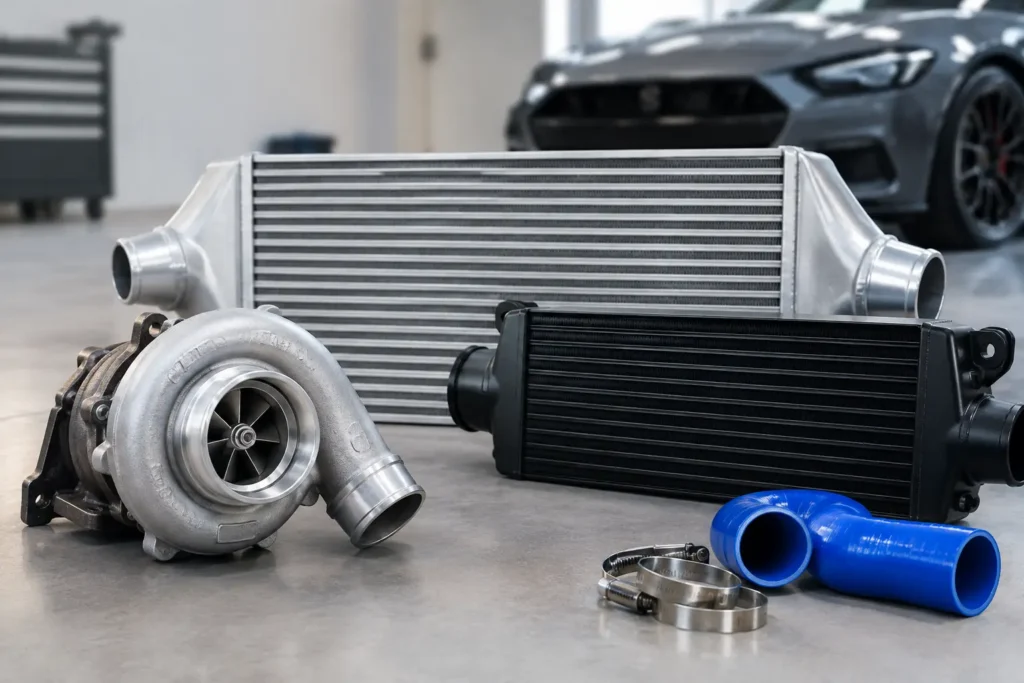
A small intercooler can make a strong turbo setup feel sharp for one pull, then soft and inconsistent once inlet temperatures climb. An oversized core can create its own problems: poor packaging, extra pipe volume, unnecessary weight and pressure drop. That is why searches for “what size intercooler for turbo car” builds need more than a simple horsepower number.
The correct intercooler is the smallest properly engineered core that maintains stable charge temperatures at your real boost level, power target and duty cycle. A fast road car, drift car and circuit car at the same power can need very different solutions.
What size intercooler for a turbo car?
Start with your realistic power target, not the figure the engine makes today. If the plan is 350 bhp now and 500 bhp after injectors, turbo and mapping, buy for the finished specification where packaging allows. Replacing a restrictive core and remaking all the pipework later costs more than choosing correctly at the fabrication stage.
As a broad starting point for a front-mounted intercooler:
- Around 250-350 bhp: a core roughly 550-600 mm wide, 180-230 mm high and 65 mm thick is commonly sufficient for a well-vented fast-road build.
- Around 350-500 bhp: look towards roughly 600 mm wide, 230-300 mm high and 76 mm thick, with efficient end tanks and sensible pipework.
- Around 500-700 bhp: a 600-700 mm wide, 300 mm high, 76-100 mm thick core is often appropriate, provided airflow through the radiator is protected.
- Above 700 bhp: specify the system around compressor flow, charge-air temperature, vehicle speed and sustained use. Core dimensions alone are no longer a reliable buying method.
These are starting dimensions, not a universal fitment chart. A 500 bhp turbocharged BMW used for short rolling pulls does not impose the same thermal load as a 500 bhp time-attack car completing repeated hard laps. Equally, two cores with identical external dimensions may perform very differently because of their internal fin design, fin density, end-tank shape and build quality.
Size is more than core volume
Intercooler dimensions are easy to compare, but frontal area is usually more valuable than simply adding thickness. A wide, tall core exposed to clean air can reject heat effectively without forcing charge air through an excessively deep internal path. A very thick core behind a restrictive bumper opening may receive poor airflow and can obstruct the radiator and oil cooler behind it.
For most front-mounted installations, maximise usable frontal area first. Then select enough thickness to support the required airflow without creating a major pressure penalty. A thicker core is not automatically better. Once core depth becomes excessive for the vehicle and airflow path, the gains can flatten while turbo response and cooling airflow elsewhere suffer.
Core construction also matters. Bar-and-plate intercoolers are popular in performance builds because they are durable and generally handle boost pressure, heat cycling and road debris well. They can be heavier and may have higher resistance than a comparable tube-and-fin design. Tube-and-fin cores are often lighter and can flow very well, but selection should be based on the quality of the core and intended use, not just the construction label.
Choose by compressor flow where possible
Power figures are useful shorthand, but compressor flow is the better technical reference. A turbo moving more air at a given pressure ratio creates a larger charge-air cooling requirement. High boost with a modest turbo may produce substantial compressor outlet temperatures, while a larger turbo operating efficiently can deliver cooler air at the same boost pressure.
If you have a compressor map, datalogged intake-air temperatures and a clear power target, use them. For a custom race or high-output street build, those numbers are worth more than copying the intercooler fitted to someone else’s car. Their bonnet venting, bumper aperture, turbo efficiency, fuel type and mapping may be completely different.
Pressure drop matters as much as temperature
An intercooler should lower charge temperature without making the turbo work harder than necessary. Pressure drop is the difference between boost pressure at the compressor outlet and pressure reaching the inlet manifold. Some loss is normal, but a restrictive core, poor end tanks, undersized piping or abrupt silicone hose steps can turn a good turbo system into a hot, inefficient one.
For a serious road or track setup, aim for low and repeatable pressure drop while achieving acceptable intake temperatures. There is no single magic figure, because sensor locations and test conditions vary, but a core losing several psi at peak flow deserves investigation. Raising boost to recover lost manifold pressure increases compressor work and heat, which can cancel out the benefit of a large intercooler.
Pipe diameter needs the same common sense. For many 300-500 bhp builds, 63 mm or 2.5-inch charge piping is a strong baseline. At higher flow levels, 76 mm or 3-inch piping may be justified. Going too large on a modest-power engine adds volume and makes routing harder without delivering a meaningful gain. Keep bends smooth, minimise unnecessary length and use properly beaded pipe ends with quality clamps.
End tanks and inlet position affect real fitment
A core with well-shaped, tapered end tanks distributes air more evenly across the internal passages. Square box-style tanks can work, but poor tank geometry may leave part of the core underused or create turbulence at the inlet and outlet. This is especially relevant when selecting a universal core for a fabricated installation.
Also consider where the inlet and outlet sit. A shorter route from turbo to intercooler to throttle body usually reduces pipe volume and simplifies fabrication. On some chassis, a reversed-flow intercooler gives cleaner routing. On others, it creates tight bends, heat exposure near the exhaust side or difficult access to headlights, washer bottles and crash-bar brackets. Measure the whole system before ordering a core.
Do not sacrifice radiator cooling
The front of the car is limited real estate. A huge intercooler installed hard against the radiator can reduce coolant control when the car is working hardest. That is a poor trade on a road car and a race-ending issue on track.
Leave a sensible air gap where the chassis permits, seal the intercooler to the bumper opening so air is driven through rather than around it, and ensure the radiator has a clean exit path for hot air. Ducting, undertrays, fan shrouds and bonnet venting can make a correctly sized intercooler work far better than fitting a thicker core alone.
Drift cars need particular attention here. They often see high boost and high engine load with limited vehicle speed, so natural airflow through the front stack is weak. A core that survives a motorway pull may heat-soak during a drift run. Effective fans, ducting and radiator capacity are part of the intercooler decision, not separate jobs.
Match the intercooler to the car’s job
A fast-road car needs quick response, durable hardware and stable temperatures through repeated acceleration. A sensible front-mounted core with short pipework is usually the right answer. Avoid choosing a giant race core just because it fits behind the bumper.
A circuit car needs repeatability. Size the core for sustained full-load operation, then verify it with logs after several laps. Monitor intake-air temperature after the intercooler, coolant temperature and boost at the manifold. If intake temperature steadily climbs each lap, the issue may be insufficient core capacity, poor ducting or heat from the radiator and engine bay recirculating into the intake path.
A drag car can prioritise peak flow and low restriction, but it still needs enough thermal capacity for staging, heat soak and successive runs. Ice tanks or water-to-air intercoolers can be effective in this environment. For a tightly packaged rear-engine car, or a build where very short charge pipes are valuable, water-to-air cooling may also be the smarter route. It adds pump, heat exchanger, reservoir and plumbing complexity, so it should be chosen for a clear reason.
Check results with data, not guesswork
Once fitted, the intercooler should be validated. Log ambient temperature, post-intercooler intake-air temperature, boost pressure and, where possible, compressor outlet temperature. Test under repeatable conditions. A single third-gear pull on a cool evening tells you very little about how the car will behave on a warm track day or during a hard summer drive.
A good system will bring intake temperature down quickly after a pull and resist a major temperature rise over repeated runs. If the car loses power as temperatures build, do not immediately fit the largest possible core. Check for boost leaks, blocked fins, poor bumper ducting, a restrictive grille, radiator heat transfer and an air filter drawing hot engine-bay air.
The right intercooler is one that fits the chassis properly, supports the finished power target and keeps manifold air temperatures controlled without punishing flow. Measure the available aperture, build around the way the car is actually driven, and leave room for the cooling system to do its job. That approach produces a turbo car that stays consistent when the road, track or drift run gets demanding.