

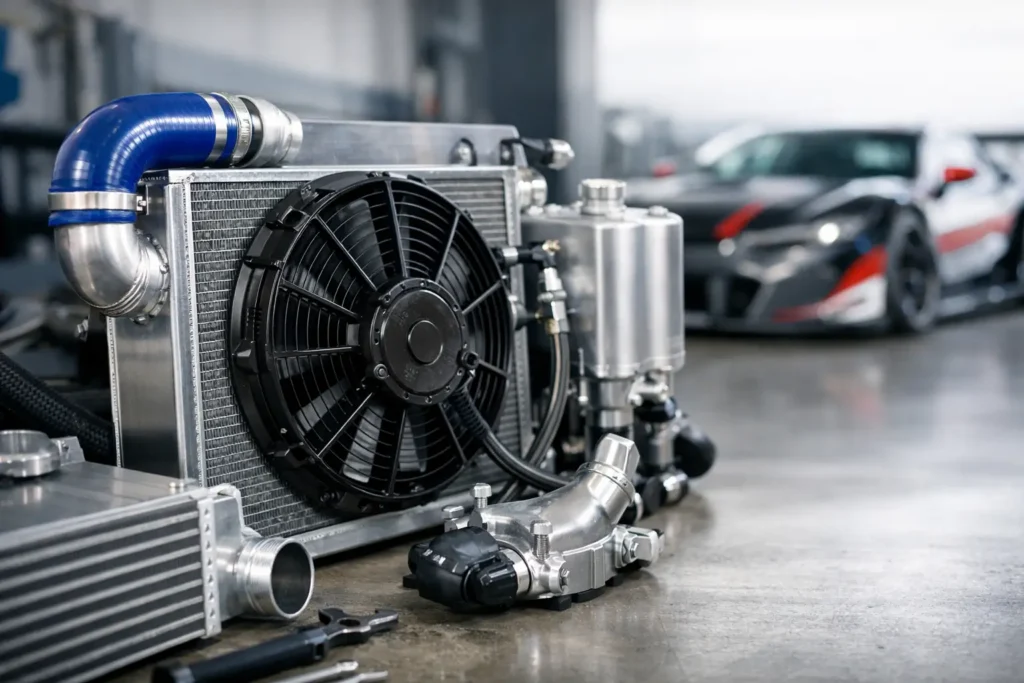
A car that holds perfect coolant temperature on the road can still boil over after three hard laps. That is why a motorsport cooling system guide must start with heat load, airflow and packaging – not simply the largest radiator that fits behind the bumper. Track cars, drift builds and high-boost street cars need a system that can reject heat repeatedly, survive vibration and remain easy to inspect between sessions.
Cooling is a complete circuit. The radiator, oil cooler, intercooler, ducting, thermostat, pump, header tank, hoses and caps all affect the result. Fit one high-flow component without considering the rest, and you can create a restriction, an air trap or an airflow problem that costs more performance than it gains.
Start with the engine’s real heat load
Before choosing hardware, be honest about the car’s duty cycle. A naturally aspirated road car used for occasional sprint events has very different requirements from a turbocharged drift car sitting at high RPM with limited vehicle speed. A circuit car sees sustained load and repeated high-speed airflow. A drift car often sees lower forward speed, high engine speed and heat soak while waiting on the line. A time-attack build may produce extreme power for a short run, but still needs stable temperatures on the cool-down lap.
Power is only one part of the calculation. Compression ratio, ignition timing, boost pressure, fuel type, turbocharger placement and exhaust manifold temperature all add heat to the engine bay. Automatic gearboxes, DCT systems and power steering circuits add further thermal demand. If the car has been remapped or fitted with a larger turbo, assess cooling capacity before asking it to make full power lap after lap.
Use logged data where possible. Coolant temperature, oil temperature, intake air temperature, ambient temperature and vehicle speed tell a more useful story than a dashboard gauge alone. A problem that appears only at low speed points towards fan capacity or duct sealing. Rising temperatures at high speed usually point to insufficient core capacity, poor pressure control, blocked airflow or a circulation issue.
Choose the radiator by core efficiency, not just size
A thicker radiator is not automatically better. Core thickness, fin density, tube design and frontal area must suit the available airflow. A very thick core placed behind a restrictive bumper opening can struggle because air cannot pass through it efficiently. In some installations, a high-quality, wider core with good ducting outperforms a thicker unit with no controlled airflow path.
Aluminium performance radiators are a common choice because they offer strong heat transfer and durable construction. For a race application, prioritise a correctly sized core, welded tanks and mounting that allows for chassis movement. Hard-mounted radiators can crack at the tanks or mounting points when exposed to kerbs, vibration and engine movement. Rubber-isolated mounts are a small detail with a major reliability benefit.
The filler and expansion arrangement also matters. The highest point in the system should allow air to separate and escape. If the radiator sits lower than the cylinder head or heater circuit, a remote header tank or swirl pot may be required. Trapped air reduces coolant contact, creates local hot spots and can produce inconsistent temperature readings that are difficult to diagnose.
Pressure caps and thermostats are working parts
A higher-pressure cap raises the coolant boiling point, but it is not a cure for an undersized radiator or combustion gases entering the cooling system. Use a cap pressure that suits the radiator, hoses and tank construction. Excess pressure can expose weak clamps, old hoses and plastic fittings very quickly.
The thermostat should also match the application. Removing it altogether can reduce control over coolant flow and make warm-up slower, particularly on a road-driven car. A quality thermostat maintains the engine in its intended operating range. For dedicated competition use, a lower-temperature thermostat can be useful, but only if the ECU calibration and the rest of the system support it.
Oil cooling needs temperature control
Engine oil carries a significant amount of heat away from pistons, bearings and turbochargers. Once oil temperatures remain too high, viscosity falls, oxidation increases and bearing protection suffers. For many tuned and track-driven engines, an oil cooler is not an optional cosmetic upgrade.
The right layout uses a suitable cooler core, motorsport-grade hose and fittings, and ideally a thermostatic sandwich plate or inline thermostat. Sending cold oil through a large cooler from start-up can leave it below its efficient operating range, increase drag and retain moisture in the oil. The goal is stable oil temperature, not the lowest number on the gauge.
Cooler placement is a trade-off. Put it directly in front of the radiator and it receives clean, cool air, but it also adds heat to the air reaching the radiator. Mount it in a separate ducted opening and both systems can work more efficiently, although plumbing becomes longer and packaging is more complex. Protect any front-mounted cooler from stones, but do not fit a guard so dense that it becomes an airflow restriction.
Transmission and differential coolers follow the same principle. They are most valuable on cars with high drivetrain load, including endurance cars, turbocharged drift builds and heavy track cars with automatic transmissions. Fit a temperature sensor before deciding how much cooling hardware is required.
Ducting is where cooling systems win or lose
Air takes the easiest route. If there are gaps around the radiator, much of the air entering the grille will pass around the core instead of through it. A properly ducted radiator forces the high-pressure air at the front of the car through the core, then provides a low-pressure route out of the engine bay.
Seal the gap between the bumper opening, radiator support and core using suitable panels, foam or rubber edging. The fan shroud should cover the core effectively, rather than leaving the fan to pull air only through a small central area. On cars with limited frontal opening, ducting delivers more value than simply fitting larger fans.
Extraction matters just as much. Hot air trapped behind the radiator reduces the pressure difference required for airflow. Bonnet vents, radiator exits and carefully managed under-bonnet paths can reduce this pressure and help cooling at speed. However, vent placement should suit the vehicle’s aerodynamic layout. A poorly positioned vent can disrupt airflow or allow hot air to recirculate back towards the intake.
For drift and pit-lane operation, electric fans need enough static-pressure capability to pull air through a dense core. Check fan direction, shroud clearance and relay wiring. Fans should be controlled by a reliable temperature input and protected with correctly rated fuses. A fan wired directly through a marginal switch is a predictable failure point.
Build the plumbing for pressure, movement and serviceability
Cooling hoses in a modified engine bay must cope with temperature, pressure, vibration and contact with surrounding components. Silicone hose is widely used for its durability, but it still needs the correct diameter, bend radius and clamp choice. An oversized hose can be difficult to seal; a tight bend can collapse or restrict flow.
Keep hoses away from exhaust manifolds, turbo housings, belts and sharp fabricated edges. Where heat exposure cannot be avoided, use shielding and secure the hose with insulated P-clips. Do not rely on a cable tie to support a heavy coolant or oil line. It may survive a garage test, then fail after repeated heat cycles and chassis movement.
For coolant plumbing, bead-rolled aluminium hard lines are useful in long runs and custom rear-radiator layouts. Use quality couplers at engine and chassis movement points. For oil systems, select hose and fittings rated for hot oil and the operating pressure of the engine. Reusable fittings make service easier, but only when the hose type and fitting series are matched correctly.
Clamps deserve the same attention as the expensive parts. Traditional worm-drive clamps can damage soft silicone if overtightened. Constant-tension clamps and properly selected T-bolt clamps are often a better choice for boosted or high-pressure applications. Recheck clamp tension after initial heat cycles.
Test the system before the race weekend
A cooling system should be pressure-tested after every major plumbing change. Test cold, inspect every joint, then bring the engine to temperature and check again. Confirm that fans switch on when expected, the heater circuit flows correctly where retained, and the expansion tank level remains stable after a full cool-down.
On track, log coolant and oil temperature alongside RPM, speed and intake air temperature. If temperatures climb only in traffic, improve fan performance and low-speed airflow. If they climb on long straights, look at radiator capacity, duct sealing, coolant circulation and hot-air extraction. If coolant is pushed into the overflow while the gauge looks normal, investigate air pockets, cap control and possible combustion pressure before fitting more parts.
ProSpeed Parts supplies the specialist cooling, hose, fitting and clamp hardware needed to build systems around the car rather than forcing the car around generic parts.
Build for the hottest session, not the easy one
The best cooling setup is not the one with the biggest catalogue specification. It is the one that maintains controlled temperatures on the hottest day, after the longest pull, with the bonnet shut and the car moving at the speed your discipline demands. Measure, log, inspect and refine the system before it becomes the reason a strong build leaves the circuit early.