

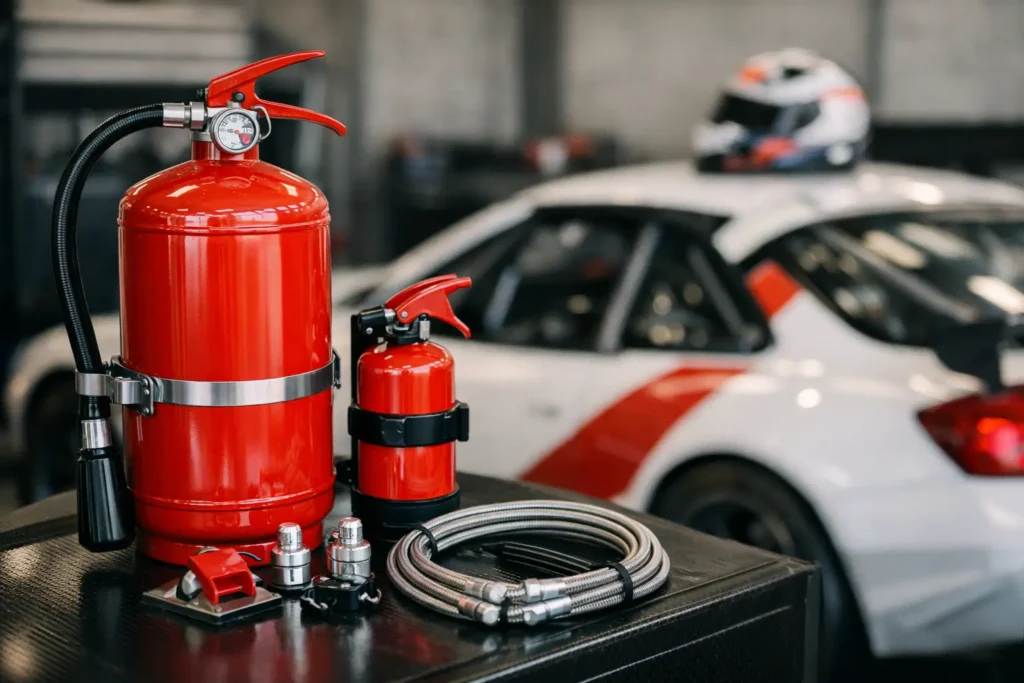
A fire in a competition car rarely gives the driver time to think. Fuel, oil, wiring insulation and hot exhaust components can turn a minor leak or electrical fault into a retirement within seconds. That is why motorsport fire extinguisher kit requirements should be specified at the start of a build, not treated as a final scrutineering item before the first event.
For a drift car, circuit racer, rally build or serious track car, the correct system depends on the championship regulations, vehicle layout and the risks created by the fuel, oil and electrical systems. A compact handheld extinguisher may be acceptable for some events. For others, a plumbed-in system with cockpit and external activation is mandatory. Buying a quality kit is only part of the job. It must be the right type, correctly mounted, accessible and in date.
Start with the regulations for your discipline
There is no single set of motorsport fire extinguisher kit requirements that applies to every car and every event. Motorsport UK regulations, FIA regulations and championship supplementary regulations can all apply. Organisers may also set additional requirements for vehicle type, class or competition level.
Before selecting a system, check the current technical regulations for the exact series you intend to enter. The wording matters. A regulation may specify the extinguishant type, minimum capacity, FIA homologation, number of nozzles, activation method, mounting position and service interval. A road-legal track-day car can have very different requirements from an FIA-specification rally car.
Do not assume that a system accepted at a local sprint or drift day will pass scrutineering in a national championship. Equally, fitting a more expensive system does not automatically make it compliant if its certification has expired or its installation does not meet the rulebook.
Handheld or plumbed-in system?
A handheld extinguisher is the simplest option. It is generally suited to lower-risk track use, sprints, hillclimbs or categories where the regulations only require a portable extinguisher. It should be secured in a dedicated metal bracket, within reach of the seated and harnessed driver, and released without tools.
A plumbed-in system is designed to attack a fire where it starts. The cylinder is mounted securely in the vehicle and connected to nozzles through heat-resistant tubing. It can usually be triggered by the driver inside the car and, where required, by an external pull handle for marshals. This is the normal route for race and rally cars with enclosed cockpits, significant fuel-system modifications, turbocharged engines or more demanding series regulations.
The trade-off is straightforward. A handheld unit is cheaper and easier to fit, but it requires the driver to identify the fire, unclip the extinguisher, aim it and operate it. A plumbed-in system costs more and takes careful planning, but can discharge directly into high-risk zones while the driver remains restrained in the seat.
Choose an approved extinguishant and capacity
Motorsport systems are commonly supplied with foam or clean-agent extinguishants. The right choice depends on the rules and the application. Foam is effective on flammable liquid fires and can help suppress fuel and oil fires, but it is heavier and may leave residue. Clean-agent systems are lighter and leave less residue, which can be attractive in tightly packaged race cars with valuable electrical and electronic equipment.
Powder extinguishers are common in general automotive use, but their residue is highly corrosive and difficult to remove from engines, wiring, connectors and cockpit equipment. They may be permitted in some classes, but they are rarely the first choice for a competition build where rapid recovery and component protection matter.
Capacity is not a figure to guess. A small handheld unit may satisfy a basic event requirement, while a plumbed-in FIA-approved system will have a specified agent quantity and discharge performance. Follow the minimums in your rulebook, then consider the car’s genuine risk profile. A naturally aspirated track car with a standard fuel system presents a different installation challenge from a turbocharged race car with a surge tank, braided fuel lines, dry sump plumbing and exhaust heat concentrated under the bonnet.
If an FIA-approved system is required, verify that the exact model is currently approved to the required standard. Labels, serial numbers and service documentation are not optional details at scrutineering.
Nozzle placement matters as much as cylinder size
A plumbed-in extinguisher is only effective if the extinguishant reaches the fire. Poor nozzle positioning is one of the most common weaknesses in DIY installations. Do not place nozzles simply where the tubing reaches most easily.
Most competition cars need coverage for the engine bay and the driver area. In the engine bay, aim nozzles towards likely ignition points such as fuel rails, injectors, pressure regulators, turbocharger oil-feed areas, fuel filters, carburettors where fitted, and areas where oil or fuel could reach exhaust components. Avoid aiming directly at a solid bulkhead or placing a nozzle where bodywork, intercooler pipework or intake ducting blocks the discharge.
In the cockpit, the objective is to protect the driver and suppress flames around the footwell, transmission tunnel or fuel-cell area where applicable. Nozzles should not be directed into the driver’s face. A focused discharge at the lower cabin or pedal-box area is generally more useful than filling the upper cabin first.
Rear-mounted fuel cells, pumps and swirl pots may need separate attention. Some regulations prescribe nozzle locations or minimum nozzle counts, so use the system manufacturer’s installation instructions alongside the championship rules. Keep lines protected from sharp edges, exhaust heat, moving suspension components and chafing. Grommets, P-clips and proper routing are basic motorsport installation practice.
Mounting and activation must work under load
The extinguisher cylinder needs a rigid mounting location that remains secure during kerb strikes, vibration, contact and heavy braking. Thin interior trim, unsupported aluminium panels or improvised cable-tie mounting are not acceptable. Use the supplied bracket or an approved motorsport bracket, fastened to a substantial structure such as a reinforced floor, tunnel, roll-cage mounting area or purpose-built bracketry.
Position the cylinder where it is protected from impact but still serviceable. In many race cars, this means low in the passenger footwell area, on the transmission tunnel or behind the seats. Check that it does not interfere with seat travel, harness operation, driver extraction or passenger-side safety equipment.
Internal activation must be obvious and reachable by a fully harnessed driver. A driver should not need to release belts, lean across the cabin or remove the steering wheel to operate it. External activation is commonly required on plumbed-in systems and should be clearly marked using the specified fire symbol or decal. Mount it where a marshal can reach it quickly without searching around bodywork or aero panels.
Cable-operated systems need smooth, protected cable routing with no tight bends or kinks. Electrical systems need correctly protected wiring, a reliable power supply where applicable, and installation that follows the manufacturer’s instructions. Test the mechanism carefully, but do not discharge a system merely to prove it works unless you are prepared to service or replace it immediately afterwards.
Service dates, condition and scrutineering checks
A fire system is a consumable safety component, not a fit-and-forget accessory. Check the cylinder’s service date, pressure indication where fitted, seals, pull cables, electrical connections, tubing and nozzle condition before every event. A missing pin, damaged cable sheath or loose nozzle can be enough for a scrutineer to reject the car.
Service intervals vary by manufacturer, extinguishant and approval standard. Some systems need periodic inspection and recertification by an authorised service agent. Others have a defined lifespan after which the cylinder or complete kit must be replaced. Keep the service certificate with the car’s event paperwork, particularly for FIA-regulated competition.
Inspect after any crash, heavy impact, engine-bay fire, water ingress or accidental activation. Replace damaged brackets and clips rather than bending them back into shape. If a system has discharged, even briefly, it must be refilled or replaced before the car returns to competition.
Build the system around the car, not the catalogue
The best fire installation matches the vehicle’s layout and the regulations it must pass. Plan cylinder placement before finalising seats, harnesses, fuel lines, ECU locations and interior panels. It is far easier to route extinguishing tubing properly before the cabin is finished than to retrofit it around a completed race harness and fabricated dashboard.
For workshops and private builders, treat the extinguisher system with the same care as fuel plumbing, brake lines and battery isolation. ProSpeed Parts customers already understand that performance hardware has to fit the application. Safety hardware is no different: the correct approval, mounting, routing and maintenance are what turn a fire extinguisher kit into a system that can protect both the driver and the car when it counts.