
A fuel rail is easy to overlook when planning a power build. It sits between the injectors and the fuel lines, looks simple, and often gets blamed only after a fitting leaks, an injector does not seat correctly, or fuel pressure becomes unstable at full load. For turbocharged street cars, drift cars and dedicated race builds, this fuel rail upgrade guide focuses on choosing a system that fits properly and supports the fuel demand you are actually building towards.
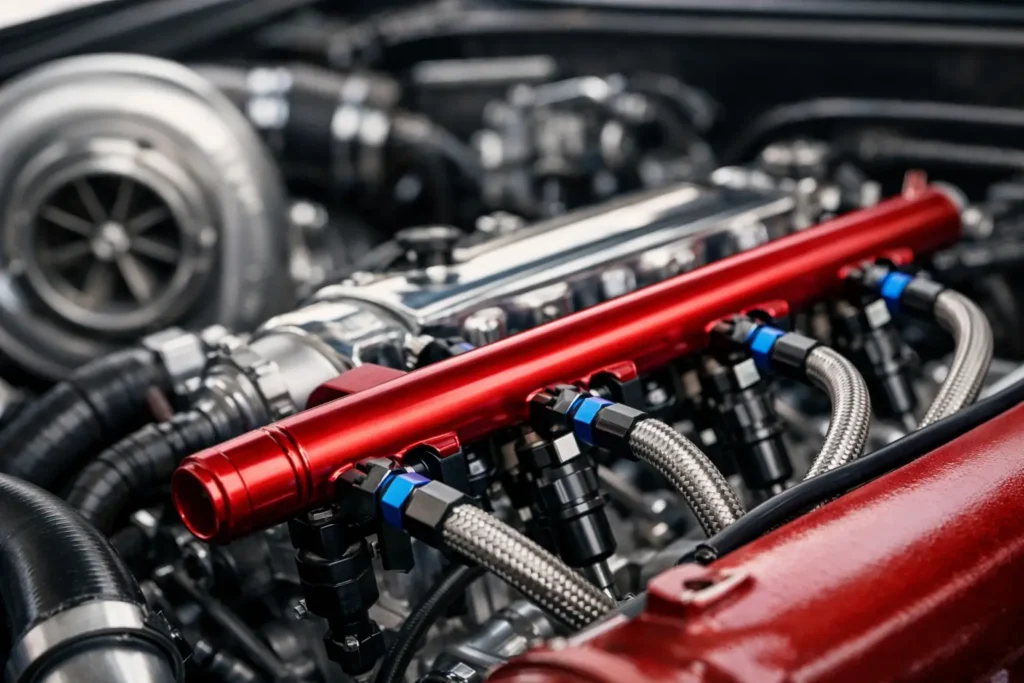
A larger rail alone does not create horsepower. Its job is to distribute fuel evenly to the injectors, provide secure connections for the feed, return and pressure sensor, and give the system the capacity and serviceability needed for higher-flow injectors and upgraded fuel lines. The right rail is part of a complete fuel-delivery plan, not a cosmetic billet addition.
When a fuel rail upgrade makes sense
Many factory rails are capable of supporting respectable power figures, especially on naturally aspirated engines or modest boost applications. Replacing one simply because it is aftermarket is not always money well spent. If the original rail accepts your intended injectors, has safe hose connections, supports the required fuel pressure and clears the inlet manifold, it may remain the sensible option.
An upgrade becomes worthwhile when the stock rail limits injector choice, uses restrictive or awkward connections, cannot accommodate a fuel pressure sensor, or is showing its age. It is also a practical move when converting to AN-style plumbing, adding an adjustable regulator, building a return-style fuel system, or preparing for ethanol blends that demand substantially more fuel flow.
For a competition car, service access matters as much as outright capacity. A rail with properly placed ports can make it far easier to fit a pressure sensor, bleed the system, connect a gauge during setup, or route the lines away from turbocharger heat. That saves time between sessions and makes fault-finding less painful when the car is on the ramp.
Fuel rail upgrade guide: start with the engine, not the rail
The correct rail is dictated by the engine family, inlet manifold, injector type and fuel-system layout. Start by confirming the exact engine code and manifold arrangement. Similar engines can use different injector spacing, mounting heights, rail bolt positions and injector connector clearance.
Injector geometry is the first fitment check. Most rails are designed around a specific injector body style, commonly top-feed injectors with 11 mm or 14 mm O-rings, but the overall injector length is just as critical. An injector that is too short may not seal at both ends. One that is too long can preload the O-rings, distort the mounting position or prevent the rail from seating on the manifold.
Check whether your chosen injectors use the correct lower seats and upper adapters for the manifold and rail. Do not assume that an injector described as suitable for an engine will work with every aftermarket rail. Measure where possible, and verify the published dimensions before ordering parts for a custom installation.
The next decision is fuel-system architecture. A conventional return-style system usually feeds the rail and returns excess fuel through a regulator. This is familiar, easy to tune and well suited to high-output builds. Some engines use returnless arrangements, where pressure control is managed at the tank or by electronic fuel pump control. Converting either layout is possible, but it changes the required plumbing, regulator position and calibration strategy.
Rail size, flow and pressure capacity
A larger internal bore can reduce pressure variation across the rail when injector flow and fuel demand are high. This is most relevant on engines with multiple large injectors, high base fuel pressure, ethanol fuel or sustained high-load running. It is less significant on a mild road car with sensible injector sizing and a healthy standard fuel system.
Do not select a rail based on bore size alone. The fuel pump, wiring, filter, hose bore, fittings, regulator and injectors must all support the same target. A big rail fed through undersized lines or a tired pump will not solve a pressure drop. Equally, fitting oversized plumbing everywhere can make routing needlessly difficult without improving the result.
Confirm the manufacturer’s stated pressure rating and fuel compatibility. Modern petrol, E5 and E10 blends, E85 where appropriate, and race fuels can all affect seals and hose materials differently. Use components rated for the fuel you intend to run, not merely the fuel currently in the tank. For ethanol applications, compatible O-rings, hoses and fittings are essential because ethanol exposes weak material choices quickly.
Ports, fittings and line routing
Aftermarket rails commonly use threaded ports for AN adapters, pressure sensors and gauges. This is where a clean installation can become either reliable or troublesome. Identify the thread specification before choosing fittings. NPT, ORB and metric threads are not interchangeable, even when they appear similar at a glance.
Where the rail uses O-ring boss ports, the seal is made by the O-ring, not by excessive thread sealant. NPT fittings seal on the tapered thread and need a fuel-safe sealant applied correctly. Never use PTFE tape where loose material can enter the fuel system. A small fragment in an injector or regulator is an avoidable failure.
Plan the line route before tightening anything. Fuel hose should be protected from exhaust heat, turbocharger housings, sharp edges and moving components. Keep bends gradual and support the hose with suitable clamps rather than relying on the fitting to carry its weight. If the car sees drift or track use, account for engine movement under load. A line that looks clear in the workshop can rub on a strut brace, bulkhead or manifold once the engine twists.
For higher-output setups, it is often worth using a feed and return arrangement that allows the fuel to move through the rail with minimal restriction. The exact direction and port choice depend on the rail design and engine layout, so follow the hardware manufacturer’s recommendation rather than copying a generic diagram from another platform.
Pressure regulation and data you can trust
Fuel pressure must be measured relative to manifold pressure on boosted engines. A rising-rate, boost-referenced regulator maintains the intended pressure differential across the injector. If manifold pressure rises but fuel pressure does not rise with it, the injector delivers less fuel than the ECU calculation expects. That is how a setup that looked safe in low boost becomes lean under load.
Mount the regulator where it can control pressure accurately and remain accessible for adjustment. A pressure sensor should be installed in a suitable rail port or close to the injectors, not at the far end of a long supply line where readings may not reflect rail conditions as accurately. For ECU-controlled engines, a fuel-pressure input can provide valuable protection: if pressure falls below target, the calibration can reduce boost, limit torque or shut the engine down.
A mechanical gauge is useful during installation, but it is not a substitute for logged sensor data during a hard pull. Vibration, heat and poor visibility make cockpit or under-bonnet gauges a limited diagnostic tool when the car is moving.
Installation details that prevent leaks
Cleanliness is non-negotiable. Debris introduced while assembling a fuel system can damage injectors and block filters. Flush new hoses where required, inspect every port and keep exposed components capped until assembly.
Lubricate injector O-rings lightly with fuel-compatible lubricant before installation. Never force dry O-rings into the rail or manifold. A nicked O-ring may hold pressure during priming, then leak once the engine reaches operating temperature.
Tighten rail fasteners evenly to the engine manufacturer’s or rail supplier’s torque specification. Over-tightening can crack plastic injector seats, damage threads or pull the rail out of alignment. Once assembled, prime the fuel system several times without starting the engine and inspect every injector, adapter, hose end and regulator connection under pressure.
After the first heat cycle, inspect again. Then check the system after the first road pull or track session. Fuel smell, damp fittings and unexplained pressure changes deserve immediate attention. Do not treat a minor seep as something to monitor later.
Match the upgrade to the build stage
For a fast road car, an application-specific rail with quality adapters, compatible injectors and a proper pressure sensor may be all that is needed. A drift or track car benefits from more deliberate line support, heat management and easy access for checks. A serious race build may justify twin-feed arrangements, larger lines, redundant pressure monitoring and motorsport-grade plumbing throughout.
ProSpeed Parts customers building custom systems should prioritise matched hardware over random upgrades: rail, injectors, fittings, hose, regulator, pump and ECU strategy must work as one package. Spend where failure has consequences, especially on hoses, fittings, sensors and fuel-pressure control.
The best fuel rail installation is not the one with the largest fittings or the brightest anodised finish. It is the one that seals first time, keeps fuel pressure stable at maximum load and leaves enough access to inspect every critical connection before the next hard run.