

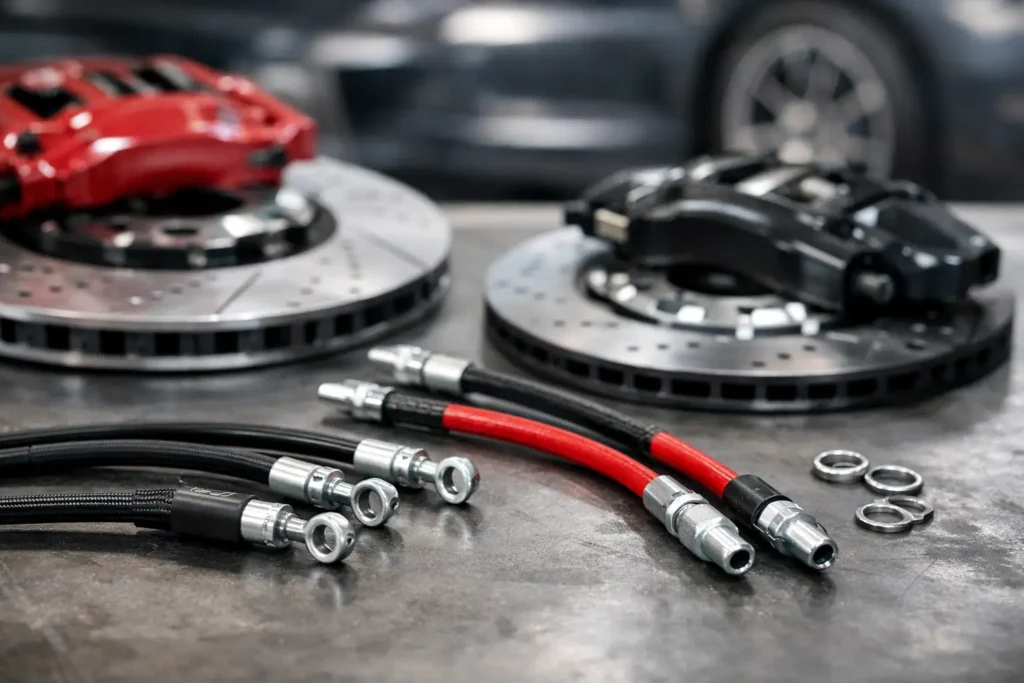
A long pedal on the road is frustrating. A long pedal at the end of a fast lap, during a drift entry or under repeated heavy braking is a confidence killer. Knowing how to choose brake lines means looking beyond the hose itself: the correct line must suit the car’s braking system, suspension movement, fluid pressure, fittings, routing and intended use.
For an OEM refresh, a quality direct-replacement hard line or flexible hose may be the right answer. For a modified street, drift or race build, a properly specified braided hose assembly can offer better protection, firmer pedal response and the flexibility needed around aftermarket calipers, master cylinders and custom routing. The key is to choose by specification, not appearance.
Start with the brake system and the job
Before selecting material or fittings, establish what you are replacing and why. A flexible hose connects the fixed hard line on the chassis to a moving caliper or axle. A hard line carries fluid along the body, bulkhead or subframe. They do different jobs and should not be treated as interchangeable.
If the car retains factory calipers, brackets and hose locations, vehicle-specific replacement hoses are normally the cleanest route. They should match the original length, mounting points and end fittings. This matters because an incorrect hose can pull tight at full steering lock or rub a wheel, tyre, damper or anti-roll bar.
Custom systems need a more measured approach. A brake upgrade may introduce a different caliper inlet thread, a banjo connection instead of a female port, or a relocated master cylinder. Measure each connection, identify the thread and seat type, then plan the route with the suspension at full droop, full compression and full lock. Never choose a brake hose length from a static car alone.
Choose brake line material for the application
The main choice is between hard line materials for fixed chassis runs and flexible hose constructions for moving sections.
Hard lines: steel, copper-nickel or stainless steel
For hard brake lines, copper-nickel is a strong option for road and performance builds. It resists corrosion far better than plain mild steel and is easier to form accurately without cracking or fighting the tube. That makes it particularly useful when fabricating new lines around a modified engine bay, hydraulic handbrake or relocated proportioning valve.
Steel line is durable and commonly used in factory systems, but it can corrode badly where road salt and moisture are present. It also requires more care when bending and flaring. Stainless steel offers excellent corrosion resistance, but its stiffness makes it harder to work with and it demands the right cutting, bending and flaring tools. A poorly formed flare is not acceptable simply because the tube material is premium.
Whatever material you use, match the tube outside diameter to the fittings, clips and flaring tool. Many passenger vehicle systems use 3/16 inch line, but do not assume that applies to every vehicle or every circuit. Measure the original line or confirm the system specification first.
Flexible hoses: rubber versus braided PTFE
Standard rubber hoses are cost-effective, quiet and suitable for normal road use when they are quality items in good condition. Their limitation is that rubber can expand slightly under high pressure and deteriorate with age, heat, contamination and repeated hard use. A swollen, cracked or soft hose is a replacement job, not a debate.
Braided PTFE hose is the usual choice for serious performance applications. The PTFE inner bore handles brake fluid well and resists expansion, while the stainless braid provides external strength and abrasion resistance. The result can be a more consistent pedal, particularly when replacing old rubber hoses. Do not expect braided lines to cure air in the system, boiling fluid, worn pads or an undersized master cylinder, but they remove one potential source of hose flex.
For road cars, choose braided brake hoses with a protective outer coating where possible. A clear, coloured or PVC-style cover helps prevent braid from trapping dirt and moisture against surrounding components, and reduces the risk of the braid chafing paint, suspension arms or bodywork. Bare stainless braid may look motorsport-focused, but the installation and inspection standard needs to be equally serious.
Select the correct fittings, threads and seat types
Brake fittings are not a place for guesswork. Metric and imperial threads can feel similar by hand while being completely incompatible. Thread pitch, sealing method and fitting angle all matter.
A brake line may use a male flare nut into a female port, a banjo fitting with sealing washers, or a specific caliper fitting. The seal may be created at an inverted flare, a bubble flare, a cone seat or through crush washers on a banjo bolt. The thread does not do the sealing on a flare connection – the flare and seat do. Forcing the wrong fitting can damage the port and create a dangerous leak.
Use the original component data where available, then verify with a thread gauge and callipers on custom work. Record the thread diameter, pitch, flare type, hose end type and fitting angle for every connection. This is especially useful on builds using mixed-brand calipers, bias valves, pedal boxes and hydraulic handbrakes.
Banjo fittings need particular care. The bolt diameter and thread must match the caliper, the banjo angle must support a natural hose route, and new correct-specification sealing washers should be fitted. Avoid stacking washers, modifying bolts or rotating a fitting into a position where the hose immediately kinks.
Get hose length and routing right
A brake hose should move freely without being loose enough to catch anything. At full steering lock and full suspension travel, it must not become taut, bend sharply, twist around its own axis or rub against a moving part. Check both sides of the axle, as steering geometry, caliper position and bracket orientation can make left and right hose requirements different.
On a front axle, inspect clearance to the tyre sidewall, wheel barrel, driveshaft, damper body and steering arm. On the rear, check the exhaust, spring, damper, trailing arms and differential movement. A line that clears in the workshop may contact a component once the car is loaded, kerbed or driven aggressively.
Use proper P-clips, brackets and bulkhead mounts to support hard lines and prevent vibration fatigue. Keep brake lines away from exhaust heat and shield them where routing near heat sources cannot be avoided. Do not secure a brake hose with cable ties as a permanent fixing, and do not allow a braided line to lie against a sharp edge because the braid looks durable. It will eventually wear through whatever it touches – or be worn through itself.
Match the specification to street, drift or race use
A fast road car benefits from reliable, road-legal components, protected braided flexi hoses and corrosion-resistant hard lines. The priority is predictable braking over years of wet-weather use, not simply the firmest possible pedal.
Drift cars place unusual demands on front hose routing due to high steering angle, frequent lock-to-lock movement and altered knuckles or suspension arms. Give the hose enough controlled slack at maximum angle, use correctly oriented fittings and inspect it after the first events. Hydraulic handbrake plumbing must also be designed as a proper brake circuit, with compatible fittings and secure line support.
Race cars need the same fundamentals, but inspection intervals are shorter and the consequences of poor routing are greater. Consider heat exposure, quick wheel changes, suspension travel, debris and service access. A motorsport-grade assembly is only as good as its installation. If a line cannot be inspected easily, it is more likely to be missed when damage starts.
Do not overlook fluid, bleeding and compliance
Brake hoses are only one part of the hydraulic system. If you are upgrading lines because of a soft pedal, inspect the fluid condition, master cylinder, caliper seals, flexi hose condition, pad knock-back and bleed procedure. Use brake fluid with a specification appropriate to the vehicle and duty cycle, and never mix fluids unless their compatibility is confirmed.
After any brake line work, pressure-test the system and inspect every joint for leaks before the vehicle returns to the road or circuit. Bleed in the manufacturer’s recommended sequence where applicable. Then recheck with the wheels turned lock-to-lock and the suspension loaded. A firm pedal with the car stationary is not proof that a hose will clear under real movement.
For UK road use, brake components and modifications must be suitable for the vehicle and capable of meeting MOT and roadworthiness requirements. Keep the work professional, retain sensible documentation for the components fitted, and use a qualified technician if you cannot identify flare standards, thread types or safe routing with certainty.
When sourcing parts for a custom build, ProSpeed Parts can help simplify the hardware side with performance-focused hose, fitting and braking component options. Still, measure first, specify every end correctly and treat the final installation as safety-critical work.
The best brake line is not the shiniest braided hose on the shelf. It is the correctly sized, correctly terminated and properly routed assembly that stays protected, leak-free and clear of moving parts every time the pedal is pressed.