

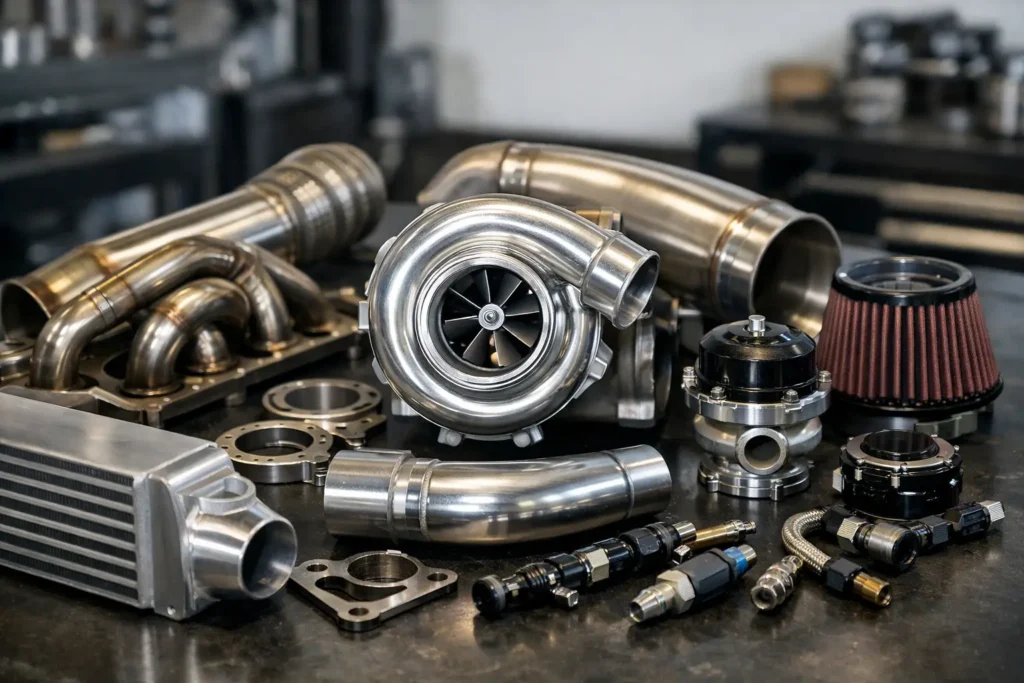
A turbocharger is rarely the part that ends a street build. More often, it is a missed oil drain detail, undersized fuel line, poor intercooler placement or a map that was never calibrated for the hardware. This street turbo build parts list example is built around the systems that keep a sensible road car responsive, reliable and serviceable – not just impressive on a dyno graph.
The right specification depends on engine capacity, compression ratio, fuel type, target power, available space and how the car is actually used. A 300 bhp daily-driven hatchback and a 600 bhp weekend saloon may both be called street builds, but they require very different turbo sizing, fuel capacity and drivetrain planning.
Set the target before buying parts
Start with a realistic power and torque target at the wheels or flywheel, then decide where in the rev range you want it. For a genuine street car, broad mid-range torque, controlled boost and good transient response generally matter more than chasing the largest possible peak number.
Also define the fuel you will run every day. Standard pump fuel, premium unleaded, E85 and race fuel require different injector sizing, pump capacity, hose compatibility and calibration strategy. Do not build around fuel that is difficult to obtain locally unless the car is intended for occasional use only.
Before ordering hard parts, check the engine’s compression health, oil pressure, cooling condition and timing system. Forced induction does not correct a tired engine. It exposes weak ring seal, marginal head gaskets, old cooling components and worn clutches quickly.
Street turbo build parts list example
This example suits a healthy 1.8 to 2.5-litre petrol engine with a realistic target of roughly 300 to 400 bhp on premium pump fuel. It is a useful baseline for a responsive road build, but it is not a universal shopping list. Confirm fitment, flow ratings and material compatibility against your exact engine and chassis.
Turbocharger and exhaust hardware
Choose a turbocharger sized for the target, not the biggest compressor wheel that fits the bay. A modern ball-bearing unit can improve response, but a correctly matched journal-bearing turbo can also deliver excellent street performance at a lower initial cost. Match turbine housing A/R to engine displacement, camshaft profile and intended rev range.
Your core hot-side package should include:
- Turbocharger with the correct flange, turbine housing and wastegate arrangement
- Exhaust manifold designed for the engine, with proper bracing and heat management
- External wastegate or reliable internal actuator, plus a suitable valve spring
- Downpipe, flex section and exhaust system sized for the expected flow
- Wastegate screamer pipe or plumb-back arrangement, depending on noise and legal requirements
- Blow-off valve or recirculation valve for stable compressor operation on throttle lift
A quality manifold is not just about flow. It must support turbo weight, tolerate repeated heat cycles and leave room for plugs, lines and servicing. Add locking fasteners where appropriate, use high-temperature gaskets, and brace the exhaust system so the manifold is not carrying the full load.
For road use, a plumbed-back wastegate and properly silenced exhaust are normally the sensible route. An open screamer may sound aggressive, but it can create avoidable noise, MOT and enforcement problems.
Charge-air system and intake
Fit a front-mounted intercooler with enough core volume and flow capacity for the power target, but avoid choosing a huge core purely for appearance. Excessive charge-pipe length and poor routing can hurt response. A correctly sized intercooler, mounted in clean airflow, is more effective than an oversized unit hidden behind a blocked bumper.
Use aluminium or stainless charge piping, quality silicone couplers and T-bolt clamps. Standard worm-drive clips can work on low boost, but they are a common source of boost leaks as pressure and temperature rise. Include a proper air filter, intake pipework that avoids drawing hot air from the engine bay, and a secure turbo inlet connection that cannot collapse under suction.
Pressure-test the completed charge system before mapping. A small leak can cause unstable boost control, rich or lean fuelling behaviour and unnecessary turbo overspeed as the controller tries to hit target pressure.
Oil feed, oil return and coolant lines
Turbo oil plumbing is a non-negotiable system, not an afterthought. The feed line must supply clean, correctly pressurised oil, while the drain must return oil to the sump without restriction. A drain that is too small, too horizontal or routed uphill can cause turbo seal problems even when the turbocharger itself is in perfect condition.
Use motorsport-grade hose and fittings rated for oil temperature, with the correct feed restrictor only if specified by the turbo manufacturer. Tap or weld the sump return above the static oil level and position it for a continuous downhill run from the turbo centre housing.
If the turbo is water-cooled, add suitably rated coolant hose, fittings and a routing plan that prevents trapped air. Heat shielding is equally important around oil and coolant lines near the turbine housing. Fire sleeve, reflective barrier and secure P-clips are inexpensive compared with replacing cooked hoses or repairing an engine bay fire.
Fuel system and engine management
Fuel delivery should be specified from injector duty cycle and expected fuel demand, with safety margin. For a 300 to 400 bhp petrol build, this commonly means larger injectors, an uprated in-tank pump or external pump arrangement, a high-flow fuel filter, suitable fuel hose and fittings, and a stable fuel pressure regulator where the original system cannot support the demand.
If the vehicle runs a return-style system, use a boost-referenced regulator and verify base pressure. For returnless systems, understand how the factory controller manages pressure before changing pumps or injectors. Incorrect assumptions here can lead to inconsistent fuelling under load.
A capable standalone or programmable ECU, such as a Link Engine Management unit where suitable, gives the tuner proper control of boost, ignition, fuel, intake temperature compensation and safety strategies. At minimum, plan for a wideband lambda sensor, intake air temperature sensor, manifold absolute pressure sensor and reliable engine speed signal. Add oil pressure and fuel pressure inputs if the ECU supports protection functions.
Never estimate a turbo map. The calibration must be completed by a tuner who understands the ECU, injectors, fuel and boost-control hardware fitted to the car. Conservative ignition timing and sensible torque management often make a quicker, more enjoyable street car than an aggressive calibration that constantly fights traction.
Cooling, drivetrain and stopping power
More power creates more heat everywhere. Check radiator capacity, fan control, thermostat condition and coolant routing before the first hard pull. An upgraded radiator and properly shrouded fans may be needed, especially where the intercooler reduces airflow through the front of the car. An oil cooler can help on cars that see repeated high-load road use, track days or drift sessions, but it must include a thermostatic solution so oil reaches operating temperature.
The clutch, gearbox, driveshafts and differential deserve the same attention as the engine. A clutch rated only just above the target torque may hold briefly but deliver poor pedal feel or short service life. If torque arrives hard in the mid-range, traction and gearbox durability can become the limiting factors before peak power does.
Do not overlook brakes and tyres. Fresh high-quality fluid, suitable pads, healthy discs and tyres with enough load and grip capacity are fundamental. Street performance means being able to stop repeatedly, drive in wet conditions and retain predictable behaviour on imperfect roads.
Build details that prevent repeat work
The strongest builds are easy to inspect and repair. Leave clearance around service items, use bulkhead fittings where lines pass through panels, support hoses and wiring at regular intervals, and label sensors, relays and connectors. Keep spare fittings, clamps and vacuum hose in the garage because small hardware is often what delays a finished installation.
Boost control lines should be short, heat-protected and secured properly. Use a dedicated vacuum manifold if several devices need a reference signal, rather than stacking multiple tees onto one ageing hose. Check all clamps after the first heat cycles, inspect fluid levels, and retorque accessible fasteners once the system has settled.
A street turbo build should feel engineered, not merely assembled. Buy the turbo that meets the target, then give it the fuel, cooling, calibration and supporting hardware it needs. The result is a car you can drive hard, take home confidently and enjoy again the next morning.