

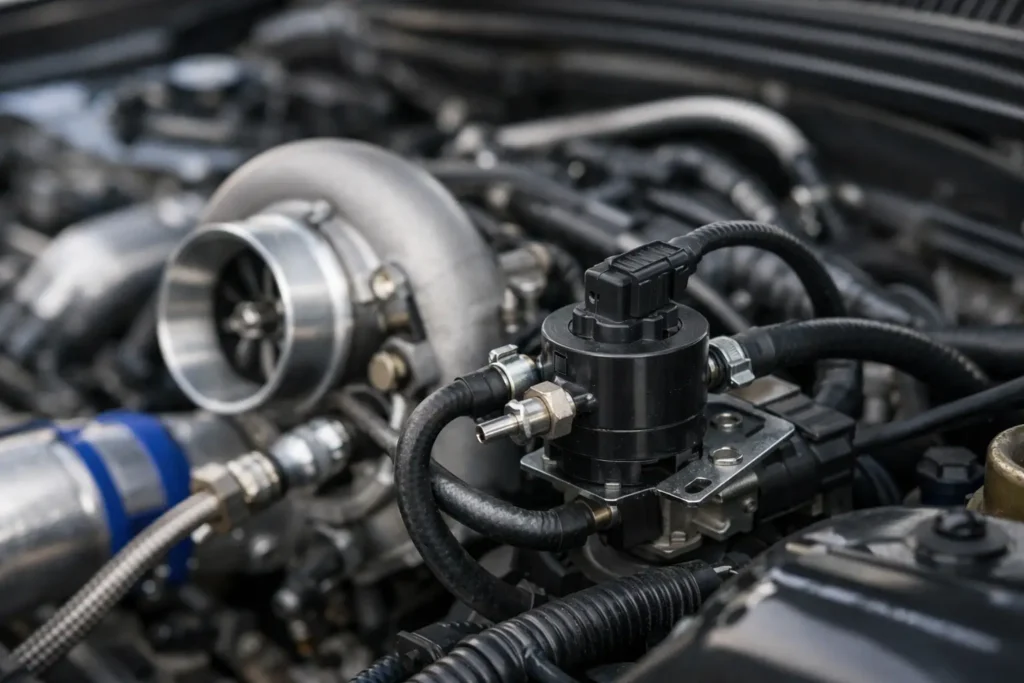
A turbo setup can have the right turbocharger, wastegate and intercooler yet still feel inconsistent if boost control is not properly managed. So, what does a boost solenoid do? It gives the ECU electronic control over the pressure signal reaching the wastegate actuator, allowing boost to be adjusted by engine speed, gear, throttle position and other calibration inputs.
For a standard road car, this may mean smoother torque and protection against overboost. On a tuned street, drift or race build, it is what allows the engine management system to deliver repeatable boost targets rather than relying on a fixed spring pressure alone.
What Does a Boost Solenoid Do?
A boost solenoid is an electrically operated valve fitted into the boost reference plumbing between the turbocharger compressor housing, wastegate actuator and, in some layouts, the intake system. The ECU pulses the solenoid on and off at high speed to control how much pressure reaches the wastegate.
The basic principle is simple. A wastegate opens when it sees enough pressure at its actuator. Once it opens, exhaust gas bypasses the turbine wheel, slowing the turbocharger and limiting boost. If the actuator receives full boost pressure directly from the compressor housing, boost is generally limited to the wastegate spring pressure.
The solenoid changes that relationship. By bleeding, diverting or routing part of the pressure signal, it can delay wastegate opening. This lets the turbocharger produce more boost than the base spring pressure. A 0.7 bar wastegate spring, for example, can be controlled to run a higher target where the turbo, fuel system, engine and calibration safely support it.
Most modern electronic boost control solenoids are either two-port or three-port designs. A two-port solenoid is commonly used as a bleed-style controller. It vents some pressure from the wastegate reference line, making the actuator see less pressure than the compressor is producing. It can work well on straightforward internal-wastegate setups, but control authority is limited.
A three-port solenoid is the more common choice for serious aftermarket installations. It actively switches pressure between ports to control the wastegate more effectively. This normally provides faster response and a wider usable boost range. External-wastegate turbo systems, high-boost applications and vehicles using standalone ECUs often benefit from a correctly configured three-port solenoid.
Why Electronic Boost Control Matters
Boost is not simply a peak number. The way it arrives matters just as much. A car that hits maximum boost too early can overwhelm tyre grip, stress the drivetrain and make throttle control difficult. That is particularly relevant for rear-wheel-drive drift cars and powerful front-wheel-drive street cars.
With a boost solenoid and a capable ECU, the tuner can shape the boost curve. Lower boost can be commanded in first and second gear, with more pressure introduced in higher gears where traction improves. Boost can also be reduced when intake air temperature rises, when coolant temperature is excessive or when fuel pressure falls outside the expected range.
This is not only about chasing maximum power. It is about making performance usable and protecting expensive components. A well-calibrated system can improve consistency from one pull to the next, particularly when track conditions, ambient temperatures and gear loading change.
Electronic control also makes launch strategies possible. A race car may use a lower boost target on the line, then increase boost as vehicle speed rises. A rolling anti-lag or traction strategy may have its own boost duty settings. These features depend on accurate sensor data, correct solenoid plumbing and a calibration that has been developed for the engine.
Duty Cycle and Boost Targets
The ECU controls a boost solenoid through duty cycle. At zero per cent duty, the solenoid is inactive. At 100 per cent duty, it is fully commanded. The actual effect depends on the solenoid type, plumbing arrangement and wastegate configuration, so duty cycle is not a universal boost setting.
More duty often means more boost, but not always in the same way across every system. A change that adds 0.2 bar on one car may do very little, or far too much, on another. Turbo size, actuator preload, exhaust back pressure, hose routing and wastegate spring rate all affect the result.
This is why boost control should be mapped using measured boost pressure, not guesswork. The ECU needs a reliable manifold absolute pressure sensor, and the vehicle should be monitored with appropriate fuelling and ignition safeguards. On a higher-output build, exhaust gas temperature, fuel pressure and intake temperature data add another useful layer of protection.
Boost Solenoid vs Manual Boost Controller
A manual boost controller uses a mechanical ball-and-spring or bleed arrangement to alter the signal going to the wastegate. It is inexpensive, simple and can suit a basic setup where one stable boost level is all that is required.
Its limitation is that it cannot react to changing conditions. It cannot pull boost in low gears, reduce pressure for high intake temperatures or compensate for a boost drop at higher engine speed. It also cannot integrate with ECU safety strategies.
An electronic boost solenoid costs more and needs proper wiring, vacuum hose routing and ECU configuration. However, it offers much greater control. For a modified turbo car already running aftermarket engine management, it is usually the sensible route. The extra calibration work is worthwhile when the goal is reliable power delivery rather than a single headline boost figure.
Correct Plumbing Is Critical
A boost solenoid can only control accurately if the reference lines are installed correctly. Use heat-resistant vacuum hose of the right internal diameter, keep runs as short as practical and secure every connection with suitable clamps or cable ties. A loose hose, split line or blocked solenoid port can cause unstable boost, boost creep or sudden overboost.
The pressure source should normally be taken from a clean compressor housing reference port or a dedicated boost source, depending on the wastegate and turbo system design. Do not copy a generic hose diagram without checking the solenoid manufacturer’s port markings and your wastegate’s operating requirements. Ports labelled COM, NO and NC must be connected according to the intended control strategy.
Mounting location matters too. Keep the solenoid away from extreme turbine heat and avoid locations where hoses can melt, kink or rub through. On competition cars, protect the wiring loom from vibration and heat, and ensure the connector is accessible for inspection.
For twin-scroll, twin-turbo or dual-wastegate systems, plumbing becomes more involved. Some engines require separate control of each wastegate, while others use a shared strategy. The correct answer depends on the turbo configuration, manifold design and ECU outputs available.
Common Boost Solenoid Fault Symptoms
When boost control starts behaving unpredictably, the solenoid and its plumbing should be checked early. A failed solenoid does not always stop the car from running, but it can leave the engine on wastegate spring pressure or allow boost to rise beyond the target.
Typical symptoms include boost that is lower than expected, boost spikes, oscillation around the target, inconsistent performance between runs and fault codes relating to boost control circuits. A clicking solenoid is not automatically a healthy solenoid, but a silent unit may indicate a wiring, ECU output or coil issue.
Start with the basics. Pressure-test the reference hoses, inspect fittings, confirm the wastegate moves freely and verify the solenoid wiring polarity and connector condition. Then confirm the ECU is commanding the expected duty cycle. If the hardware checks out, the issue may be in the boost control table, target map or safety limits within the calibration.
Do not attempt to cure boost creep by simply reducing duty cycle. Boost creep occurs when the wastegate cannot bypass enough exhaust gas, often because of an undersized internal wastegate port, restrictive turbine housing geometry or excessive exhaust flow. That is a mechanical control problem, not always an electronic one.
Choosing the Right Solenoid for Your Build
Choose a solenoid that is compatible with your ECU, intended pressure range and plumbing strategy. Check coil resistance, connector type, port size, response speed and whether the manufacturer specifies it for bleed or interrupt control. A quality motorsport solenoid is a small component, but it sits at the centre of a system that can determine engine reliability.
For a mild internally wastegated street car, a two-port setup may be enough. For external wastegates, standalone management, flex-fuel tuning or competition use, a three-port solenoid is typically the stronger option. Four-port solenoids can offer greater control in certain external-wastegate applications, though they add plumbing complexity and must be mapped correctly.
Match the hardware to the build, use motorsport-grade hose and fittings, and give the calibration the same attention as the turbo hardware. When boost is controlled properly, the car is faster where it counts: predictable on the road, manageable at the limit and repeatable every time it comes on boost.