

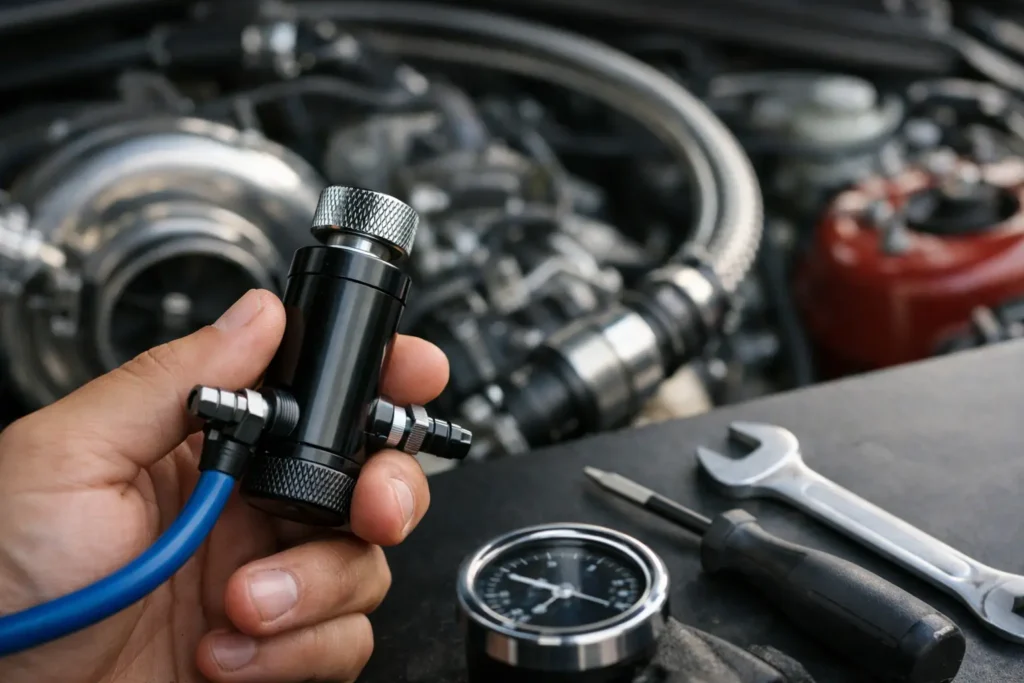
A turbo car that spikes, creeps, or feels flat in the mid-range usually does not need guesswork. It needs a proper manual boost controller setup. Get the plumbing wrong, preload it too far, or try to mask a weak wastegate spring, and you can turn a simple turbo control upgrade into an expensive lesson.
A manual controller is still a solid option when you want straightforward boost adjustment without adding electronic control. On drift builds, fast road cars, track day projects, and older turbo setups, it gives you direct control with minimal hardware. The catch is that simple does not mean foolproof. The result depends on the wastegate spring, the turbo, the boost reference source, the hose routing, and how disciplined you are with adjustment.
What a manual boost controller setup actually does
A manual boost controller sits in the pressure signal line between the compressor housing or boost source and the wastegate actuator. Its job is to delay or bleed off the pressure signal so the wastegate stays shut longer. That lets the turbo build more boost before the actuator opens the gate.
In practical terms, you are not creating boost. You are managing when the wastegate sees enough pressure to start opening. That is why the base mechanical setup matters so much. If the actuator spring is too soft, the turbo is too small, the exhaust backpressure is excessive, or the wastegate flow is poor, the controller cannot fix the underlying limitation.
This is also where many people get caught out. They fit a manual controller expecting precise, ECU-like boost targeting. What they get is a useful but mechanical device with some variation depending on gear, load, ambient conditions, and exhaust setup. For many builds that is perfectly acceptable. For others, especially where consistency is critical, an electronic controller may be the better tool.
Choose the right controller and hardware first
Not all manual controllers behave the same. A basic bleed valve is cheap and simple, but it tends to offer less stable control and can be more sensitive to conditions. A ball-and-spring style controller is generally the better choice for performance use because it holds the wastegate shut more positively and usually gives sharper spool with more repeatable behaviour.
The rest of the hardware matters just as much. Use proper boost-rated vacuum hose, secure clamps where needed, and quality fittings that will not split, leak, or soften near heat. If you are routing lines close to the manifold or turbine housing, heat protection is not optional. A controller is only as reliable as the hose and fittings around it.
If you are building a car properly, this is where a specialist stockist earns its keep. Matching the controller, fittings, hose size, tees, reducers, and clamps in one order saves time and avoids the usual patchwork install.
Manual boost controller setup for internal and external wastegates
The core principle is similar on both systems, but the plumbing can differ.
On a basic internal wastegate turbo, the controller usually goes in line between the compressor housing pressure nipple and the actuator. Keep the hose run short and clean. The more unnecessary length and extra joins you add, the more chance there is for delay, leaks, or inconsistent signal.
On an external wastegate with a boost control port arrangement, you need to know whether you are controlling the lower port only or working with a more advanced top-and-bottom port strategy. For a manual controller setup, most simple street and track applications use the lower port reference only. If you do not understand the gate port configuration, stop and verify it before applying pressure to the wrong side of the diaphragm.
Do not take the boost reference from a poor source. The best signal is normally from the compressor housing or a dedicated boost source close to it. Pulling the signal from a long manifold line shared with other devices can introduce noise and delay.
Start with wastegate spring pressure, not target boost
The safest way to set up a manual controller is to begin with the controller backed right off, or at its minimum setting, so the actuator sees near-base pressure. Then make a run and confirm what boost the car produces on spring pressure alone.
That number matters because it is your foundation. If your wastegate spring is 0.7 bar, do not expect the car to hold 1.5 bar cleanly everywhere just because the controller can be wound in further. On many setups, especially with internal gates, asking for too much above spring pressure leads to boost creep, unstable control, or poor repeatability.
A sensible rule is to increase in small steps and log every change. A quarter turn can be the difference between safe and excessive on some controllers. If the car does not have reliable boost monitoring, stop there and fit a proper gauge or use ECU logging. Tuning boost by feel is how engines get hurt.
The adjustment process
Make adjustments only when the car is mechanically healthy and already fuelling and igniting correctly for forced induction. Boost control is not a substitute for calibration.
Start with a full check for leaks, damaged hoses, weak clips, and actuator preload issues. If the wastegate arm has excessive preload, the base boost may already be higher than expected. If there is no preload at all, control can be lazy. You want the actuator adjusted to the turbo manufacturer or actuator manufacturer’s specification, not whatever looked right during installation.
With the controller at minimum, do a controlled pull in a suitable gear and watch boost carefully. Confirm the base figure. Then add a very small amount of adjustment and repeat under the same conditions. If boost rises cleanly and predictably, continue in small increments until you reach your safe target.
If the boost jumps suddenly, spikes hard before settling, or overshoots the target and stays there, back the controller off immediately. That usually points to either an aggressive setting, poor hose routing, a weak control source, or a mismatch between the controller and the wastegate behaviour.
Keep conditions consistent while setting up. A third-gear pull on a cool evening will not always match a fourth-gear pull on a warm day. Chasing the same number in every condition with a manual controller can lead you into over-adjustment.
Common problems and what they usually mean
Boost spike is the classic complaint. The turbo overshoots before the wastegate catches up. This can happen with over-tight controller adjustment, poor routing, long hoses, or a gate that simply reacts too slowly for the turbo and exhaust setup.
Boost creep is different. That is when boost continues to rise with rpm even though the wastegate should be controlling it. A manual controller usually does not cause creep by itself. More often it exposes an airflow or wastegate flow limitation. Small internal gates, restrictive turbine housings, and high-flow exhaust setups can all contribute.
If boost is lower than expected, look for leaks first. Then check the controller orientation, hose connections, wastegate preload, and whether the boost reference is strong enough. Some installs are wrong in very ordinary ways – reversed ports, split hose ends, loose push-fit connections, or a controller mounted where heat has cooked the internals.
If the boost varies by gear, some variation is normal on a manual system, but large differences suggest the setup is reaching the edge of what a basic controller can manage. That is common on high-torque turbo cars where load changes quickly.
Where a manual controller makes sense – and where it does not
For many street, drift, and club-level track cars, a manual boost controller is still a practical upgrade. It is compact, affordable, easy to understand, and fast to install. If your goal is a modest increase over spring pressure with straightforward adjustment, it does the job well.
It becomes less ideal when you need multiple boost maps, gear-based control, scramble boost, closed-loop correction, or consistent target pressure across varying conditions. That is where electronic control earns its price. There is no shame in admitting the setup has outgrown a manual device. The right part is the one that matches the build.
The same logic applies to engine safety. If the engine is near its limit on fuel system, charge temperature, or ignition timing, adding more manual boost is not tuning. It is risk. The controller should sit inside a package that already includes adequate fuelling, intercooling, monitoring, and calibration.
Final checks before you call it done
Once the target boost is set, inspect everything again after a few heat cycles. Recheck hose condition, fitting tightness, and controller mounting. Make sure the adjuster cannot move from vibration. Confirm boost remains stable in the gears and load ranges the car actually uses, not just in one quick test pull.
A clean manual boost controller setup is about control, not bravado. If the car makes the power you want, repeats it reliably, and stays inside safe limits, stop winding it in. Fast cars are built on stable systems, and the smartest boost setting is usually the one that leaves a margin for the next hard session.