

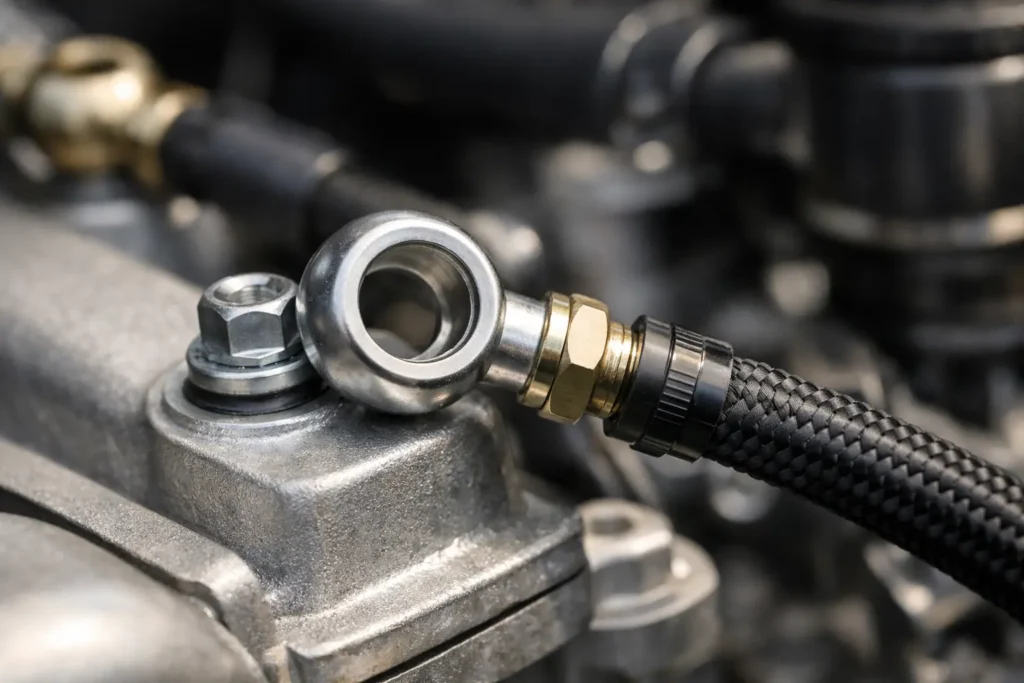
If your fuel system packaging is tight and a straight or swept hose end simply will not clear the rail, bulkhead or manifold, a banjo fitting for fuel line routing can solve the problem neatly. It is a compact, proven solution used across performance road cars, drift builds and race applications, but only when the sizing, sealing and material are right.
What a banjo fitting for fuel line does
A banjo fitting is built around two parts – the banjo eye and the hollow bolt. Fuel passes through the bolt, into the circular eye, and out through the connected hose or adaptor. The whole point is packaging. You get a low-profile connection that can turn the line without the height of a conventional straight fitting and without forcing a tight hose bend straight off the component.
That matters on modern engine bays where fuel rails sit close to intake manifolds, throttle bodies, brake master cylinders or turbo hardware. On a custom build, millimetres matter. A banjo can create the clearance you need while keeping the line path clean and reducing stress on the hose.
Why builders use banjo fittings
The biggest advantage is space efficiency. If you are routing a feed or return line in a cramped area, a banjo arrangement often gives you the angle change you need without stacking extra adaptors. Fewer stacked parts can mean fewer leak points and a tidier result.
There is also the benefit of orientation. Depending on the design, you can clock the fitting to suit the run before tightening it down. That can help on fuel pressure regulators, pumps and rails where the ideal hose direction is dictated by the chassis or other engine bay hardware.
The trade-off is that banjo fittings are not always the highest-flow answer. On a modest street setup, that may be irrelevant. On a high-horsepower build running heavy ethanol content, twin pumps or very high injector demand, fitting choice should be based on the actual internal bore and restriction through the bolt, not just the outside thread size.
Where a banjo fitting makes sense
Banjo fittings are commonly used where a conventional hose end would sit too tall or point the hose into trouble. Fuel rails are an obvious example, especially transverse engine conversions or tight longitudinal turbo setups. Regulators and filters can also benefit where you need a sharp change of direction close to a mounting bracket or inner wing.
They also work well in motorsport where serviceability matters. A compact connection that clears surrounding hardware can make the difference between a line that is protected properly and one that rubs through because there was no room to route it correctly.
That said, if there is plenty of room for a full-flow AN hose end and the application is fuel-hungry, a banjo is not automatically the better choice. Compact does not always mean ideal.
Sizing and thread choice matter more than the shape
This is where many fuel system issues start. Buyers see the banjo form and assume the rest is straightforward. It is not. You need to match the thread on the component, the banjo bolt specification, the hose or adaptor size, and the fuel type.
Metric threads are common on OEM rails, pumps and regulators. BSP and NPT appear in some specialist components, while AN-based systems often use adaptors to bridge from the component thread to the rest of the line. A banjo bolt that almost fits is useless, and forcing a thread is a fast way to damage an expensive rail or regulator body.
You also need to think about line size honestly. A compact fitting on a return line may be perfectly fine. On the main feed of a high-output turbo build, especially on E85, you need to consider the true flow path through the bolt and eye. The headline hose size does not tell the full story.
Banjo bolt diameter and internal passage
A larger bolt does not always mean an unrestricted path, but it often helps. Different manufacturers machine different internal passages, and the cross-drilled holes in the bolt can become the limiting point. If your setup is sensitive to pressure drop, look at the actual dimensions rather than buying on appearance alone.
Hose connection style
Some banjo fittings terminate in a hose barb, others in an AN male or female end. For modern performance fuel systems, AN-style connections are often the cleaner option because they integrate properly with PTFE or braided hose assemblies. Hose barbs can still be suitable on lower-pressure sections or OEM-style systems, but for custom high-performance use, consistency across the fuel system usually makes future changes easier.
Sealing is critical
A banjo fitting seals with washers, typically copper or aluminium crush washers, placed either side of the banjo eye. Reusing old washers is false economy. If you are rebuilding the system, fit fresh sealing washers and make sure the mating faces are clean, flat and free from damage.
Over-tightening does not fix poor sealing. It can distort the washers, damage the bolt or crack a component if the material is weak. Under-tightening obviously invites leaks. The correct torque matters, and if the fitting manufacturer provides a figure, use it.
Fuel leaks in a performance engine bay are not a minor nuisance. Add exhaust heat, turbo heat and electrical load and the risk is obvious. Treat every sealing surface as critical.
Material choice and fuel compatibility
Not every fitting is suitable for every fuel. Petrol compatibility is one thing. Ethanol blends are another. If the car runs E5 or E10 occasionally, many quality fittings will cope without drama. If it is a dedicated ethanol setup or sees long-term exposure to aggressive fuels, material specification and seal compatibility need closer attention.
Aluminium banjo fittings are common because they are light and practical, but quality varies. Poorly machined low-grade fittings are a bad gamble on any fluid system, especially fuel. Stainless options can offer extra durability, though they may add cost and weight. The right answer depends on the application, service intervals and how hard the car is used.
For race and drift cars that get stripped, checked and updated regularly, premium hardware pays for itself in reliability. For a fast road build, good-quality aluminium from a proper performance supplier is often the sensible balance.
Installation mistakes to avoid
The most common mistake is chasing packaging while ignoring service access. A banjo fitting may clear the manifold perfectly, but if you cannot get a spanner on it once the car is assembled, future maintenance becomes a headache.
Another issue is line twist. Because banjo fittings often solve awkward routing problems, installers sometimes force the hose to meet the fitting rather than building the hose to suit the route. That puts load into the connection and can shorten hose life. The line should sit naturally, with enough clearance from heat and moving parts.
Washer placement sounds basic, but it still catches people out. One washer goes between the bolt head and banjo, the other between the banjo and the component face. Miss one, stack the wrong size, or use damaged washers, and leaks follow.
Finally, pressure test before the car goes into service. A visual check after tightening is not enough. Prime the system, inspect every joint, and check again once the engine has run and heat-cycled.
When a banjo fitting is the wrong choice
There are times when you should skip it. If maximum flow is the priority and you have room for a larger full-flow hose end, that may be the better route. If the component thread is awkward and requires multiple adaptors before you even reach the banjo, the packaging gain can disappear quickly.
It can also be the wrong answer if the fitting will sit near major heat and the hose path still ends up compromised. A banjo does not magically fix poor routing. It is one tool in the system, not a cure for bad planning.
Choosing the right part for a performance build
For a street, drift or race car, the right banjo fitting comes down to four things – thread, line size, fuel compatibility and available space. Get those right and the fitting does exactly what it should: compact routing, proper sealing and dependable service. Get one of them wrong and you create restriction, leaks or constant fitment headaches.
This is why serious builders buy by specification, not by guesswork. Check the thread on the rail, regulator or pump. Confirm the bolt size. Match the fitting to the hose system you are already using. Then think honestly about fuel demand, not just current power but where the build is heading.
A good banjo fitting for fuel line use is not about fashion or copying another engine bay. It is about solving a packaging problem without compromising safety or flow. If the part matches the application, it is a smart piece of hardware. If it does not, no amount of tightening will turn it into one.
When you are building a fuel system, the small parts decide whether the whole setup feels professional – and this is one of those parts worth getting right first time.