

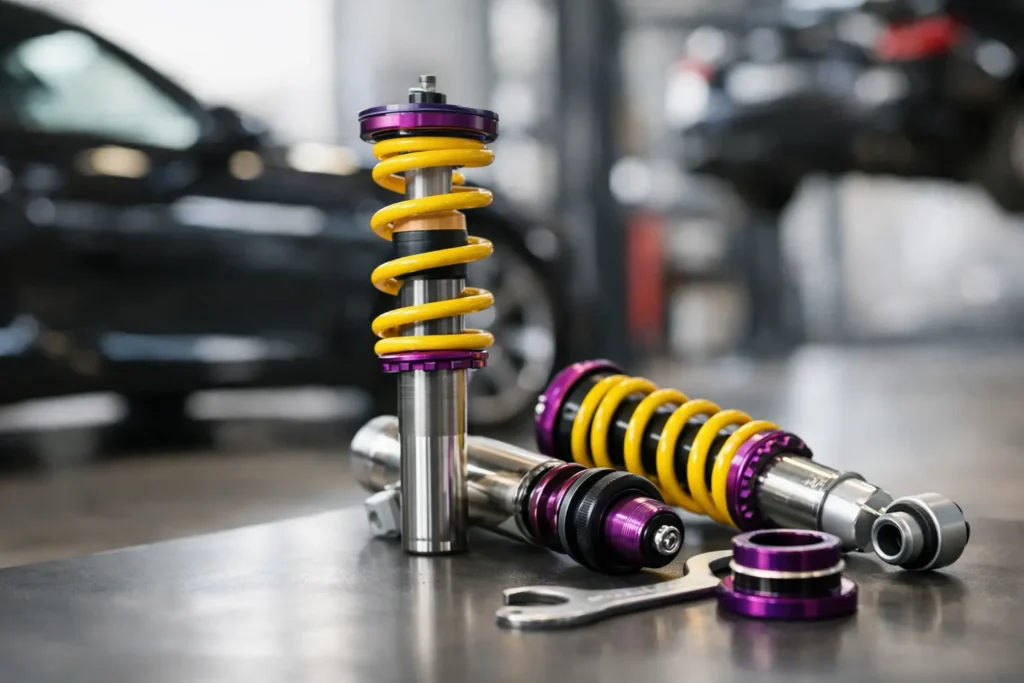
A proper KW suspension review starts with the question most buyers actually care about: will the car be better to drive, or simply lower and firmer? On the right application, KW coilovers deliver far more than ride-height adjustment. They give a road, drift or track build a controlled chassis platform, useful damper tuning and a level of finish that explains their position above budget coilover kits. They are not, however, a universal shortcut to faster lap times or a comfortable daily driver. Specification, setup and intended use decide the result.
For performance cars that need to work hard without becoming unpleasant on British roads, KW has earned its reputation through sensible spring and damper calibration rather than headline-low ride heights. That distinction matters. A coilover kit is only as good as its ability to keep the tyre loaded and the chassis predictable over cambers, broken tarmac and kerbs.
KW suspension review: build quality and design
KW’s core appeal is engineering consistency. Many of its road-focused kits use corrosion-resistant inox-line stainless-steel strut bodies, which is a serious benefit for cars exposed to wet roads, salt and year-round use. The threaded adjustment range remains usable for longer than it typically does on low-cost plated-steel coilovers, where seized collars can turn a straightforward height change into a workshop job.
The finish is purposeful rather than cosmetic. Springs, adjustable collars, bump stops and top-mount arrangements are selected around the specific vehicle platform, not simply pulled from a generic parts bin. That vehicle-specific approach is why a well-chosen KW kit often feels composed rather than overdamped.
It is still vital to check the exact application. Not every kit uses identical materials, top mounts or damper architecture, and the supplied components vary by car. Some applications retain original top mounts, while others are designed around included mounts or motorsport-oriented camber plates. Read the fitment details before ordering, especially on cars with electronic damping, adaptive chassis control or unusual axle-load requirements.
The KW range explained
The correct version matters more than the badge on the box. Buying additional adjustment you will never use is unnecessary, but fitting a basic kit to a car that spends weekends on circuit can be equally limiting.
Variant 1
KW Variant 1 is the entry point for drivers who want a fixed damper setup with adjustable ride height. The damping is pre-set by KW for the platform, so there is no rebound or compression dial to chase. That makes V1 a strong choice for a fast-road car where the owner wants improved control, a clean stance and less complication.
For many street builds, fixed damping is a positive. The manufacturer has already selected the working range, leaving the installer to set ride height correctly and carry out a proper alignment. The trade-off is clear: if your tyres, aero, track use or driving style demand a different damper balance, there is no external adjustment available.
Variant 2 and Variant 3
Variant 2 adds rebound adjustment. This gives the driver scope to influence how quickly the damper extends after compression, helping refine body control and response without changing the spring rate. It is useful for an enthusiast who is willing to test settings methodically rather than turn every click to maximum stiffness.
Variant 3 is where KW becomes especially compelling for mixed road-and-track cars. It provides independently adjustable rebound and compression damping, allowing far more precise control over transient response, pitch, roll and kerb behaviour. A V3-equipped car can be set up to support hard braking and rapid direction changes without automatically becoming harsh over poor surfaces.
That does not mean V3 is always the better purchase. More adjustment creates more opportunity to make the car worse. If the alignment is poor, bushes are worn or the ride height has pushed suspension arms outside their useful geometry range, damper clicks will not fix the underlying issue.
Clubsport and DDC
KW Clubsport systems sit closer to dedicated track use. Depending on the application, they combine adjustable damping with motorsport-spec top mounts and geometry adjustment. For a car on sticky tyres, with upgraded brakes and regular circuit work, that extra camber control can be more valuable than lowering the car another 10 mm.
The compromise is road refinement. Spherical-bearing top mounts transmit more noise and vibration than original rubber mounts, and aggressive geometry settings increase tyre wear on everyday mileage. A Clubsport kit makes sense when lap consistency and steering precision are genuine priorities, not because the car visits a track day once a year.
KW DDC is the answer for drivers who want coilover ride-height adjustment while retaining, or adding, electronically controlled damping on compatible vehicles. It suits modern fast-road cars particularly well, but fitment and electronic compatibility must be verified carefully. Treat DDC as an integrated system, not a simple suspension swap.
How KW coilovers feel on the road
The most convincing aspect of a correctly installed KW setup is usually body control. Turn-in feels more immediate, float through faster bends is reduced and the car settles sooner after a crest, compression or steering input. The aim is not to eliminate movement altogether. A fast car needs suspension travel to deal with real roads.
On typical UK tarmac, a sensible ride height and damper setting will often feel firmer but more controlled than tired original suspension. The difference is especially noticeable on performance cars with ageing factory dampers, where fresh coilovers restore confidence under braking and through uneven corners.
The ride can become poor when the installation chases appearance over function. Excessive lowering reduces bump travel, risks contact between tyres and bodywork, alters roll-centre behaviour and can place driveshafts or control arms at unfavourable angles. A car that crashes over every pothole is not necessarily set up for performance. It may simply be out of travel.
Tyre choice also changes the result. A low-profile tyre with a stiff sidewall, high pressures and a firm damper setting can make even a quality coilover feel unforgiving. Evaluate the whole package before blaming the suspension.
Setup is where the performance comes from
Installing KW suspension is not the final step. It is the start of chassis setup. Set the car at a functional ride height, allow the springs to settle, then have the alignment checked with the vehicle at its intended running height. Camber, toe and corner balance should suit the way the car is used.
For road use, avoid extreme negative camber and aggressive toe settings just because they look serious on an alignment printout. They can cause rapid inner-edge tyre wear and make the car nervous under braking or on rutted roads. For track use, more negative camber may be justified, but it should be supported by tyre-temperature readings, driver feedback and repeatable lap performance.
Where damping is adjustable, begin near KW’s supplied baseline. Change one axle or one adjustment at a time, make small moves and test on the same route or circuit section. If the car skips across bumps, loses rear traction on exit or becomes busy over surface changes, stiffer is not automatically better.
A workshop should also inspect drop links, top mounts, control-arm bushes, wheel bearings and tyres before fitting the kit. Fresh coilovers will reveal weaknesses in the rest of the chassis quickly.
Is KW worth the money?
KW suspension is rarely the cheapest route to a lowered car, and that is not its purpose. The price reflects vehicle-specific development, materials, damper quality and the ability to choose a level of adjustment that matches the build. For a serious road car, V1 or V2 can be a smart long-term investment. For dual-duty cars, V3 is often the sweet spot. For regular circuit work, Clubsport may justify its compromises.
Budget coilovers can make sense on a low-mileage styling build or a project with limited spend, but they frequently ask the buyer to accept less corrosion resistance, less refined damping and a narrower usable setup window. If the car sees fast B-roads, drift events, track days or long road miles, the difference becomes easier to justify.
ProSpeed Parts customers building street, drift and race cars should select KW by application first, then by adjustment level. Confirm axle loads, drivetrain configuration, wheel and tyre clearance, electronic-damper compatibility and the ride height you can actually run. Choose the kit that supports the car you drive, then give it the alignment and testing time that quality suspension deserves.