

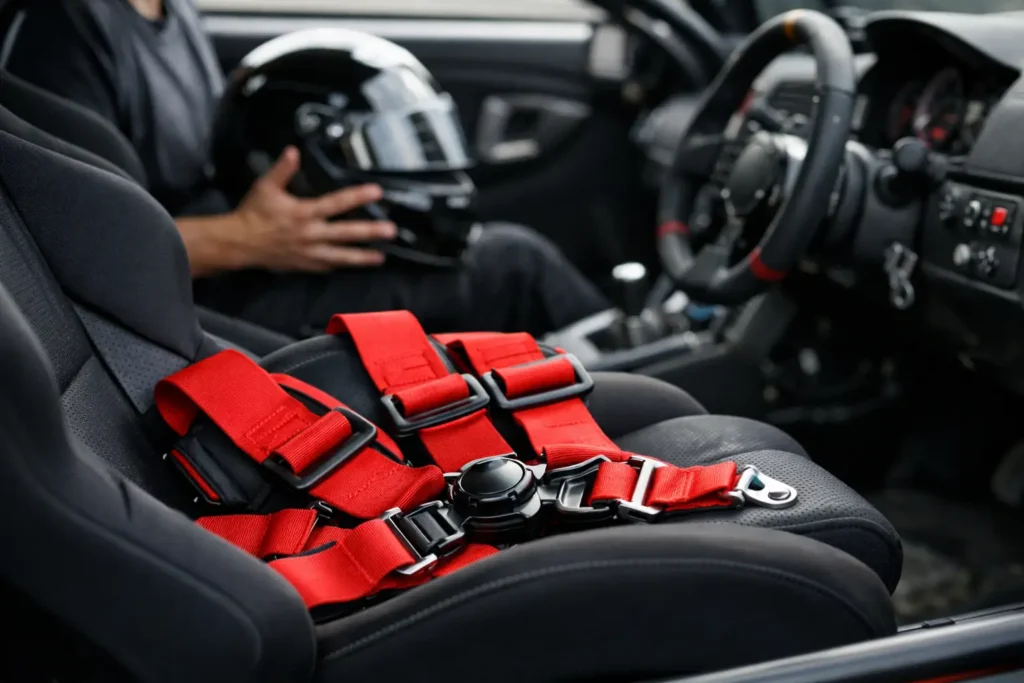
A racing harness is not a styling accessory or a universal upgrade. It is part of the restraint system that has to work with the seat, roll structure, mounting points, helmet and the type of driving you actually do. Knowing how to select racing harness equipment starts with an honest look at the car and the regulations, not the colour of the webbing.
For a drift car, track-day build or competition car, the wrong harness can create poor belt geometry, interfere with seat access or fail scrutineering. For a road-driven project, it may also be unsuitable for normal road use. Choose the restraint system as carefully as you would brakes, suspension or fuel-system hardware.
Start with the car’s real job
A harness that suits a dedicated circuit car may be a poor choice for a car driven to work, used on occasional road trips or shared by multiple drivers. Competition harnesses hold the driver firmly in the seat, which is the point, but that restriction makes shoulder checks, reaching controls and day-to-day driving less practical.
Before buying, establish whether the car is for road use, track days, drifting, sprinting, rallying or regulated race competition. Then check the rules of the organiser or championship. Some events require current FIA approval; others accept different approvals or have specific requirements for mounting, buckle type, number of mounting points and expiry dates. A harness can be genuine, high quality and still be ineligible for your class.
If the car will see both road and circuit miles, do not assume a competition harness replaces the factory three-point belt. Retain and use the original restraint system where legal and appropriate. Road legality varies by vehicle, modification and local regulation, so check the requirements before committing to a fixed-back seat and harness installation.
Choose the right number of mounting points
The number on the harness describes how the occupant is restrained, but more points are not automatically better. The layout needs to suit the seat, mounting structure and intended safety equipment.
A four-point harness uses two shoulder straps and two lap straps. It can be suitable in certain applications, but it must be designed to control submarining, where the body moves beneath the lap belt in a heavy impact. Do not treat a basic four-point harness as interchangeable with a five- or six-point system.
A five-point harness adds one anti-submarine strap. A six-point harness uses two anti-submarine straps and is common in serious track and race installations, particularly with a fixed-back competition seat. The twin straps support better positioning of the lap belt and spread the load more effectively. For a car that will be driven hard on circuit with a helmet and HANS device, a six-point system is often the sensible starting point, provided the seat and chassis installation support it.
The seat matters as much as the harness. It needs correctly positioned shoulder openings and a base designed for the chosen crotch-strap layout. Never route straps around foam, through improvised cuts or over sharp seat-shell edges. A harness and seat should be selected as a matched system, not as separate cosmetic upgrades.
Check approval before choosing a racing harness
For competition use, examine the label before the product description. FIA-approved harnesses carry a certification label showing the standard and manufacturing information. Your governing body may set a validity window based on that label, so a discounted older harness can be false economy if it is near the end of its eligible competition life.
Approval is not a guarantee that every installation is safe. It confirms the harness was built to a particular standard. Correct mounting, belt routing, adjustment and compatibility with the seat and head-and-neck restraint remain the installer’s responsibility.
Also check whether your event requires a specific buckle release, webbing width or shoulder-belt construction. Three-inch webbing remains common, while two-inch shoulder straps are often preferred with HANS devices because they sit more cleanly on the restraint’s yokes. There is no universal answer: follow the harness manufacturer’s instructions and the approval requirements for your event.
Build the mounting plan before ordering
This is where many otherwise well-specced builds go wrong. A harness must mount to reinforced, approved points on the chassis, a properly designed harness bar or a roll cage structure. It must not be attached to a thin floor section, an unreinforced rear panel, a seat rail or a random bracket fabricated because it was convenient.
Shoulder straps should leave the seat openings and run rearwards at the angle specified by the harness manufacturer. Excessive downward angle can increase compression loading in a frontal impact. Straps should also run straight and avoid rubbing on seat edges, roll-cage tubes or interior trim. If a harness wraps around a bar, use a bar and wrap configuration approved for that purpose, with correct webbing length and anti-slip arrangement.
Lap belts need to pull down and back across the strongest part of the pelvis, not across the stomach. Their mounting points must allow that position without the webbing folding, twisting or passing over the seat side bolster. Anti-submarine straps need a clear, correct route through the seat base and to their designated anchorage points.
There are several common attachment styles: bolt-in fittings, clip-in fittings and wrap-around shoulder straps. Bolt-in systems can be neat and permanent when installed into correctly reinforced points. Clip-in fittings make removal easier, but require compatible eye bolts and should never be clipped to unknown hardware. Wrap-around shoulders are popular with cage-equipped cars, but demand accurate bar diameter, placement and wrapping. Buy the attachment style for the car you have, not for a future cage plan that may never happen.
Match the harness to the driver and seat
Harnesses are adjustable, but adjustment range does not remove fitment requirements. A compact driver in a deep race seat and a taller driver in the same seat may need different strap lengths, mounting positions or seat placements. Check that the adjusters can be reached and tightened once seated, and that there is enough tail length without leaving excessive loose webbing.
Pull-up and pull-down lap adjusters are another practical choice. Pull-up adjusters can be easier to use in some low-sided seats, while pull-down adjusters may suit others. Test access with the driver in full kit, including race suit, gloves and helmet where relevant. A harness that is difficult to tighten properly will be left loose, which defeats its purpose.
The buckle should sit centrally and be easy to operate without fouling the seat, tunnel, handbrake or seat-mounted controls. Avoid fitting a harness purely around the needs of one driver if the car is used by a team. In that case, allow enough adjustment range and make sure every regular driver can achieve the correct belt path.
Consider HANS compatibility and head protection
If you use a frontal head restraint, select shoulder belts designed to work with it and confirm the width, shape and spacing meet the device manufacturer’s guidance. A HANS device, helmet, seat wings and shoulder belts all occupy the same critical area. Poor compatibility can cause straps to sit off the device, migrate towards the neck or fail to retain the driver as intended.
The headrest and seat shell also need attention. High-side containment seats can offer valuable lateral support in drift and circuit use, but the shoulder openings must still align with the driver. Sitting too low or too far forward can put the belt paths outside their designed range. Set seat position first, then finalise harness routing.
Do not ignore webbing condition and service life
Harness webbing is safety equipment. UV exposure, fuel vapour, oil, cleaning chemicals, abrasion and repeated loading all take a toll. Inspect the straps before every event for fading, cuts, frayed edges, stiff sections, contamination and damaged stitching. Check adjusters, snap hooks, eye bolts and buckle operation at the same time.
Never dye, paint, bleach or repair webbing. Do not run it through sharp-edged openings or allow it to rub against a cage tube without the required protection and routing. Replace a harness after a significant impact, if the manufacturer directs replacement, or when its competition validity expires.
A good installation should make inspection easy. If the straps disappear behind panels or are trapped beneath trim, problems remain hidden until the worst possible moment. Keep the system accessible and follow the supplied fitting instructions exactly.
Buy the complete system, not just the belts
Budget for the harness, compatible seat, approved mounts, eye bolts or backing plates where required, harness bar or cage work, and professional installation if you are not experienced with safety-critical fabrication. The cheapest route is often buying a harness first and attempting to make it fit later. That approach regularly leads to compromised angles, unsuitable mounting or spending twice.
ProSpeed Parts can help performance builders source motorsport-grade safety hardware alongside the seat, brackets and supporting components needed for a properly planned installation. Confirm every specification before ordering, especially approval standard, attachment type and seat compatibility.
The right harness should disappear once tightened: no twisted webbing, no awkward buckle position, no uncertain mounting and no compromise in belt geometry. If any part of the system feels improvised, stop the build there and correct it before the car reaches the start line.