

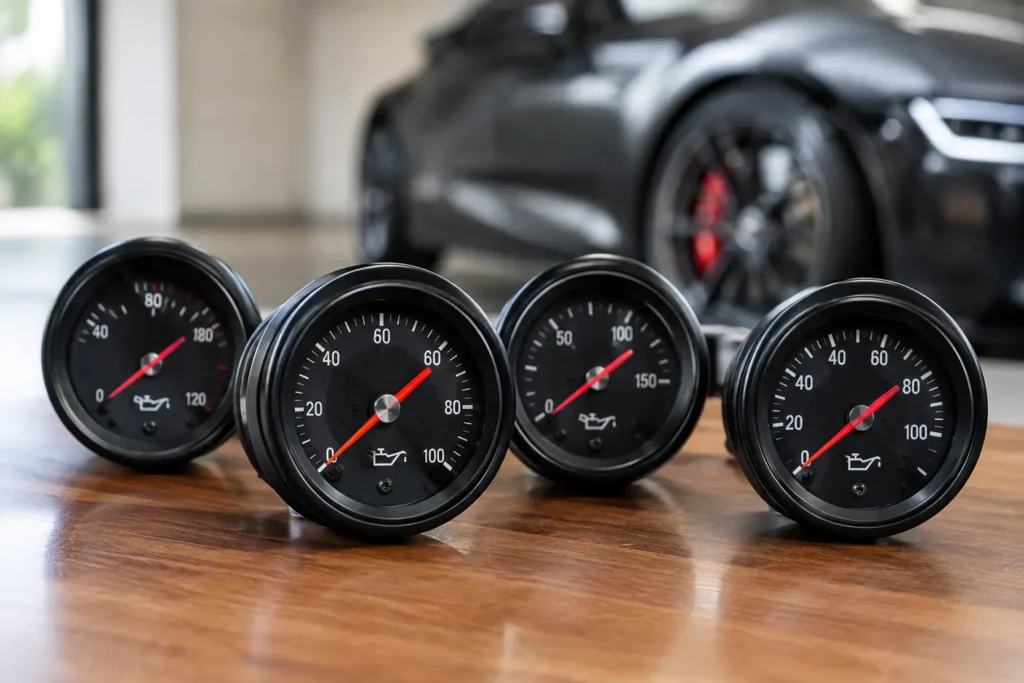
A falling oil-pressure reading is rarely a problem you want to discover after the bearing material is already in the sump. The best oil pressure gauges put a live, credible number in your eyeline, so you can back off before a marginal oil system becomes an expensive engine rebuild. For turbocharged street cars, drift cars held at high rpm and dedicated race builds, this is one of the most useful instruments you can fit.
The right gauge is not simply the one with the brightest display or the highest advertised range. Sender quality, response speed, warning capability, sensor placement and compatibility with the rest of the dash matter just as much. A clean installation also matters: a badly supported sender or a poorly sealed adapter can create the leak you were trying to prevent.
What makes the best oil pressure gauges?
An oil pressure gauge needs to be accurate enough to show a meaningful change, easy to read at a glance and dependable in a hot, vibrating environment. In a performance application, warning functions are especially valuable. Oil pressure often drops before oil temperature looks alarming, particularly under long lateral load, braking zones or sustained boost.
Most performance gauges sit in a 0-7 bar, 0-10 bar, 0-100 psi or 0-150 psi range. There is no advantage in fitting a huge range to an engine that normally runs below 6 bar. A scale that matches your expected pressure makes small changes easier to see. For many modified road and track engines, 0-10 bar or 0-150 psi gives useful headroom without making the normal range too cramped.
Electrical gauges are the preferred choice for most modern builds. They keep pressurised oil out of the cabin, allow programmable warnings and can integrate with digital dashes or data systems. Mechanical gauges remain quick, simple and often accurate, but their capillary line must be routed with serious care. They are better suited to stripped-back competition cars than a daily-driven road car.
8 best oil pressure gauges by build type
1. AEM X-Series Oil Pressure Gauge
AEM X-Series is a strong all-round choice for a street, drift or track build that needs a compact digital gauge with serious functionality. The display is bright, the warning function is useful, and the output options make it easier to connect the signal to a compatible ECU or data logger where required.
This is the gauge to choose when a conventional analogue dial does not offer enough information. It suits cars running Link Engine Management, standalone ECUs or a data-focused dash setup, provided the sensor output and calibration are matched correctly. The trade-off is that installation takes more planning than a basic mechanical gauge, especially when configuring warnings and signal wiring.
2. AutoMeter Ultra-Lite Electric Oil Pressure Gauge
AutoMeter Ultra-Lite gauges have earned their place in race cars, hot rods and hard-used performance builds because they are uncomplicated and easy to read. The white face and clear pointer work well in daylight, while the electric sender keeps the oil circuit in the engine bay.
For drivers who prefer a traditional analogue gauge, this is one of the safest choices. It does not deliver the configurable features of a modern CAN-enabled display, but the format is proven and the reading is quick to interpret during a run. Match the pressure range to your engine rather than choosing purely by appearance.
3. Defi Advance A1 Oil Pressure Gauge
Defi remains a premium option for Japanese performance builds and anyone who wants an OEM-quality instrument finish. The Advance A1 combines an analogue-style display with electronic control, warning capability and expandable system architecture through the relevant control unit.
It is particularly well suited to high-spec turbo cars where matching oil pressure, oil temperature, boost and water temperature gauges are installed as a proper driver-information package. The cost is higher than basic gauge kits, and the control module adds wiring, but the quality of presentation and response makes sense in a serious build.
4. STACK Oil Pressure Gauge
STACK gauges are aimed squarely at motorsport. Their clean displays, practical scale layouts and race-oriented reputation make them a sensible choice for circuit cars, rally cars and competition builds where function is ahead of cabin styling.
A STACK gauge is worth considering when the car spends real time on track and the driver needs a display that remains legible through vibration, glare and a busy cockpit. Choose the electrical version for most applications, then pair it with an independent warning light or ECU protection strategy if the gauge itself does not provide the alarm setup you require.
5. Prosport Premium Oil Pressure Gauge
Prosport Premium gauges suit enthusiasts building a cohesive multi-gauge installation without moving into premium motorsport pricing. Their electronic operation, configurable illumination and warning features can make them a practical option for turbo road cars, drift builds and weekend track cars.
They are a good fit where budget still matters but a cheap, unbranded gauge is not acceptable. Spend time on the installation: use a reliable sender adapter, good earths and properly terminated wiring. Gauge reliability starts with the hardware around it, not just the gauge face.
6. GlowShift Elite Oil Pressure Gauge
GlowShift Elite gauges offer a feature-led digital option for drivers who want alarms and configurable display settings at an accessible price point. They are most at home in modified street cars where an obvious warning and readable numerical value are more useful than a period-correct analogue needle.
Check the supplied sender thread before ordering fittings. Many engines use metric or BSP ports, while some senders use NPT threads. Forcing a near-match thread into an aluminium oil housing is a fast route to damaged threads and an oil leak.
7. AutoMeter Sport-Comp Mechanical Gauge
For a simple race-car installation, the AutoMeter Sport-Comp mechanical gauge remains a credible option. A direct mechanical system avoids electrical sender calibration and provides immediate needle movement, which appeals to traditional competition builders.
The compromise is safety and packaging. Never route a basic plastic line carelessly through a road-car cabin. Use a suitable high-quality line, protect it from heat and abrasion, and consider a bulkhead fitting. For most road and drift applications, an electric equivalent is still the more sensible choice.
8. AEM CD-5 or Digital Dash Pressure Input
A standalone oil pressure gauge is not always the best answer. If the car already runs a digital dash such as an AEM CD-5, a compatible oil-pressure sensor can display pressure, trigger warnings and record data without adding another gauge pod.
This approach is ideal for race teams, time-attack cars and advanced ECU builds. It gives you the chance to identify pressure loss at a specific corner, rpm or oil temperature rather than relying on memory after a session. It does cost more and requires correct sensor scaling, but it is the most useful route when data drives the build.
Choosing electrical versus mechanical oil pressure gauges
For nearly every modified road car, electrical is the recommendation. A quality sender mounted on the engine or remotely mounted through a short hose can feed the gauge while keeping oil outside the cabin. Many electronic gauges also offer a low-pressure alarm, which is more valuable than constantly watching the dial.
Mechanical gauges still have a role in purpose-built competition cars and old-school builds. They can be very direct, have fewer electronic components and are straightforward to diagnose. However, the oil line, fittings and bulkhead routing must be treated as critical safety components. If the line fails inside the cockpit, hot oil follows it.
Installation details that decide whether the reading is useful
Fit the sender at a pressurised main gallery location specified for the engine, not at a convenient but irrelevant port. An oil-filter sandwich plate can work well where space permits, although it may show a slightly different reading to a cylinder-head gallery. What matters is understanding the location and using it consistently when establishing normal readings.
Large, heavy pressure senders should not always hang directly from an alloy housing. Engine vibration can fatigue the sender body, adapter or housing threads. A short remote hose and a bracket are often the better solution, particularly on engines with harsh vibration or limited clearance around the filter housing.
Use the correct thread adapter and sealant for the thread type. NPT seals on its tapered threads, while BSPP and metric threads may seal with a washer, O-ring or bonded seal. Do not apply excessive tape or sealant that can enter the oil system. Once installed, prime the system if appropriate, inspect for leaks and compare cold idle, hot idle and loaded readings against the engine builder’s expected figures.
Set a warning that protects the engine
A gauge only helps if you act on it. Set the warning threshold with engine speed in mind. A fixed alarm low enough to avoid nuisance warnings at hot idle may fail to catch a dangerous pressure drop at 7,000 rpm. The best solution is ECU-based oil-pressure protection using an rpm-based threshold, with a dash warning as the driver’s immediate cue.
For simpler builds, set the gauge alarm conservatively after confirming normal hot-idle pressure. Treat any sudden change, fluctuating needle or pressure drop under load as a reason to lift off and investigate. A familiar baseline is often more useful than chasing one universal pressure number.
Choose a gauge that suits the engine, the cockpit and the way the car is used, then install the sensor with the same care you give fuel and oil fittings. A trustworthy reading is cheap insurance when the engine is working at full load.