

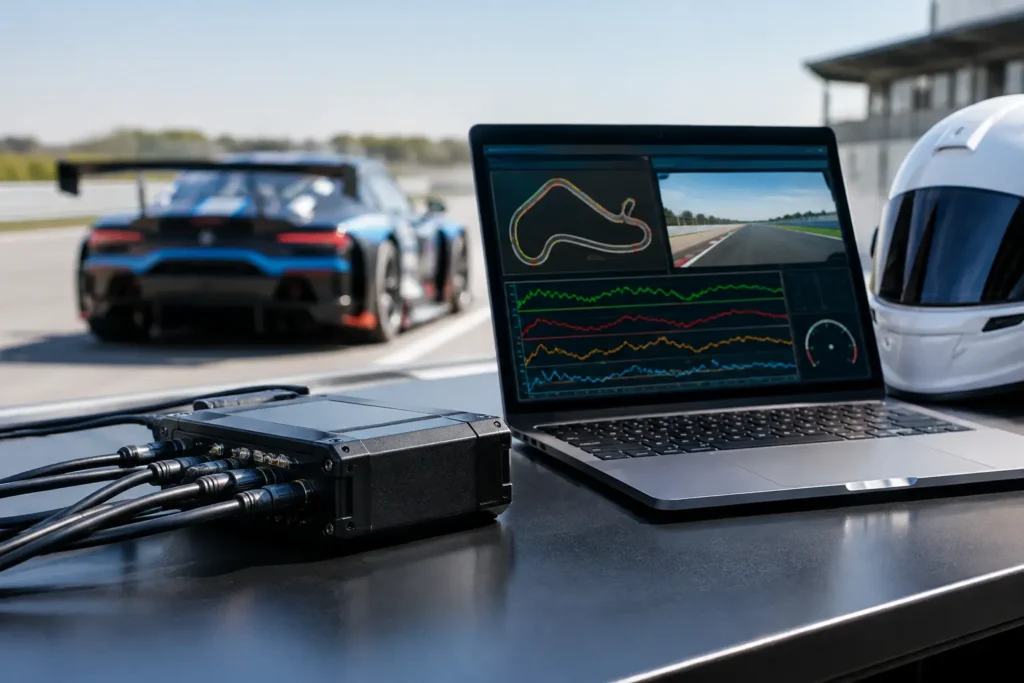
A car can feel planted, pull hard and still give away time at every braking zone. A racing data logger guide starts with that reality: lap time is not a feeling. It is the result of speed, position, brake release, throttle application and vehicle behaviour measured through a complete lap.
For track-day drivers, drifters and race teams, the right logger turns a vague setup change into evidence. It can show whether a damper adjustment improved kerb control, whether brake pressure is repeatable, or whether the driver is carrying less minimum speed than the car allows. The objective is not to fit every available sensor. It is to capture clean, useful information and act on it.
What a racing data logger should tell you
At its simplest, a logger records GPS position, speed and lap times. That is enough to identify where time is gained or lost and compare driving lines. For many club racers, this is the correct starting point. A reliable GPS logger with clear analysis software will produce more useful progress than an overcomplicated installation nobody has time to review.
The next level combines GPS with vehicle data. Engine RPM, throttle position, coolant temperature, oil pressure, fuel pressure, gear position and wheel speeds give context to the lap trace. Instead of seeing a speed drop, you can establish whether the driver braked earlier, traction control intervened, boost fell away or the engine was heat-soaked.
A serious system can also log dedicated analogue inputs such as brake pressure, steering angle, damper position, lambda and suspension travel. These channels are valuable when the car is developed around them. They are not automatically valuable just because the logger has spare inputs.
The best question before buying is simple: what decision do you need the data to support? If you want cleaner driving and quicker laps, GPS, RPM, throttle and brake data may be enough. If you are diagnosing fuel surge in a high-grip corner or calibrating a turbo engine, fuel pressure, boost, lambda and oil pressure become priorities.
Choose the right data source first
GPS-only logging
GPS-only systems suit track days, sprint events and drivers building confidence with data. Look for a unit with a dependable satellite receiver, configurable circuits and an easy way to define a start-finish line. Update rate matters here. A 1 Hz signal records one point per second, which is too coarse for detailed corner analysis. A 10 Hz unit is a sensible minimum for performance driving, while 20 Hz or higher gives more precise speed and position traces.
More GPS frequency does not compensate for poor mounting or poor analysis. Mount the antenna where it has a clear view of the sky, then compare laps at the same circuit and in similar conditions. Chasing a tenth between a cold morning session and a hot afternoon session can lead to bad conclusions.
CAN bus and ECU data
Most modern standalone ECUs and many factory ECUs can transmit information over CAN bus. This is usually the cleanest route to engine data because one connection can supply a broad channel list without adding individual sensors. Link Engine Management systems, for example, can provide a strong foundation for a CAN-based logging setup when the correct protocol and configuration are used.
Check compatibility before ordering anything. A logger may physically connect to CAN but still need a specific communication template, CAN ID, baud rate or ECU firmware version. Confirm exactly which channels are available too. Seeing RPM and throttle is useful, but a forced-induction build may need manifold pressure, inlet air temperature, injector duty cycle, knock activity and fuel pressure to make the data genuinely diagnostic.
CAN data also has limits. Some channels are transmitted slowly, filtered by the ECU or unavailable from a factory control unit. Critical safety measurements such as oil pressure may justify a sensor wired directly to the logger, especially on a race car where a warning must react immediately.
Analogue and digital sensors
Dedicated sensors give control over what is measured and how quickly. A pressure sensor on the brake circuit shows driver input far better than a brake-light switch. A steering angle sensor reveals how much lock is being used and whether understeer is forcing the driver to unwind late. Damper pots and suspension travel sensors can expose bottoming, topping-out and poor platform control that cannot be seen from lap time alone.
These additions demand proper installation. Use motorsport-grade connectors, protected wiring routes, suitable sensor ranges and a stable sensor ground. Keep sensor wiring away from ignition coils, alternators and high-current power cables where possible. A noisy signal or an intermittent connector creates false data, and false data wastes testing time.
Sampling rate, accuracy and channel count
It is easy to get distracted by a logger advertising dozens of channels. Channel count only matters if the system can record each important signal accurately at an appropriate rate. Brake pressure, steering angle and wheel speed change quickly, so they benefit from faster sampling. Coolant temperature changes relatively slowly, so a lower rate is normally fine.
As a working principle, prioritise data quality over quantity. A system recording GPS at 20 Hz, brake pressure and steering angle at a high rate, and ECU channels at their true transmission speed is more useful than a large channel list full of slow or unstable readings.
Accuracy matters as much as rate. Calibrate sensors before testing and recheck them after any repair, wiring work or sensor replacement. A throttle trace that never reaches 100 per cent may be a driver issue, a calibration issue or an ECU scaling issue. You need to know which before changing the car.
Installing a logger for reliable results
A logger belongs in a dry, protected location with secure mounting and sensible cable routing. Avoid placing it near major heat sources or where it can be struck by loose equipment. In a competition car, treat the installation as part of the vehicle’s electrical system, not an accessory added on the night before an event.
Power supply quality is critical. Use a fused, switched supply where required, and confirm the unit has a reliable ground. Voltage dips during cranking, poor earth points and shared high-current circuits can cause logging interruptions or corrupt files. If the system includes a dash, make sure it remains readable in direct sunlight and does not obstruct the driver’s view.
Before the first event, carry out a static validation. Confirm every channel reads sensibly with the engine off and running. Check that RPM matches the dashboard, throttle moves in the correct direction, pressure sensors return to a believable zero point and GPS obtains a stable fix. Then complete a short road or paddock test and inspect the file before relying on the system at speed.
Analyse laps in the right order
Data pays back when analysis is disciplined. Begin with the lap time and sector splits, then overlay a representative quick lap against a consistent reference lap. Do not compare a hero lap full of traffic-free risks with a lap driven in a different session unless you account for the conditions.
Look first at minimum corner speed, braking point, brake release and throttle pickup. These areas usually reveal more than peak speed. If one lap is faster down a straight, trace the advantage backwards. The cause may be a better exit, an earlier throttle application, less steering lock or a cleaner release of the brake several seconds earlier.
Use video alongside the trace where possible. Data can show that the car lost speed at corner entry; video helps explain whether the cause was missed apex, traffic, wheelspin, a kerb strike or driver hesitation. The combination prevents assumptions.
For setup work, change one meaningful variable at a time. If you alter tyre pressures, rear damping, anti-roll bar position and boost control together, the logger may show a change but cannot identify why it happened. Record ambient temperature, tyre condition, fuel load and alignment settings in the event notes. Context turns test sessions into development work.
Build the system around your car and goal
A naturally aspirated track car may need little more than GPS, RPM, throttle, brake pressure and oil pressure. A turbocharged race build generally benefits from CAN logging plus boost, fuel pressure, lambda, inlet temperature and coolant data. A drift car may place greater value on steering angle, wheel speeds, RPM, throttle and temperature monitoring than conventional lap overlays.
Budget also matters. Spend first on a dependable logger, secure installation and the channels that protect the engine or answer your immediate performance questions. Add suspension sensors, tyre temperature systems and advanced expansion modules once the team can consistently use the data already available.
The fastest data setup is not the one with the largest specification sheet. It is the one that produces trustworthy traces, survives hard use and gives you one clear improvement to test at the next session.