

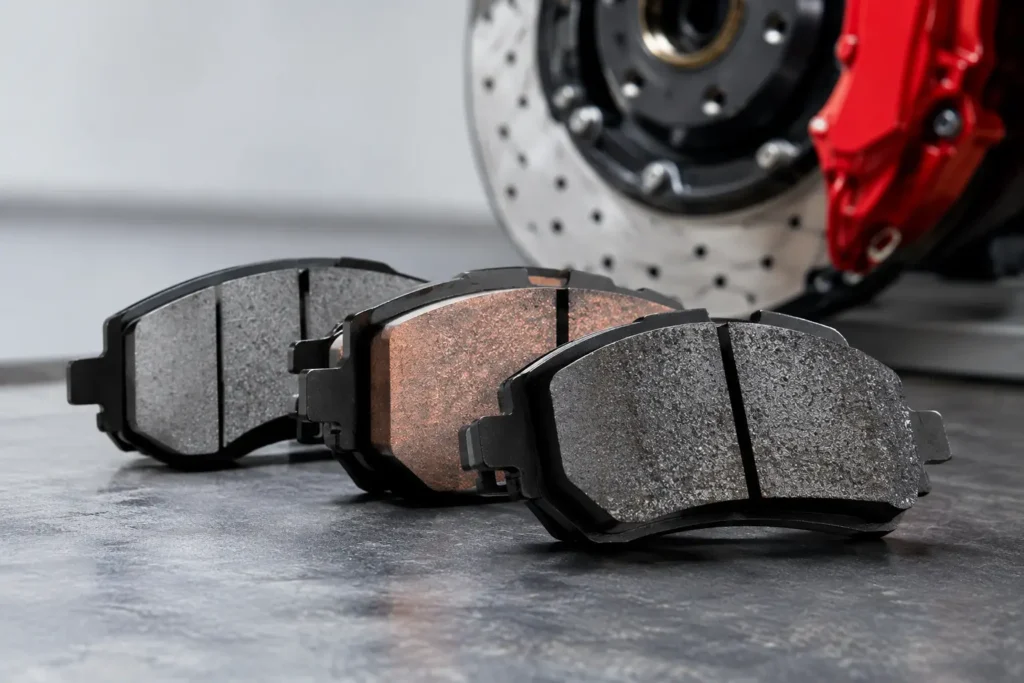
A brake pedal that goes long at the end of a session is not a confidence problem. It is a heat-management problem. Racing brake pads are designed to work where standard road compounds start to fade, smear or lose consistency – but fitting the most aggressive pad available is not automatically the right answer for your car.
For track cars, drift builds and high-output fast-road machines, pad choice needs to match vehicle weight, tyre grip, brake hardware, driving style and real operating temperature. Get that combination right and the car brakes later, stays stable under pressure and delivers the same pedal lap after lap. Get it wrong and you can end up with poor cold bite, excessive disc wear, noise, vibration or a braking balance that makes the car harder to drive quickly.
What Racing Brake Pads Actually Change
A performance brake pad is defined by its friction material, commonly referred to as its compound. That compound determines how much friction the pad produces, how it responds as temperature rises and how consistently it behaves through repeated heavy stops.
Road pads are usually built around low noise, low dust and dependable cold performance. Those are sensible priorities for a daily-driven car sitting in traffic, making short journeys and stopping from ordinary road speeds. A dedicated race compound moves the priorities towards heat capacity, fade resistance and repeatable friction at high temperatures.
This matters because braking is not a single event. On circuit, every stop adds heat to the pads, discs, fluid and caliper. If the pad compound is outside its useful temperature range, the friction level can fall away as the session develops. The driver then pushes harder on the pedal for less deceleration, which generates more heat and makes the issue worse.
A proper motorsport compound should retain a predictable friction coefficient when it is hot. It may also offer a firmer pedal feel and stronger initial response, depending on the design. However, some race-focused pads need heat before they work at their best. On a cold morning or during the first few corners of an out lap, that trade-off is very real.
Choosing Racing Brake Pads for the Application
The correct pad is not simply the pad with the highest advertised friction level. A lightweight track car on semi-slicks, a heavy turbocharged saloon, a drift car and a sprint vehicle can all need very different compounds even when they use similar calipers.
Track day and circuit use
For track day use, look for a compound with a broad working range, good resistance to fade and consistent behaviour over a full session. The target is repeatability rather than a dramatic first stop. A pad that bites hard for two laps but overheats after that is not a performance upgrade.
Consider how the car is used between events. If it is driven to the circuit, a full race compound can be inconvenient or unsuitable on the road. Cold response, squeal and abrasive dust may be acceptable in the paddock but become tiresome during normal driving. A track-capable fast-road compound is often the better compromise for dual-purpose builds.
Drift use
Drift braking places different demands on the system. The front brakes may see repeated high-energy stops to set up entries, while the rear braking system can be used for initiation or fine adjustment depending on the setup. Consistency still matters, but so does controllability.
An overly aggressive front pad can make the car nervous on entry if the front axle locks too easily relative to the rear. On the other hand, a weak pad can leave the driver without enough confidence to brake deep and commit to the initiation. Match the compound to tyre, suspension geometry, master cylinder setup and the balance the driver wants from the chassis.
Race cars and high-grip builds
Race cars running slicks, aerodynamic load and repeated long sessions need pads that are stable at significantly higher temperatures. These vehicles can generate enough braking force to overwhelm an entry-level track compound quickly. The pad must work with the disc, caliper and cooling package rather than acting as an isolated upgrade.
A heavier car with high terminal speeds may need a more temperature-tolerant compound than a lighter car with similar power. Likewise, larger brakes do not automatically eliminate the need for a suitable pad. Bigger discs increase thermal mass and leverage, but the compound still controls how the system turns pedal pressure into braking torque.
Temperature Range Is More Useful Than Marketing Claims
When comparing pad options, check the stated operating range and intended use. The maximum temperature figure is useful, but it should not be viewed on its own. A pad that survives extreme heat may still be poor below its effective working range.
The ideal compound reaches operating temperature quickly enough for your use, remains stable during the hardest braking zone and recovers predictably as temperatures fall. For an occasional track car, this often means choosing a compound with a broad usable range rather than the most extreme race specification.
Pedal feel is also part of the decision. Some pads give a sharp initial bite that suits a driver who brakes aggressively and releases the pedal quickly into the corner. Others build torque more progressively, which can make threshold braking easier in a heavier car or wet conditions. Neither is universally better. The fastest choice is the one that lets the driver repeat the same braking input with confidence.
Pads, Discs and Fluid Must Work Together
A pad upgrade cannot compensate for old fluid, cracked discs, seized caliper slides or inadequate cooling. Braking performance is a system, and the weakest component will set the limit.
Use discs that are compatible with the pad compound and in good condition. More aggressive compounds can accelerate disc wear, particularly when paired with budget plain discs not designed for sustained temperature. Inspect for heat checking, cracking, heavy lips and uneven deposits. A vibration under braking is not always a warped disc – it can be uneven pad material transfer caused by poor bedding, overheating or holding the car on the pedal while stationary with hot brakes.
High-temperature brake fluid is equally important for hard use. When fluid boils, the pedal can become soft or travel further because vapour compresses. That feels very different from pad fade, but both problems can appear after repeated heavy braking. Fresh fluid, correctly bled lines and a sound master cylinder should be in place before judging a new pad compound.
Brake cooling should be considered on cars that repeatedly exceed pad or disc temperature limits. Properly routed ducting can extend pad life, protect fluid and make performance more consistent. It is often a better solution than repeatedly fitting a more aggressive compound to mask an overheating system.
Bedding In Is Not Optional
New pads and discs need a controlled bedding-in process. The aim is to establish an even transfer layer of pad material on the disc face while bringing the components through heat cycles without shocking them.
Follow the pad manufacturer’s procedure where supplied, as compounds differ. In general, this means a series of firm, progressive stops from moderate speed, with enough cooling time between applications to avoid parking the car with the brakes overheated. Avoid holding the pedal down after a heavy stop, especially with fresh components, as this can leave an uneven deposit on the disc.
Do not judge a new race pad from the first road junction after installation. Until the pad and disc have bedded correctly, bite and pedal response may not represent the finished result. Check hardware torque, pad fitment, retaining pins and fluid level before the first hard session.
When a More Aggressive Pad Is the Wrong Upgrade
If a car locks tyres too easily, pulls under braking or suffers instability on entry, adding a higher-friction pad may make the problem worse. Start by checking tyre condition, alignment, corner weights where relevant, caliper operation and front-to-rear brake balance.
For many modified cars, the better route is a matched package: suitable pads, quality discs, fresh high-boiling-point fluid, braided hoses where appropriate and cooling for sustained use. This delivers a meaningful gain without creating a brake system that only works well during the hottest part of a track session.
Noise and dust deserve an honest mention. Racing compounds can squeal, produce corrosive dust and wear discs faster than an OE-style pad. Those are normal compromises for a product designed around performance under heat. If the vehicle spends most of its life on public roads, factor those compromises in before fitting a pure race pad.
Choose the compound for the temperatures your brakes actually see, not the specification that sounds most extreme. A well-matched pad gives you a firmer reference point at every braking zone – and that is where faster, safer driving starts.