

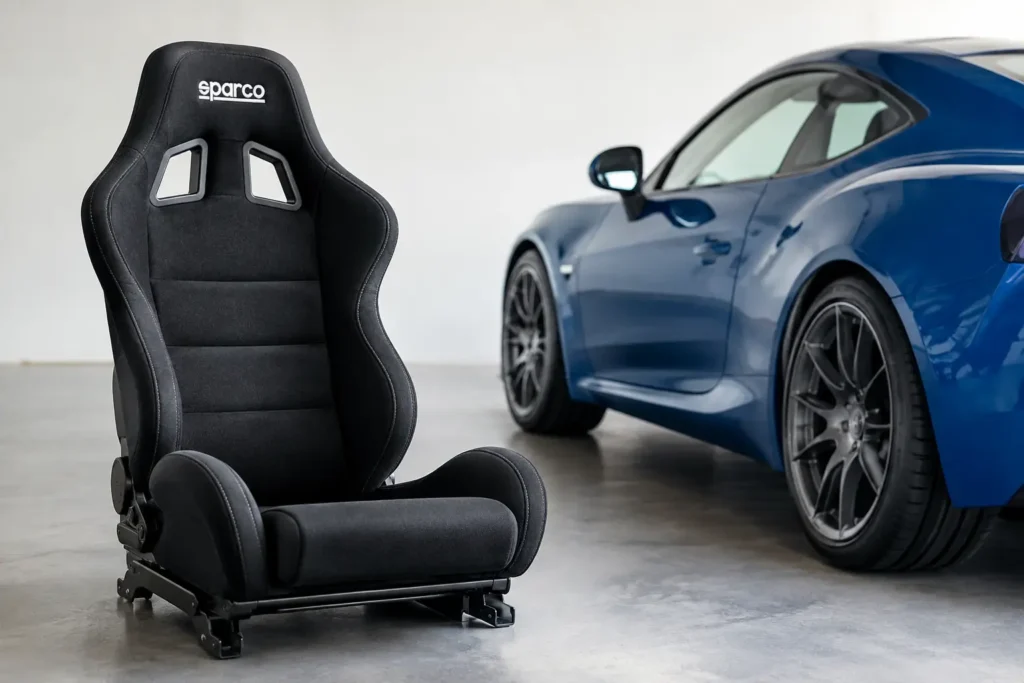
A seat is not a cosmetic upgrade once the car is making serious power, carrying speed through corners, or spending full days at a circuit. It determines how consistently you reach the wheel, pedals and shifter – and how much energy you waste holding yourself in place. This Sparco seat review focuses on the decisions that matter before ordering: shell type, support, approval, mounting and whether the seat suits a road, drift or race build.
Sparco has a broad enough range to cover all three, from reclining road seats to FIA-labelled competition shells. That range is a strength, but it also means choosing by appearance alone is an easy way to buy the wrong seat.
Sparco seat review: the range makes sense when you start with use
The first question is not whether a fixed-back seat looks more serious than a recliner. It is where the car will be used and what restraint system it needs to work with.
For a fast road car that still covers regular mileage, a reclining Sparco seat is often the sensible route. Seats in the R100-style category offer noticeably better lateral support than a standard production seat, retain an adjustable backrest and make access to rear seats less awkward in a hatchback or coupé. They are also easier to live with if more than one driver uses the car. The compromise is weight, reduced shoulder containment compared with a shell, and typically no current FIA competition approval.
For track days, drifting and competition, a fixed-back shell is the proper solution. Models in the Sprint, Grid and EVO families are built around a rigid shell, defined harness openings and much stronger lateral containment. A correctly sized fixed-back seat keeps the driver positioned through braking and sustained cornering rather than forcing them to brace against the wheel. That is better for control, consistency and fatigue over a long session.
The trade-off is immediate. Fixed-back seats are harder to get in and out of, especially with a roll cage, and their angle cannot be changed once mounted. They can also be unforgiving on the road if the shell width, padding or seating position is wrong. A road car does not automatically need a competition shell simply because it has coilovers and sticky tyres.
Fit comes before fabric, colour or logo
A racing seat should fit the driver, not just the car. The best shell on paper becomes a poor choice if it pinches at the hips, leaves space at the shoulders or pushes the helmeted head too far forward.
Measure the driver in normal driving clothing, then compare hip width, shoulder width and torso height with the manufacturer’s current sizing information. If the car is used with a helmet, test the position with the helmet on. The head should sit naturally against or close to the head restraint, not be forced forward because the seatback clashes with the helmet.
Sparco’s multiple shell sizes are valuable here. A narrower shell can give excellent containment for a slim driver, while a larger version may be essential for a broader build. Do not treat extra clearance as comfort. In a track or race car, excessive movement inside the seat reduces the support you paid for. Equally, a seat that is too tight creates pressure points and makes longer stints miserable.
Seat shape also changes with the intended discipline. Drift drivers often value pronounced side bolsters and shoulder support because the body is loaded repeatedly during transitions. Circuit drivers need stable braking support and a helmet-friendly head area. Road users may accept less containment in return for easier daily access and better comfort over distance.
FIA approval is not a shortcut to correct specification
FIA approval matters for racing because regulations may require a seat carrying a valid label and mounted according to the applicable standard. It does not mean every FIA seat is suitable for every championship, every harness setup or every vehicle.
Check the label on the exact seat, not a generic product description. Approval standards, expiry periods and organiser requirements can differ, and race series may impose their own rules around seat age, side mounts, head restraint and back brace use. If the car is entering a regulated event, confirm the regulations before buying the seat, mounts or harness.
For track-day use, an FIA-labelled seat can still be a sensible investment because it is designed around motorsport restraint systems and shell integrity. But it may be unnecessary for a car that is primarily road-driven and uses a conventional three-point belt. In that case, a quality reclining seat with correct mounting can be the better-balanced purchase.
One point is non-negotiable: belts, seat, mounts and roll protection must be considered as one system. A harness routed at the wrong angle, a poorly placed buckle or a seat mounted on unsuitable hardware can undermine an otherwise high-quality installation. Never assume a harness will work correctly because the seat has harness holes.
Mounting is where good seats are won or lost
A Sparco seat needs application-specific mounting hardware or a properly engineered solution for the chassis. Universal rails and brackets can be useful on custom builds, but they are not an excuse to drill, space and improvise without checking geometry and strength.
Fixed-back seats commonly use side mounts. These allow adjustment of height, rake and fore-aft position, and they give the rigid shell the support it was designed to have. The aim is a driving position where the shoulders remain against the seatback, the wrists can rest near the top of the steering wheel with arms slightly bent, and the pedals can be fully operated without locking the knees.
Mounting low is often desirable in a track or drift car, especially for helmet clearance under a roof or cage. Too low, however, can compromise forward vision, pedal feel and access to controls. In a road car, retaining a slider may be necessary for shared use, but it adds height and moving parts. A dedicated competition car is usually better with a fixed position once the main driver’s setup is established.
Before ordering, measure more than the mounting points. Check transmission tunnel clearance, door card clearance, steering wheel position, roll-cage intrusion and the space behind the seat for harness routing. On compact cars, the outside bolster can contact the door before the seat reaches the position the driver needs. On others, a tall seat shell may interfere with a rear cage diagonal or prevent the required recline angle.
Comfort is performance when sessions get longer
A common mistake is judging a seat after sitting in it for two minutes. Pressure around the hips, thighs and ribs can take half an hour to show up, particularly when the car has stiff suspension and no isolation from road vibration.
Sparco’s padding options and removable cushions can help tailor a fixed-back shell, but padding should fine-tune a sound fit rather than rescue a bad one. Thick cushions may also alter harness opening height and driving position. If lumbar support is needed, use only a modest solution that does not push the driver forward from the shell.
Material choice has practical consequences too. Fabric-covered seats tend to offer more grip than smooth trim, which is useful under braking and cornering. They will also collect dust, workshop grime and helmet lint, so a car used hard needs regular cleaning. A reclining seat with more generous padding may be the better call for a weekend road car, while a stripped track chassis benefits more from stable body control than lounge-chair comfort.
Who should buy which Sparco seat?
For a tuned street car, choose a reclining seat when daily usability, rear access and occasional passenger adjustments matter. It delivers a meaningful improvement in driving support without turning every journey into a competition-car routine.
For a drift build or frequent track car, a fixed-back seat with suitable side mounts is usually the stronger choice. Prioritise shell fit, low and secure mounting, and correct harness compatibility over visual style. For a race car, start with the series regulations, then select the current FIA-approved seat and mounting package that meets them exactly.
ProSpeed Parts customers building cars for real use should treat the seat as a control component, not cabin trim. Get the driver position right before finalising steering wheel spacers, harnesses and cage bars. Once the seat holds you properly, every input at the wheel and pedals becomes more precise – which is where a well-specified build starts to feel genuinely faster.