

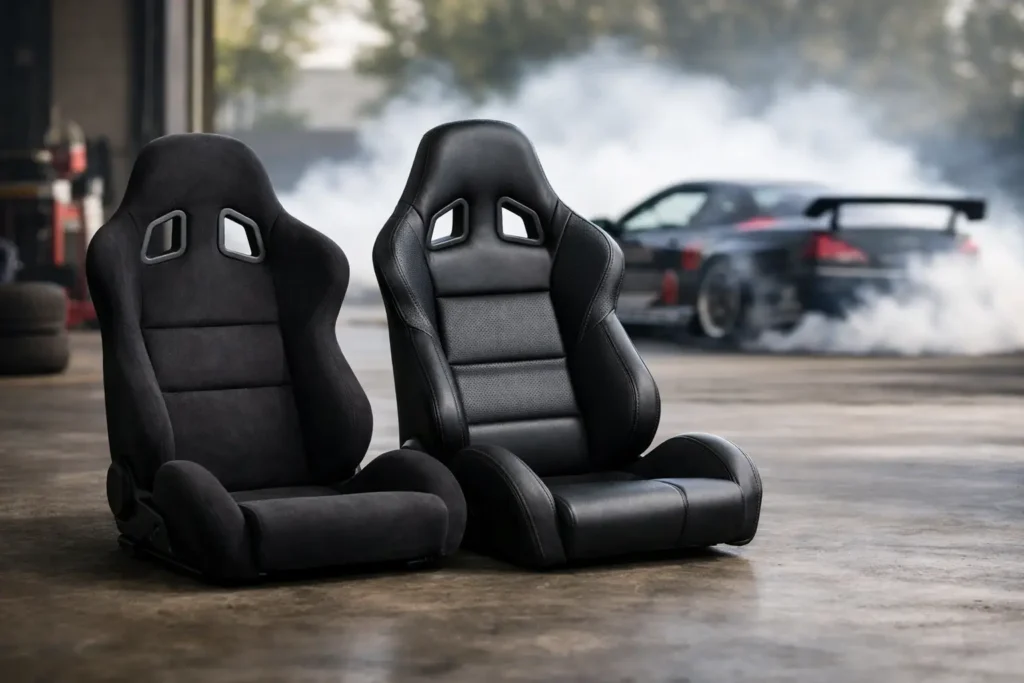
A drift seat is not a styling upgrade. When the car transitions hard, hits a kerb or takes a door-to-door nudge, the best racing seats for drifting keep the driver centred, supported and correctly positioned behind the wheel. Choose badly and you will brace yourself with the steering wheel, lose pedal precision and finish a short session fighting the seat rather than driving the car.
For a serious drift build, a fixed-back bucket seat is usually the correct starting point. The right model depends on your cage, harness setup, body size, championship rules and whether the car still sees regular road miles. Here is how to spec it properly before ordering shells, brackets and hardware.
Best Racing Seats for Drifting: Start With the Shell
A fixed-back bucket provides the lateral support that drifting demands. Its one-piece shell controls movement around the shoulders, ribs and hips, allowing the driver to make fast steering inputs without sliding across the cushion. It also gives a proper platform for multi-point harnesses and can be mounted low and securely with side brackets.
Fibreglass is the sensible choice for most club-level and track-day drift cars. It is strong, relatively affordable and available in a wide range of shell sizes. The trade-off is weight. A composite or carbon-fibre shell can save several kilograms and may offer excellent stiffness, but it costs significantly more and is not automatically a better fit.
A reclining sport seat has a place in a street car that occasionally drifts, especially where rear access and everyday usability matter. However, it is not the first choice for competition use. Recliner mechanisms add weight, allow more movement than a fixed shell and may not meet the rules of the event organiser. If the car has a cage, harnesses and regular track duty, buy the bucket seat first.
FIA approval is not a decorative label
For competition, check the regulations for your specific championship before buying. FIA-approved seats are built and tested to defined standards, but the approval period matters. Some events require a current homologation, while others accept older certified seats for non-championship entries or track days. A seat can be structurally sound yet fail scrutineering if its label has expired under the applicable rules.
Do not assume an FIA shell automatically makes the entire installation legal. The seat, brackets, runners, mounting points, harness and cage interfaces all need to work as a system. Keep labels visible where possible and retain product documentation for scrutineering.
Fit Matters More Than Brand or Price
The best seat is the one that holds your pelvis and torso firmly without creating pressure points. A shell that feels tight for five minutes in a showroom can become painful after a full day of driving. Conversely, a loose shell forces you to tense your legs and shoulders during every transition.
Measure yourself and the interior before selecting a size. The critical dimensions are hip width, shoulder width, thigh support and the space between the seat and door bar. Wide shells suit larger drivers, but can create clearance problems in compact chassis. Narrow shells may fit the tunnel and cage neatly but restrict the driver or prevent winter clothing from fitting comfortably.
If possible, sit in the actual shell, wearing the type of clothing you use on track. Your hips should sit fully back in the seat, with your lower back supported. Your shoulders should contact the bolsters without being pinched, and you should be able to reach full steering lock without your elbows catching the sides. A well-fitted seat feels secure, not restrictive.
Padding can fine-tune fit, but it cannot turn the wrong shell size into the right one. Removable lumbar, thigh and side pads are useful for sharing a car between drivers or accommodating different body shapes. Use only manufacturer-approved inserts where the seat’s certification or safety design requires it.
Harness Compatibility and Driving Position
Seat choice cannot be separated from harness geometry. A drift car normally benefits from a five- or six-point harness, installed according to the harness maker’s instructions and the event regulations. The shoulder straps must leave the seat at the correct angle and attach to an appropriate harness bar or rear mounting point. Running them sharply downwards to the floor can increase spinal compression in an impact.
Check that the shell’s harness slots match your shoulder height and strap width. The belts should pass cleanly through the openings without rubbing hard on the shell edge or crossing at an awkward angle. Sub-strap openings also need to line up with the harness and mounting points, particularly when the seat is mounted low.
Your driving position should put the wheel close enough that you can rest your wrists on the top of the rim with shoulders still against the backrest. With hands at nine and three, keep a usable bend in the elbows. Depress the clutch fully without locking your knee, and make sure your left foot has somewhere secure to rest when off the pedal.
Drifters often mount seats lower and farther rearward than an OEM seat to gain helmet clearance and lower the centre of gravity. That can work well, but do not sacrifice pedal reach or sight lines. The driver needs to see the clipping point, bonnet corners and track surface without craning their neck around the cage bar.
Mounts, Runners and Floor Strength
A premium bucket fitted to weak universal runners is a poor installation. Use vehicle-specific seat bases where available, combined with quality side mounts matched to the seat. This gives a secure, low mounting position and simplifies alignment with the steering wheel and pedals.
Fixed side mounts are lighter, stiffer and generally preferred for dedicated drift cars. They also eliminate another moving mechanism from the safety system. Runners are useful if multiple drivers use the car or if access behind the seat is required, but they add height and must be rated for motorsport use. Avoid improvised brackets, elongated holes and stacked spacers that place unnecessary leverage on the floor mounts.
Inspect the vehicle floor and factory mounting points before installation. Older cars, cars with corrosion, or builds that have had previous seat conversions may need reinforcement. Follow the seat manufacturer’s torque values and use the correct high-tensile fasteners, washers and backing plates where specified. A cage-mounted seat may be appropriate in a full competition car, but it must be designed and fabricated to the relevant regulations.
Practical Seat Choices by Build Type
For a road-registered weekend drifter, a reclining seat from a recognised motorsport manufacturer can be a practical compromise if it is used with the appropriate belt setup and your events permit it. Prioritise a rigid frame, head support and a mounting solution that does not leave you sitting too high.
For regular drift days and local competition, a fibreglass fixed-back bucket is the strongest value choice. Select an FIA-approved shell if competition is a possibility, even if you are not entering immediately. It gives you more options as the car develops and avoids replacing the seat when regulations become stricter.
For a dedicated competition build, choose a current FIA shell sized to the driver, paired with side mounts, a correctly positioned harness bar and a compliant multi-point harness. A halo or head-containment design may be worth considering for higher-speed circuits and cars with substantial grip, but verify helmet, cage and window-net clearance first.
Brands such as Sparco offer options across these categories, but do not buy on logo alone. Compare shell dimensions, homologation dates, mounting compatibility and the actual driving position in your chassis. The seat that fits the car and driver correctly is the performance part.
Common Buying Mistakes
The most expensive error is ordering a seat before measuring the cage, door aperture and floor. A shell may look compact in product photos but clash with a transmission tunnel, door card or side-intrusion bar once it arrives. Measure twice, including the clearance required for seat movement, harness routing and a helmeted driver.
Another common mistake is focusing only on the seat price. Budget for brackets, bases, harnesses, hardware, padding and, where needed, floor reinforcement. These parts determine whether the installation is low, rigid and safe. They are not optional extras.
Finally, do not use a seat to compensate for a poor steering-wheel or pedal position. Set up the complete driver triangle: seat, wheel and pedals. If the wheel is too far away, a spacer or hub solution may be required. If the pedals sit too far forward, adjust the seat mounting before accepting an awkward posture.
Buy the shell that fits your body, your regulations and the car’s intended use, then mount it with the same attention you give to suspension geometry or brake bias. When the seat disappears beneath you and every control falls naturally to hand, you can concentrate on the next transition instead of holding yourself in place.