

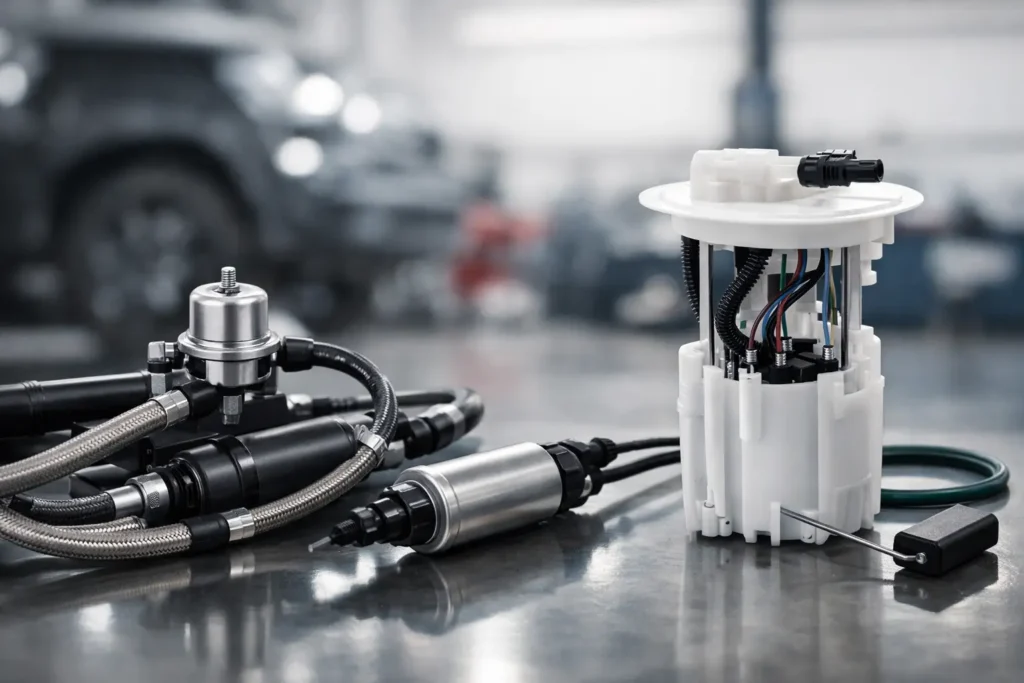
A return fuel system vs returnless decision is not just about how many hoses sit under the car. It determines how fuel pressure is controlled, how much heat reaches the tank, how easily the system scales for more power, and how much fabrication your build requires. For a standard road car, the original arrangement is often the sensible starting point. For a turbo conversion, drift car or race build, the right answer depends on fuel demand, ECU capability and how far the fuel system will be pushed.
What separates a return fuel system from returnless?
A return-style system supplies fuel from the tank to the rail at a higher volume than the engine needs. A fuel pressure regulator controls rail pressure by bleeding excess fuel through a return line back to the tank. The pump normally runs at full speed, while the regulator maintains the target pressure.
A returnless system has no external return line from the engine bay. In its simplest form, the regulator is located in or close to the tank module, with the fuel rail effectively operating as a dead-end line. More advanced OEM arrangements use a fuel pump control module to vary pump speed and maintain pressure without continually circulating excess fuel.
That sounds like a small plumbing difference, but it changes the entire strategy. Return systems control pressure after the fuel has travelled to the engine. Returnless systems reduce pressure or pump output before fuel reaches the rail.
Why return systems remain popular on performance builds
For custom EFI applications, a return system is usually the most straightforward route to predictable fuel control. Fit a quality high-flow pump, correctly sized feed and return lines, a filter, fuel rail and adjustable regulator, and the layout is easy to inspect and diagnose.
The key benefit is capacity. A return line allows a large pump to deliver more fuel than the engine currently consumes without forcing the rail pressure excessively high. That makes the setup well suited to builds that may move from pump fuel to ethanol blends, increase boost, add larger injectors or progress from a modest street map to serious track use.
A manifold-referenced regulator is another major advantage on forced-induction engines. If base pressure is set to 3 bar, the regulator can raise fuel pressure in line with boost pressure, preserving injector differential pressure. At 1 bar of boost, the rail pressure becomes roughly 4 bar. The ECU can then command fuel based on a stable and known injector operating condition.
Return systems also help keep the rail supplied during long, high-load sessions. Fuel continually moves through the rail rather than sitting there absorbing engine-bay heat. On a drift or circuit car where under-bonnet temperatures stay high, that circulation can make hot restarts and consistent fuelling easier to manage.
There are trade-offs. The returning fuel carries heat back to the tank, particularly with a large pump running flat out. On a road-driven car with a small fuel tank, hot fuel can become an issue after prolonged operation. The system also needs an additional line, extra fittings and careful routing. Every connection must be compatible with the fuel used and installed away from exhaust heat, sharp edges and moving components.
Return layout essentials
A proper return installation is more than a feed line and a universal regulator. The pump must be supplied from a baffled tank, surge tank or suitable collector so it does not uncover under braking, acceleration or cornering. This matters even more with low fuel levels and sticky tyres.
The regulator should be positioned according to its design, commonly after the rail on a return-style setup. Its reference hose must see the same manifold pressure as the engine, with no leaks, restrictions or shared connections that create unstable signals. A fuel pressure sensor at the rail is strongly recommended on ECU-controlled performance cars. It gives you data, warning strategies and the ability to identify a pressure drop before it damages an engine.
Line diameter must match power target, fuel type and route length. A line that works on petrol at 350 bhp may become a restriction at much lower power on ethanol, which requires significantly more fuel volume. Select hose, seals and fittings rated for modern pump fuel and ethanol content, not simply whatever is cheapest or easiest to find.
When a returnless system makes sense
Returnless systems are common on modern production cars for good reasons. They reduce evaporative emissions, limit the amount of hot fuel sent back to the tank and simplify the plumbing running the length of the vehicle. For a near-standard road car retaining its factory tank module, rail and ECU, keeping the original returnless architecture is often the cleanest and most reliable choice.
A conventional mechanical returnless layout can work well where fuel demand is moderate and rail pressure is fixed. The regulator, often integrated with the filter or tank assembly, controls pressure near the source. Only the required pressure is sent forward, so there is less heat exchange in the engine bay and one fewer hard line to install.
Electronically controlled returnless systems go further. The ECU or fuel pump controller reads fuel pressure and adjusts pump duty cycle. At idle and cruise, the pump slows down; under load, it speeds up. This reduces pump noise, electrical load and unnecessary fuel heating. When properly calibrated, it is an efficient solution with excellent drivability.
The limitation is complexity. A high-power conversion using a factory returnless system needs careful validation of pump capacity, module flow, wiring, controller limits and pressure sensor range. Simply fitting a larger pump can overload the original controller or expose restrictions in the in-tank assembly. If the ECU does not support closed-loop fuel-pressure control, a sophisticated returnless conversion may create more work than a conventional return system.
Return fuel system vs returnless for turbo, drift and race cars
For a turbocharged street car making a sensible increase over factory power, either design can work. Retaining a well-engineered OEM returnless system is usually preferable when the original ECU, tank and fuel rail remain in place. The target is reliable control, not adding hoses for the sake of it.
Once the build requires larger injectors, an aftermarket rail, a standalone ECU, ethanol fuel or a substantial power margin, a return system becomes easier to scale. It gives the tuner direct control over base pressure and makes component selection less dependent on the limitations of an OEM tank module.
Drift and race use bring fuel starvation into the decision. A returnless rail does not automatically cause starvation, but high lateral load, low tank level and an inadequate in-tank collector certainly can. Many motorsport setups use a lift pump feeding a surge tank, then a high-pressure pump feeding the rail and returning to the surge tank. Excess fuel from the surge tank returns to the main tank. This arrangement keeps the high-pressure pump supplied even when fuel is moving away from the original pickup.
For very high horsepower applications, staged pumps or brushless pump control may be appropriate. Here, the best design is often a hybrid approach: a return-style rail with ECU-managed pumps. The regulator maintains consistent differential pressure, while pump staging or duty control reduces unnecessary recirculation at low load.
Pressure control matters more than peak pump flow
Buying the biggest pump available is not a fuel-system strategy. A pump’s advertised flow is measured at a stated voltage and pressure. Flow falls as rail pressure rises, and it falls further when boost-referenced pressure, voltage drop, restrictive filters or ethanol demand are introduced.
Start with realistic engine power, fuel type, injector size and expected boost. Then account for a safety margin. Check the pump’s flow data at the pressure the engine will actually see, not at free flow. Size electrical cable, relay, fuse and earth path to support the pump under load. A voltage drop at the pump can turn an apparently adequate setup into a lean top-end problem.
Also consider serviceability. A system with quality fittings, sensible hose routing and accessible filters is faster to inspect between events. ProSpeed Parts customers building competition or hard-driven street cars should treat those details as part of performance, not as finishing touches.
Choosing the right layout
Choose returnless when you are retaining a capable factory system, prioritising OEM-style packaging, and staying within proven fuel-flow limits. It is particularly effective when the ECU and pump module are designed to work together.
Choose return-style when the engine is heavily modified, boost-referenced pressure control is needed, fuel demand is likely to grow, or you are fabricating the vehicle around an aftermarket ECU and rail. It uses more hardware, but it is easier to tune, expand and troubleshoot when built correctly.
Before ordering parts, map the complete fuel path from tank venting and pickup through to injector and return. A fuel system only performs as well as its smallest restriction, weakest electrical connection or least suitable fitting. Build in headroom, verify pressure under real load, and your chosen layout will support the engine rather than become the next limit.