

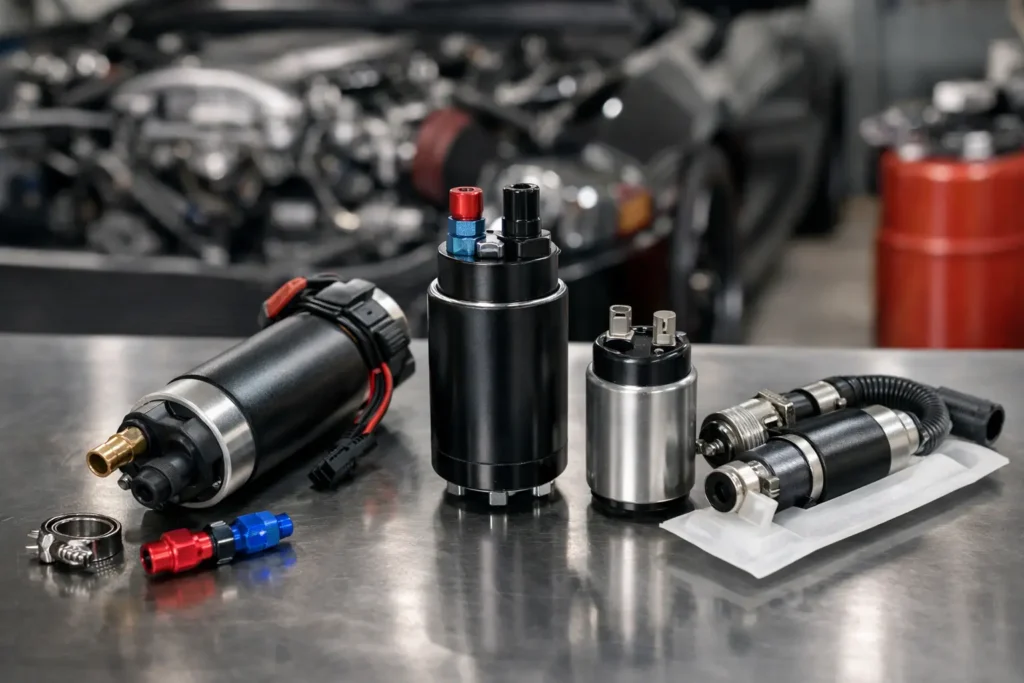
A fuel pump usually gets attention only when the car leans out, breaks up at high load, or refuses to keep up with a fresh turbo setup. That is exactly why choosing the best fuel pump upgrades matters. Get it right and the rest of the fuel system has a solid foundation. Get it wrong and even a well-specced build becomes inconsistent, noisy, hot-running, or flat-out unsafe.
The mistake many builders make is shopping by headline flow number alone. A pump rated for big horsepower on paper can still be the wrong choice for your car, your fuel, or your intended use. Base pressure, boost reference, voltage supply, line size, tank design, duty cycle and fuel type all change what the pump can really deliver once it is fitted and working hard.
What makes the best fuel pump upgrades?
The best upgrade is not always the biggest pump you can fit. It is the pump that supports your real power target with enough headroom, works with your chosen fuel, and integrates properly with the rest of the system. For a fast road car, that usually means stable pressure, low noise, decent lifespan and straightforward fitment. For drift or circuit use, fuel control under sustained lateral load matters just as much as peak flow. For race applications, serviceability and repeatable performance often matter more than convenience.
That is why the best fuel pump upgrades are always part of a complete package. Pump, wiring, relay, fuse protection, fuel pressure regulator, injectors, filters and plumbing need to match. If one area is undersized, the whole system suffers.
In-tank or external pump?
For most modern street and track builds, an in-tank pump is the cleanest place to start. It stays cooler, tends to be quieter and is usually easier to package. If your target power is sensible and the factory tank can be adapted properly, an upgraded in-tank unit often gives the best balance of reliability and cost.
External pumps still have a place, especially where space, service access, surge tanks or very high flow demands are involved. They are common on serious motorsport builds and older chassis where custom plumbing is already part of the job. The trade-off is more noise, more visible plumbing and a greater need to get mounting, filtration and supply conditions right.
If the car sees drifting, slicks, high-G cornering or low fuel levels, a single in-tank pump can become the weak point even if the pump itself flows enough. In those cases, a surge tank setup with a lift pump and external main pump is often the smarter answer.
Matching the pump to horsepower and fuel type
Power target is the obvious starting point, but fuel type changes everything. Petrol, E85 and race fuels do not behave the same way in the system. E85 needs more volume for the same power, and not every pump is genuinely happy living on ethanol blends long term. Some pumps are sold with impressive figures that drop sharply once ethanol, real voltage and rising fuel pressure are part of the equation.
Boosted engines make this even more important. As boost rises, the pump has to maintain fuel pressure above manifold pressure. A pump that looks strong at 3 bar static pressure may be far less impressive at 4 or 5 bar under load. That is where proper flow data matters more than marketing.
As a rough rule, a mild fast road turbo setup may be perfectly served by a high-quality single in-tank upgrade. Once you move into higher boost, ethanol blends or sustained motorsport use, a higher-capacity in-tank pump, twin-pump arrangement or surge tank system becomes far more sensible. There is no prize for running a pump at the edge of its capacity.
The most common upgrade paths
A straightforward in-tank pump upgrade is usually the first step for modified street cars. This works well when the standard basket and tank layout are still suitable and the fuel demand has only moved moderately beyond factory spec. It keeps the car civilised, packaging remains tidy, and installation is less involved than a full custom system.
A high-flow in-tank pump with uprated wiring is a strong option for many turbocharged and supercharged builds. This is often where people stop too early. The pump is fitted, but the original wiring, tired connectors or restrictive filter remain. Voltage drop then cuts real-world performance, and the owner blames the pump.
The next level is a dual-pump setup. That can mean twin in-tank pumps or a staged arrangement where the second pump comes online under load. This gives more headroom and can help avoid overworking a single pump. It also adds complexity. More wiring, more plumbing and more calibration logic all need proper attention.
For hard-used drift and race cars, a surge tank setup remains one of the most effective fuel delivery upgrades available. It solves fuel starvation during sustained cornering or aggressive transitions and gives the main pump a stable supply. It is not the cheapest route, but it is often the right one once grip, aero and lateral load increase.
Don’t ignore wiring, filters and regulators
A fuel pump is only as good as the voltage it receives. One of the best upgrades you can make alongside the pump is a proper relay-fed wiring kit with suitable cable size, good earths and secure connections. Many factory circuits were never designed for significantly higher current draw, and voltage loss can turn an expensive pump into an average one.
Filtration also needs to match the setup. The pre-filter must protect the pump without choking it, and the post-filter must suit injector protection requirements without becoming a restriction. Filter element size, micron rating and service intervals all matter. A heavily modified car running ethanol or seeing regular track use should not be treated like a standard road car when it comes to maintenance.
Then there is the regulator. Rising-rate pressure stability under load is non-negotiable. If the regulator cannot control pressure cleanly, pump capacity becomes harder to judge and fuelling consistency suffers. On return-style systems especially, pump, regulator and return line need to work together.
How to choose the best fuel pump upgrades for your build
Start with the fuel. If you are on pump petrol now but plan to move to E85 later, buy with that in mind. Buying twice usually costs more than choosing the right hardware once.
Next, be honest about power target. Not forum power, not dyno-sheet fantasy, but the real number the car is likely to run for a full season. Add sensible headroom. Too little headroom creates risk, but going excessively large can create heat, noise and control issues on lower-demand setups.
Then look at usage. A street car that sees occasional spirited driving has different needs from a drift car held on limiter or a circuit car spending lap after lap under sustained load. Tank baffling, pickup design and fuel slosh can matter more than the pump’s brochure rating.
Packaging is another practical factor. Some chassis accept popular in-tank upgrades easily, while others need custom cradles, modified hangers or a full external system. There is no point buying a pump with impressive numbers if fitment turns into a compromise that makes the setup less reliable.
Finally, choose proven hardware from brands and suppliers that understand performance applications. This is one area where cheap unknown parts often become expensive. Flow consistency, material quality and long-term durability vary massively.
Common mistakes that kill fuel system performance
Oversizing the pump without planning the rest of the system is a common one. Bigger is not automatically better if the regulator cannot control it, the tank pickup cannot feed it, or the wiring cannot support it.
Another mistake is ignoring fuel temperature. High-demand pumps generate heat, and poor tank design or low fuel level can make matters worse. Hot fuel reduces consistency and can shorten component life.
Many builders also underestimate how often motorsport use exposes fuel starvation. A car that looks fine on a straight-road pull may uncover serious supply issues in a long right-hander, under braking, or during repeated transitions.
Lastly, do not treat the fuel pump as a standalone power mod. It is a support component, but it is one that protects the engine. On any serious build, that makes it a priority rather than an afterthought.
When to upgrade now, and when to wait
If injector duty is climbing, fuel pressure drops at high load, or the build plan includes more boost, bigger injectors or ethanol, the pump should be addressed before the next power step. Waiting until the system shows obvious problems is not smart tuning.
If the car is still near standard output and the current system has healthy pressure and headroom, there is no need to fit a race-level setup for the sake of it. Spend where the car actually needs it. The best results usually come from balanced upgrades rather than chasing the biggest single component in the catalogue.
For builders sourcing parts for street, drift or race applications, the smart move is to buy the pump as part of a complete fuel strategy. That is where a specialist supplier such as ProSpeed Parts makes sense – not because a pump alone is difficult to find, but because matching the pump, fittings, hose, filters and supporting hardware properly is what keeps a fast build reliable.
Choose the upgrade that suits the car you are building next, not the imaginary one you might build three years from now, and your fuel system will do exactly what it should – disappear into the background while the engine delivers every time.