

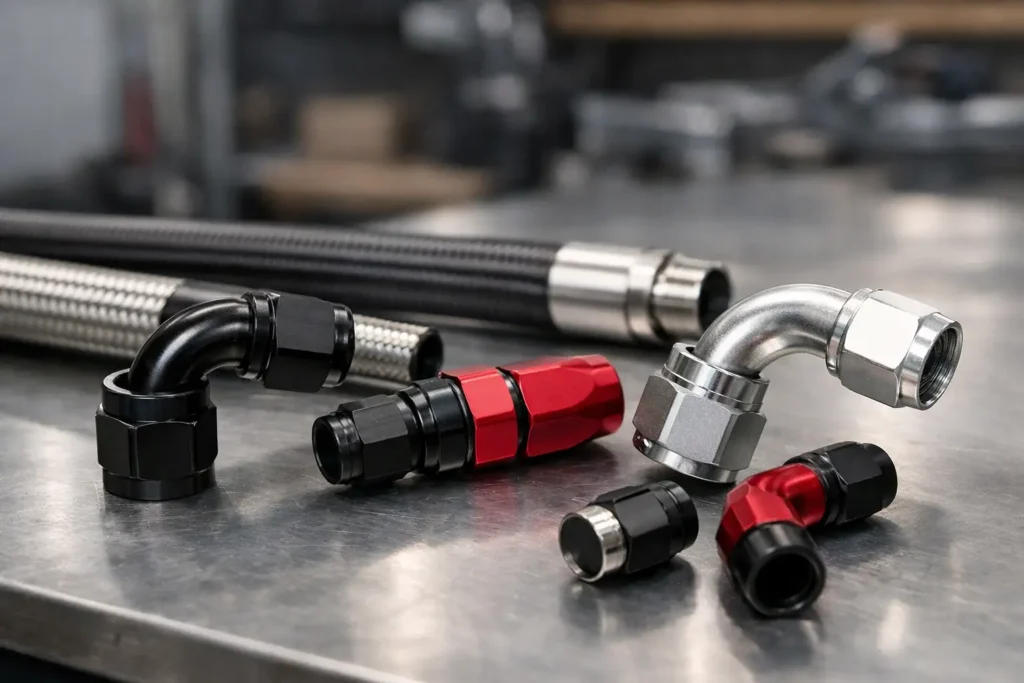
If you have ever chased a fuel smell, a weeping fitting, or a hose that looked right until it met heat and pressure, you already know why a proper PTFE hose end fitting guide matters. PTFE hose systems are a serious step up for fuel, oil and brake applications, but only when the hose, olive, end fitting and thread type are matched correctly. Get that wrong, and even premium hardware will behave like bargain-bin parts.
Why PTFE changes the fitting choice
PTFE hose is not standard rubber braided hose with a different outer braid. The inner liner is polytetrafluoroethylene, which gives strong chemical resistance and far better compatibility with modern fuels, especially ethanol blends. It also handles temperature well and resists permeation better than many conventional hose materials. That makes it a strong choice for engine bays, fuel systems, oil feeds and motorsport plumbing.
The trade-off is that PTFE is less forgiving during assembly. It does not compress and flex in the same way as rubber hose, so the hose end design matters more. You cannot assume an AN fitting that works on CPE or nitrile braided hose will work on PTFE. In most cases, PTFE-specific hose ends use a ferrule or olive that captures the liner correctly and creates the seal without damaging it.
That is why builders need to shop by exact hose type, not just by dash size.
PTFE hose end fitting guide – start with the basics
Before you order anything, separate three things in your head: hose size, hose end style, and thread specification. They are related, but not interchangeable.
Hose size is usually referred to in AN dash sizes such as -4, -6, -8 and -10. That tells you the nominal size of the hose and the fitting family it belongs to. Hose end style refers to the shape and angle of the fitting – straight, 45-degree, 90-degree, 120-degree and so on. Thread specification is the connection at the component side, such as AN/JIC flare, NPT, BSP, ORB or metric threads.
A -6 PTFE hose with a 90-degree PTFE hose end still needs the correct thread and seat at the other end. A fitting can be the right size and still be completely wrong for the port.
Match PTFE hose ends to PTFE hose only
This catches people out all the time. Standard braided hose ends for rubber-lined hose are not a shortcut. PTFE hose ends are built around the liner and usually include a compression olive that sits between the braid and the liner. That olive is part of the seal system. If it is missing, damaged or the wrong size, the fitting may tighten up but it will not seal properly.
Some hose ends are reusable, but that does not mean endlessly reusable in workshop reality. If the olive has marked the liner badly, the braid has frayed, or the threads have been abused during assembly, replace the affected parts. Saving a few pounds on fittings is not worth a fuel leak over a hot manifold.
Choosing the right size for the job
Sizing is application-led. For brake lines, -3 and -4 PTFE are common because the pressures are high but the flow demand is low. For fuel feed lines on performance builds, -6 is often a starting point, with -8 or larger used when power level, pump capacity or fuel type demands it. Oil feed and return sizing depends heavily on the turbocharger, crankcase setup and whether you are dealing with pressure or drain.
There is no magic number that suits every car. A street car on pump fuel, a drift car running hard heat cycles, and a race build on ethanol are not asking the same thing from the plumbing. If in doubt, work backwards from system demand, port size and packaging space rather than chasing oversized hose because it looks motorsport.
Oversizing can create its own problems. Large hose is heavier, harder to route and may force tighter bends near the fitting. PTFE does not like being kinked. A clean route with the correct size will nearly always beat an oversized setup with compromised bends.
Thread types and sealing surfaces
This is where many leaks start. AN-style fittings seal on a flare, not the threads. NPT threads seal through taper and usually require an appropriate thread sealant. ORB seals with an O-ring at the boss. BSP can be parallel or tapered depending on the variant. Metric fittings vary again.
Do not mix thread standards because they almost fit. Almost fit is exactly how expensive components get damaged. If the fitting starts awkwardly, binds too soon, or leaves you unsure about the seat type, stop and verify it.
Common performance setup combinations
On many custom fuel systems, you will see PTFE hose paired with AN hose ends and then adapters used at rails, regulators, pumps or bulkheads. That is practical because AN hardware gives plenty of routing options. On OEM-based systems, however, you may need metric adapters or specific conversion fittings to interface with factory hard lines or aftermarket components built around OEM ports.
The cleanest system is the one with the fewest unnecessary adapters. Every extra joint is another possible leak point and another packaging problem.
Assembly matters as much as the fitting itself
Even the right parts can fail if the hose is cut poorly or assembled carelessly. PTFE hose needs a clean, square cut. If the stainless braid is ragged or the liner is crushed, the olive may not seat properly. Many builders wrap the cut point before cutting to keep the braid under control. That is sensible workshop practice, especially on smaller sizes.
When you separate the braid and install the olive, take your time. The olive should sit correctly on the liner without gouging it. If you force it, the liner can flare unevenly or split. Once the hose is inserted into the socket and the fitting is threaded together, tighten to the manufacturer guidance rather than by guesswork. Too loose will leak, but too tight can distort components or damage threads.
A small amount of suitable assembly lubricant on threads can help prevent galling, but it should never be used as a substitute for proper engagement. The seal is created by the fitting design, not by brute force.
Routing and support in a real engine bay
A good PTFE hose end fitting guide is not only about what fits on the bench. It also needs to survive vibration, engine movement and heat. PTFE hose does well in harsh environments, but poor routing will still shorten service life.
Keep hose away from sharp edges, direct manifold heat and moving parts. Use proper separators, P-clips or bulkhead fittings where needed so the hose is supported rather than left to whip around. If a straight hose end creates a tight bend immediately after the fitting, switch to a 45-degree or 90-degree end and improve the route. That is not cosmetic. It reduces stress on both the hose and the port.
Heat protection may still be necessary near turbo systems, downpipes and exhaust manifolds. PTFE is heat resistant, but the complete assembly includes the outer braid, fitting finish, nearby seals and the fluid itself. A fuel line routed too close to exhaust heat is still a bad idea.
Common mistakes that cost time and parts
The biggest mistake is assuming all braided hose hardware is interchangeable. It is not. The second is ordering by appearance instead of specification. Black fittings, stainless braid and AN sizing can make different systems look similar when they are not.
Another common issue is mixing low-quality adapters into an otherwise decent hose setup. One poor thread, inconsistent flare or badly machined seat is enough to create a leak that sends you checking everything else first. For workshop builds and repeat customer cars, consistency across the system saves time.
People also underestimate how much angle choice matters. A straight fitting might be cheaper and easier to stock, but if it forces a loaded bend or twists the hose during tightening, it is the wrong fitting. Choosing the correct angle from the start usually gives a neater and more reliable result.
Buying the right PTFE hose end fittings
For street, drift and race work, buy by specification, not by marketing noise. Confirm the hose construction, dash size, fitting angle, thread type, seat type and intended fluid. Fuel, brake and oil systems all place different demands on the hardware, and a clean-looking fitting means very little if the internals are wrong.
It also pays to buy from a supplier that actually understands performance plumbing. A broad performance catalogue matters because custom builds often need the full chain of parts – hose, ends, adapters, bulkheads, clamps and heat management – not just one fitting in isolation. That is where a specialist source such as ProSpeed Parts makes more sense than a generic retailer shifting universal hardware.
If you are building once, the goal is a system that seals first time and stays dry. If you are building regularly, the goal is repeatability. In both cases, PTFE rewards accuracy. Choose the correct hose end for the hose you are actually using, respect the thread standard, and build the route like it has to survive a hard session rather than a photoshoot.