

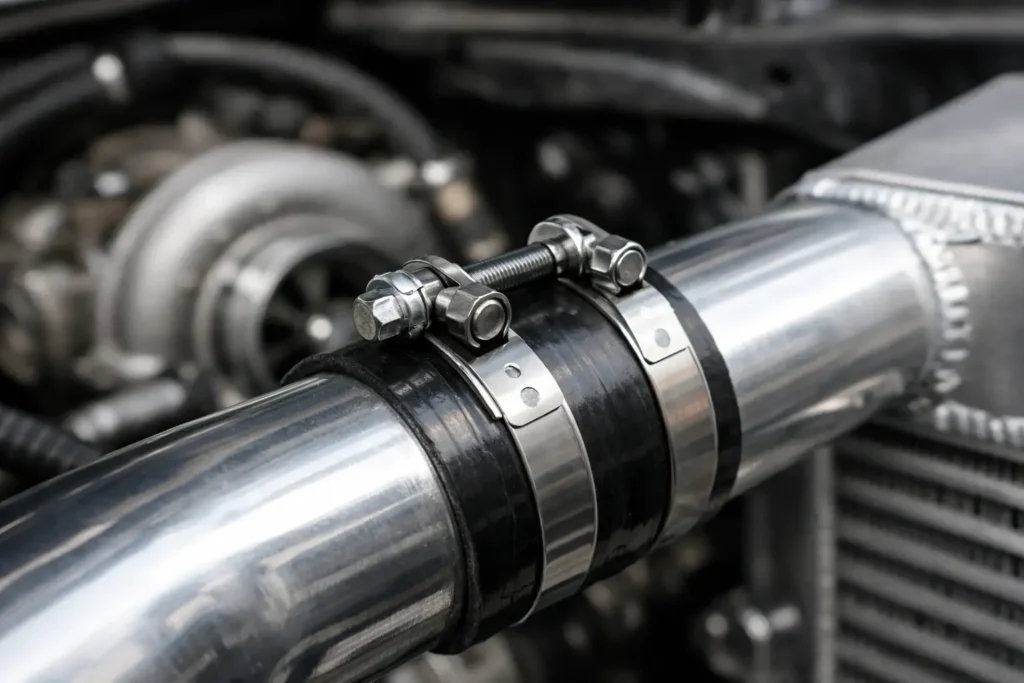
A boost leak rarely starts with the flashy parts. More often, it starts with a clamp that looked close enough on the bench and failed once heat, pressure and vibration got involved. If you are shopping for a universal hose clamp for intercooler pipes, the real question is not whether it will tighten. It is whether it will hold repeatably on your exact pipe, hose and boost setup without cutting the silicone or working loose.
On a street car running modest pressure, you can get away with more than you can on a drift or track build that sees sustained heat and constant load changes. That is why intercooler pipe clamps should be treated as a spec item, not an afterthought. A universal part can work very well, but only when you match it to the application rather than assuming one style fits every build.
What a universal hose clamp for intercooler pipes actually needs to do
Intercooler pipework lives in a harder environment than many buyers account for. Charge air temperatures rise, engine bays heat soak, silicone couplers expand and contract, and hard pipes move slightly under load. The clamp has to maintain enough clamping force to seal the joint without distorting the coupler or damaging the pipe bead.
That balance matters. Too little tension and the coupler can creep, leak or blow off under boost. Too much and you risk cutting into the hose, deforming thinner alloy pipework or creating an uneven seal that fails later. The best clamp is not the one that feels strongest in your hand. It is the one that applies stable, even pressure across the full duty cycle of the car.
Universal in this context usually means adjustable across a size range and suitable for common silicone joiners, aluminium boost pipes and fabricated intercooler systems. It does not mean truly one-size-fits-all. Clamp width, band design, bridge construction and tension behaviour still need to suit the pipe diameter and expected boost pressure.
Why clamp style matters more than most buyers expect
A standard worm-drive clamp is familiar, cheap and easy to fit. For low-boost or temporary setups, it may do the job. The trade-off is that cheaper examples often load the hose unevenly and can create pressure points. On soft silicone couplers, that can lead to material damage over time, especially if the edges are not well finished.
T-bolt clamps are a common step up for performance builds because they provide stronger and more consistent clamping force. They are usually a better fit for higher boost applications, larger diameter intercooler joints and cars that see aggressive use. The trade-off is that they need the correct size range and enough installation clearance. If the clamp bottoms out before applying proper load, or if it sits awkwardly against nearby pipework, it will not perform as intended.
Spring-loaded or constant-tension designs bring another advantage. They compensate for expansion and contraction as temperatures change, which can help maintain a more stable seal in real-world use. They are especially useful where repeated heat cycles are part of the package. The downside is cost and, in some cases, less flexibility if your setup sits between standard sizing.
Sizing a universal hose clamp for intercooler pipes
This is where most fitment problems begin. Buyers often measure the outside diameter of the bare pipe and stop there. The clamp, however, needs to fit over the assembled joint, meaning the pipe, the silicone coupler wall thickness and any bead roll all influence the final diameter.
Measure the outside diameter of the hose once installed on the pipe, not just the pipe itself. Then compare that number to the working range of the clamp, ideally landing somewhere in the middle of that range rather than right at the minimum or maximum. A clamp operating near the middle of its adjustment tends to apply load more predictably and gives you room for heat-related expansion.
If you are between sizes, the right answer depends on the clamp type. With worm-drive clamps, forcing a small clamp to the top of its range is rarely ideal. With T-bolt clamps, being too close to the minimum can also be a problem if the clamp geometry does not sit properly. There is no shortcut here. Good fitment starts with a proper measurement of the assembled joint.
The role of bead rolls, coupler quality and pipe material
Even the best clamp cannot rescue bad pipework. If your intercooler pipe ends are plain-cut with no bead roll, the coupler has less mechanical retention and is more likely to slide under boost. A proper bead on the pipe end gives the clamp something to hold against. That matters even more on high-boost turbo setups and cars that see hard gear changes.
Coupler quality also changes the result. A decent multi-layer silicone hose with stable wall thickness will clamp more consistently than a soft, low-grade joiner that deforms unpredictably. Likewise, thin alloy pipes can ovalise if overtightened, while stainless pipe can tolerate more load but may transfer more vibration into the joint. The clamp has to be chosen as part of the whole system, not as a standalone accessory.
When universal works well and when it does not
A universal clamp works well on common custom intercooler setups where pipe diameters are known, couplers are standardised and there is enough room to fit and tighten the hardware correctly. That covers a lot of street, drift and track cars. For workshops and fabricators, universal sizing also makes stockholding easier because one clamp family can cover several build variations.
Where universal starts to fall short is in very tight engine bays, unusual step-up or step-down joins, extreme boost applications or builds where OEM packaging leaves almost no tool access. In those cases, a more specialised clamp design or an exact-size solution can save time and prevent repeat issues. Universal should mean adaptable, not compromised.
Installation mistakes that cause boost leaks
Most clamp failures are not really clamp failures. They are installation problems. The clamp should sit squarely behind the bead roll, not half on the bead and half on the straight section. The hose and pipe need to be clean and dry unless a specific assembly method calls for otherwise. Oil mist on the joint lowers friction and makes coupler movement more likely.
Overtightening is another common mistake. More torque does not automatically mean a better seal. It can pinch the silicone, create local deformation and actually reduce sealing consistency. On the other side, under-tightening leaves the joint vulnerable once boost rises and temperatures stabilise. If the clamp manufacturer provides a torque figure, use it. If not, tighten with care and recheck after initial heat cycles.
Alignment matters too. A coupler under side load from poorly lined-up pipework will always be harder to seal. If you have to force the pipes together, the clamp is compensating for fabrication error, and that rarely ends well under load.
Choosing for street, drift and race use
For a mild street car with conservative boost, quality worm-drive clamps may be acceptable if the couplers, pipe beads and fitment are all right. For anything more serious, especially turbo builds that see repeated hard pulls, T-bolt or constant-tension hardware is usually the safer choice.
Drift cars add another variable because of prolonged load, engine bay heat and vibration. Race cars push things harder again, where a minor leak can cost consistency, power and track time. In those environments, clamp quality is cheap insurance. It makes more sense to fit proper motorsport-grade hardware once than to keep chasing small leaks and blown couplers.
That is also why buyers who care about repeatable results tend to source from specialist performance suppliers rather than general motor factors. The difference is not just stock. It is knowing which clamp styles actually belong on charge pipework and which ones are better left for lower-demand jobs.
What to look for before you buy
Start with the size range, then check the band construction, edge finish and intended use. A clamp for coolant hose duty is not automatically the right clamp for boosted intake plumbing. Look for hardware designed to handle pressure, heat and vibration without chewing through silicone.
Material quality matters as well. Corrosion resistance is important on road cars that see wet weather, and thread quality affects how accurately the clamp can be set. On a custom build, consistency across all intercooler joints is worth having. Mixing clamp types and quality levels can make troubleshooting harder later.
If you are building or maintaining several vehicles, it also makes sense to think in terms of repeat serviceability. A clamp that can be removed and refitted cleanly without damaging the coupler saves time in a workshop and reduces waste over the life of the car. That is one reason performance-focused ranges, including options commonly chosen by buyers at ProSpeed Parts, are worth attention when reliability matters as much as price.
The right clamp will never be the most exciting item in the basket. It will not make the dyno graph look dramatic on its own. But if your intercooler system stays sealed, stable and serviceable under real boost, that small piece of hardware has done exactly what it should – and your whole setup is better for it.