

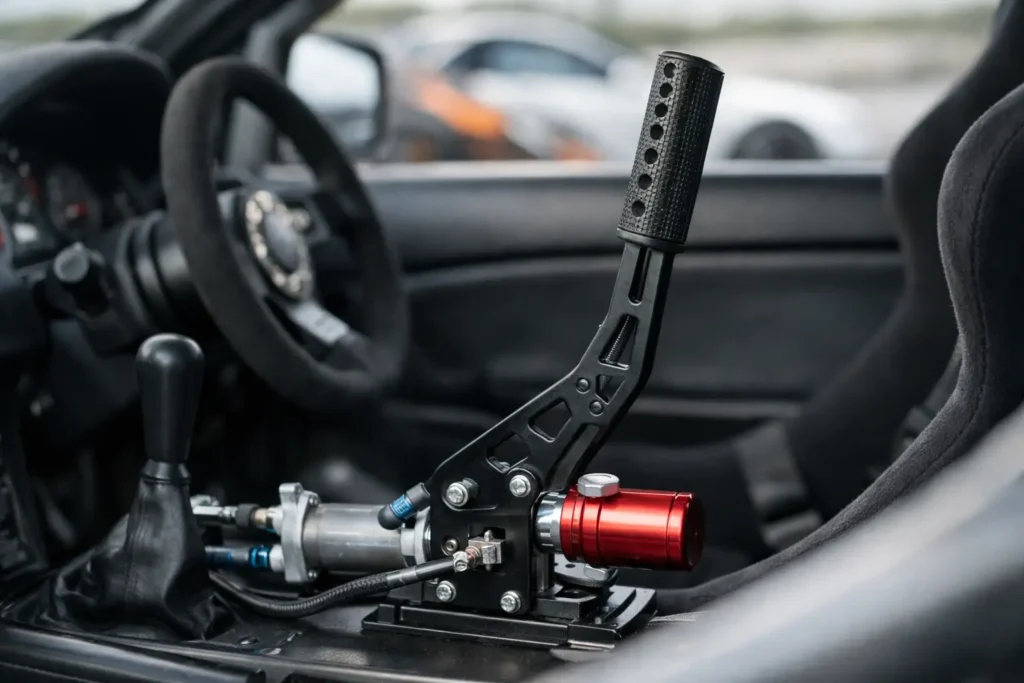
A handbrake that pulls to the stops without locking the rear wheels is not a drift upgrade. It is a distraction at the point where you need commitment. This drift handbrake setup guide covers the component choices, plumbing layouts and checks that produce repeatable rear-wheel lock-up without compromising the rest of the braking system.
For most dedicated drift cars, a hydraulic handbrake is the right route. The details still matter: cylinder bore, caliper arrangement, line routing, brake bias and pedal feel all decide whether the car rotates cleanly or leaves you fighting a soft lever and inconsistent lock.
Start with the job your handbrake needs to do
A drift handbrake should lock the rear wheels quickly enough to initiate or extend rotation, then release fully so the rear brakes do not drag. It is not a replacement for the foot brake, and it should not be treated as a parking brake unless the vehicle retains a separate mechanical system for that purpose.
Before ordering parts, decide whether the car is a track-only drift build, a dual-use car, or a road-driven project. A competition car can be configured around maximum response and serviceability. A road car needs closer attention to legal requirements, MOT implications, insurance and the requirement for a properly functioning parking brake. In the UK, an hydraulic-only handbrake will generally not satisfy the requirement for a mechanically operated parking brake.
Also establish what rear brake hardware is already fitted. Standard single-piston rear calipers, upgraded multi-piston calipers and rear brakes with an integrated cable handbrake each call for a slightly different plan. Do not choose a cylinder or plumbing layout on appearance alone.
Choosing the hydraulic handbrake hardware
A complete installation starts with a rigid lever assembly, a correctly sized master cylinder, brake hose and fittings rated for brake fluid, plus a plan for the rear calipers. Quality matters here. A flexible bracket, poor pivot hardware or an unknown cylinder can turn a straightforward braking modification into a reliability problem.
Lever position and mounting strength
Vertical handbrakes are common because they are fast to grab during transitions and do not take up much lateral space. Horizontal levers can suit certain cockpit layouts, particularly where the gear lever position or seating arrangement makes a vertical lever awkward. Neither style is automatically better. The best choice is the one you can reach without leaning away from the steering wheel or catching the lever during normal shifting.
Mount the assembly to a reinforced tunnel section, purpose-built handbrake bracket or substantial chassis structure. Thin floorpan metal is not enough. The force applied through the lever is concentrated at the mounting points, and any movement will reduce feel while eventually cracking the mounting area.
Check clearance through the full lever travel with the seat, harnesses, gear lever and steering position set as they will be on track. A clean-looking installation that forces your hand into the gear lever on a quick entry is not a finished installation.
Master cylinder bore size
Cylinder bore has a direct effect on handbrake feel. A smaller bore moves less fluid per millimetre of lever travel but generates higher hydraulic pressure for a given input. This usually gives a lighter pull with more lever movement. A larger bore moves more fluid and can create a firmer, shorter lever, but requires more effort.
There is no universal bore size because caliper piston area changes the calculation. As a practical starting point, a smaller cylinder often suits larger rear calipers or dual-caliper systems, while a larger cylinder may work well with smaller piston volumes. If the cylinder is too large, the lever can feel hard yet fail to lock the wheels. If it is too small, the lever can travel too far and feel vague.
Match the cylinder choice to the rear caliper specification, then leave enough adjustment in the system to tune the car after testing. Builders often chase a master cylinder change when the real issue is trapped air, worn pads or an incorrect plumbing layout.
Select the right brake layout
The two main hydraulic handbrake layouts are in-line and dual-caliper. Both can work, but they suit different builds and budgets.
In-line systems
An in-line handbrake is installed into the rear brake circuit, normally after the foot-brake master cylinder and before the rear calipers. Pulling the lever adds pressure to the same calipers used by the pedal. It is compact, cost-effective and common on beginner and intermediate drift cars.
The trade-off is that the rear service brakes and handbrake share the same hydraulic circuit. Pedal feel, master cylinder selection and brake bias need to be considered as one system. Poorly planned in-line plumbing can introduce pedal travel, make bleeding difficult or give unpredictable rear braking under heavy foot-brake use.
A proper in-line installation must use a handbrake master cylinder designed for this application and be routed correctly. Do not improvise with unsuitable valves, fuel fittings or hose that is not rated for brake fluid and braking pressure.
Dual-caliper systems
A dual-caliper setup adds a second caliper to each rear disc, with the hydraulic handbrake operating only those additional calipers. The foot brake remains completely separate. This is the cleaner solution for serious competition cars because it gives consistent handbrake operation without altering the service brake circuit.
It costs more and requires compatible brackets, discs, calipers and wheel clearance. Bracket alignment is critical. The additional caliper must sit squarely over the disc with the pad swept area correctly positioned. A poorly aligned bracket will wear pads unevenly, generate drag and can damage components under repeated heat cycles.
For high-use drift cars, dual calipers also simplify fault-finding. If the handbrake loses performance, you can inspect its independent circuit without immediately questioning the pedal brake system.
Plumbing the system correctly
Brake plumbing deserves the same discipline as a fuel or oil system. Keep lines away from exhaust heat, rotating shafts, suspension movement and tyre contact. Support hard lines at sensible intervals and protect them where they pass through panels or close to sharp edges.
Use motorsport-grade hard line or approved flexible brake hose, with fittings that match the thread and seat type of the master cylinder, calipers and adapters. Thread pitch is not enough. Brake fittings may seal on a flare, a cone, a banjo washer or another specific face. Forcing a fitting that appears close is an expensive mistake.
If using flexible hose at the rear axle, allow for full suspension droop and compression, plus steering movement where applicable. Route the hose so it cannot become taut, rub against the tyre or trap between suspension components. Heat shielding may be required where the line passes near the exhaust.
Keep the circuit as simple as the layout allows. Every unnecessary join is another potential leak point and another place for air to remain trapped. Before adding fluid, inspect every fitting and confirm that the reservoir feed, pressure outlet and caliper ports are connected exactly as intended.
Bleeding for a firm, repeatable lever
A hydraulic handbrake with air in the circuit will never feel trustworthy. Bench-bleed a new master cylinder where possible, then bleed the system methodically with fresh brake fluid that meets the vehicle and motorsport application’s temperature requirements.
For an in-line layout, follow the vehicle’s normal brake bleeding sequence while ensuring the handbrake cylinder is bled properly. Depending on the routing, it may be necessary to cycle the lever during the process to move air from the handbrake cylinder and lines. A pressure bleeder can save time, but it does not replace checking every circuit for a solid pedal and lever.
With dual calipers, bleed the handbrake circuit independently. If the caliper bleeder is not at the highest point once mounted, air may remain trapped inside. Some calipers need to be temporarily removed and positioned so the bleed nipple is genuinely uppermost, while keeping pads or a spacer in place and taking care not to strain the hose.
After bleeding, hold pressure on the pedal and handbrake separately while inspecting every union, banjo bolt and hose end. Even a slight weep is a failed installation. Brake fluid also damages paint, so clean spills immediately and protect painted surfaces before beginning work.
Set balance before chasing more lock
Rear-wheel lock is not only about handbrake pressure. Pad compound, tyre grip, rear brake condition, disc temperature and vehicle weight transfer all affect the result. A car on grippy rear tyres may need a different approach from one running a hard compound or narrow rear setup.
First make sure the rear discs are clean, pads are bedded and both calipers operate freely. Seized slider pins, sticky pistons or contaminated friction surfaces will make the handbrake inconsistent regardless of cylinder size. Then test in a controlled private environment at low speed, progressively checking that the lever locks the rear wheels and releases immediately.
If the rear locks too easily under foot braking, do not use the handbrake setup to mask a brake-bias issue. Address the service brake balance separately. A proportioning valve, correctly matched master cylinders or changes to caliper and pad specification may be appropriate depending on the car’s complete brake package.
Pre-event inspection matters
A drift car sees repeated high-load lever pulls, vibration, heat and occasional contact. Inspect the handbrake system before every event. Look for loose mounting bolts, cracked brackets, hose abrasion, leaking fittings, low fluid level, uneven pad wear and a change in lever travel.
Keep a small stock of consumables in the spares kit: brake fluid, suitable line fittings, copper washers where relevant, spare pads and the tools required to bleed the system. These are low-cost items that prevent a minor issue from ending a track day early.
A well-built hydraulic handbrake should feel boringly consistent. Build it with the right cylinder, properly matched hardware and careful plumbing, then spend your track time refining entries rather than wondering whether the rear wheels will lock when it counts.