

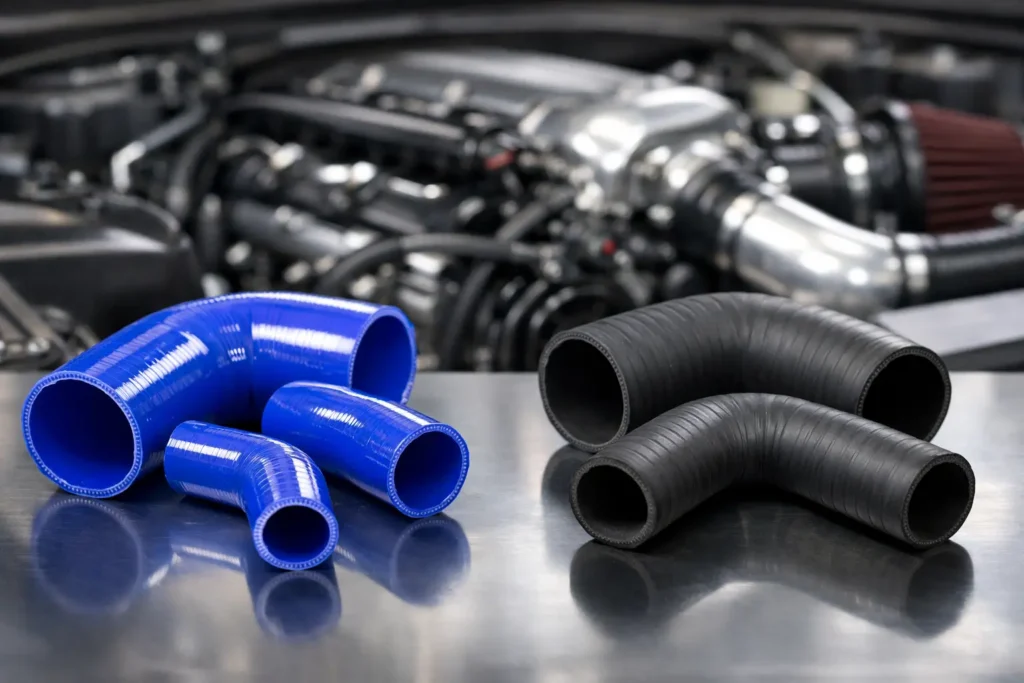
A split coolant hose at the end of a track session, a boost pipe lifting under load, or a fuel line softened by the wrong compound can stop an otherwise well-sorted build. The silicone hose vs rubber decision is not about choosing the material that sounds more motorsport-ready. It is about matching the hose to the temperature, pressure, fluid and routing in front of it.
For performance street cars, drift builds and race applications, silicone is often the clear upgrade for coolant and charge-air plumbing. Rubber remains the right answer in plenty of places, particularly where fuel, oil or brake fluid are involved. Get specific before ordering by diameter, wall thickness or colour.
Silicone hose vs rubber: the real difference
Silicone hose is usually made from silicone elastomer reinforced with polyester, aramid or fibreglass fabric plies. The number of plies, wall thickness and construction determine how much pressure it can handle. A quality multi-ply silicone coupler is designed to stay stable when a turbocharged engine sees repeated boost, heat cycling and vibration.
Rubber hose is a broader category, not one single material. EPDM rubber is common for coolant systems because it manages hot water and glycol well. Nitrile-based compounds are used where oil and fuel resistance matter. Other rubber formulations are selected for vacuum, hydraulic, brake or emissions applications. This is why a blanket claim that silicone is better than rubber misses the point.
The correct choice is application-led. Silicone generally wins in high-temperature coolant and intake work. Purpose-made rubber or specialist PTFE hose wins wherever the fluid itself attacks silicone.
Where silicone hose earns its place
Coolant plumbing and radiator hoses
Silicone is a strong choice for radiator hoses, heater hoses, expansion-tank lines and custom cooling layouts. It tolerates high under-bonnet temperatures and repeated thermal cycles without becoming brittle as quickly as poor-quality rubber can. This matters on cars with relocated radiators, rear-mounted cooling systems, aftermarket water rails or tight turbocharger packaging.
Silicone is also useful when a build needs non-standard shapes. Straight joiners, 45-degree and 90-degree elbows, reducers and hump hoses make it possible to build tidy pipework around intercoolers, radiators and engine swaps. The hose needs to be supported properly, though. Silicone can cope with heat, but it should not be expected to carry the weight of long aluminium or stainless hard pipes.
Turbocharger and intercooler pipework
Boost plumbing is where multi-ply silicone hose has become standard performance hardware. A correctly sized silicone coupler gives controlled flexibility between rigid charge pipes, engine movement and the intercooler. Hump hoses are especially useful where the engine moves relative to fixed pipework under acceleration, clutch kicks or kerb strikes.
For boosted applications, do not select hose by colour alone. Check the stated internal diameter, length, ply count, temperature range and working pressure. A high-boost setup with a large-frame turbo, aggressive boost control or anti-lag demands more than a thin universal joiner. Use properly formed pipe ends with a bead roll and quality clamps. Even the best hose can blow off a smooth tube under pressure.
Vacuum and breather lines
Small silicone vacuum hose can work well for boost-reference lines, wastegate control, MAP sensor references and some breather connections. Its heat tolerance makes it useful around turbo manifolds and cylinder heads, provided it is routed away from direct exhaust heat and protected from chafing.
However, soft silicone hose can collapse under strong vacuum if the wall is too thin or the run is too long. For brake servo lines, crankcase ventilation systems and other high-vacuum duties, use hose specifically rated for the application. A reinforced vacuum hose or formed OE-style rubber line may be the safer fit.
When rubber is the better material
Fuel systems
Do not use standard silicone hose for petrol, diesel, ethanol blends or methanol. Silicone is not generally fuel compatible, and fuel vapour can permeate through it. Swelling, softening and leakage are unacceptable on any vehicle, particularly one with a high-pressure fuel system or a fuel cell.
For low-pressure fuel plumbing, select a hose with a clear fuel rating for the fuel being used. For modern EFI systems, ethanol content and pressure rating must both be considered. E10 may be normal road fuel, but a car running E85 needs hose, seals and fittings designed for alcohol fuel. For motorsport-grade fuel systems, PTFE-lined hose with the right fittings is often the most dependable route, especially where fuel smell, vapour permeability and long-term chemical resistance matter.
Oil, transmission and power steering lines
Oil feed, oil return, transmission cooler and power steering plumbing also require fluid-compatible hose. Some silicone products may tolerate incidental oil contamination, but that does not make them suitable as oil hose. Continuous contact with hot engine oil can degrade the hose and create a failure point where you least want one.
Choose nitrile rubber, CPE, PTFE or another hose construction explicitly rated for the fluid, temperature and pressure. An oil drain from a turbocharger has different needs from a high-pressure power steering line. Treat them as separate systems, not as variations of the same job.
Brake and clutch hydraulics
Brake fluid is another hard no for generic silicone or ordinary rubber hose. Brake and clutch hydraulic systems need approved hose and fittings designed for the relevant fluid and operating pressure. This is a safety-critical area with no room for universal plumbing solutions.
Heat resistance is not the only performance metric
Silicone has an excellent reputation for temperature resistance, and rightly so. It is well suited to hot coolant and charged air, where engine-bay temperatures and turbo heat can punish standard materials. But heat resistance does not mean it is invincible.
Direct contact with exhaust components, turbine housings or sharp heat shields can damage silicone just as surely as it can damage rubber. Use heat sleeving, P-clips and sensible routing. Leave clearance for engine movement, and avoid pulling a hose tight across an edge or bracket.
Rubber can be the better option when it has been designed for a precise OE-style location. Formed rubber coolant hoses often fit tightly around accessories and chassis members without needing multiple couplers. On a clean street build, that can mean fewer joints and fewer potential leak points. On a custom race car, modular silicone sections may be easier to package and replace quickly between events.
Fitment, clamps and pipe preparation matter
Most hose failures come down to installation, not material choice. Measure the outside diameter of the pipe or spigot, then select the hose internal diameter to suit. A hose that is excessively loose relies entirely on clamp force. One that is undersized can be damaged during fitting or may never seat correctly.
Use a bead-rolled pipe end wherever possible on boost and coolant pipework. The raised bead gives the clamp something to retain when pressure rises. T-bolt clamps are a good option for larger, high-boost couplers, while quality worm-drive clamps can suit lower-pressure coolant and vacuum applications. Avoid overtightening. Too much clamp force can cut into the hose, distort a plastic neck or cause a silicone coupler to extrude.
Before final assembly, make sure the pipe ends are clean, smooth and free of weld spatter. A small amount of appropriate assembly lubricant can help with fitting, but do not use a product that could contaminate the system fluid. After the first heat cycle, inspect every joint for weeping, clamp movement and hose contact with nearby components.
Choose by system, not by appearance
Silicone hoses have a deserved place on performance builds. They handle heat well, suit custom intercooler and cooling pipework, and provide the flexibility needed around hard-driven engines. Rubber remains essential because specialised rubber compounds handle fluids that silicone should never see.
For a reliable build, map every hose run before buying parts: coolant, boost, vacuum, fuel, oil, hydraulic or breather. Then specify the material, diameter, pressure rating and fittings for that one job. The cleanest engine bays are not built with one material everywhere – they are built with the right hose in every location.