

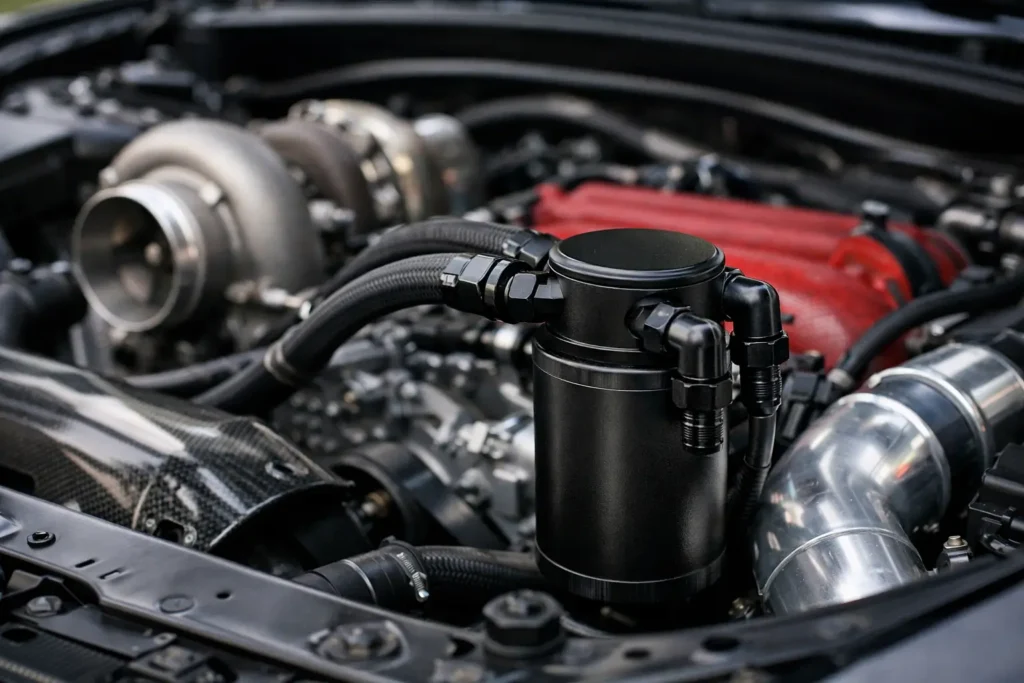
You usually notice the need for a catch can after the mess starts – oil film in boost pipework, a tired intercooler, crankcase fumes where they should not be, or an engine bay that smells hot after a hard session. This engine oil catch can guide is built for owners of tuned road cars, drift builds and race cars who want a cleaner intake tract, more stable crankcase ventilation and a setup that actually suits the car.
What an engine oil catch can actually does
A catch can sits in the crankcase ventilation system and separates suspended oil vapour and condensation from the gases moving through it. Instead of feeding that oily mist straight back into the intake, the can slows the flow, gives the vapour a surface to condense on, and stores the liquid so it can be drained later.
That matters more on modified engines than many people think. Higher boost, more cylinder pressure, longer time at high rpm and increased heat all raise the amount of blow-by and vapour moving through the PCV or breather system. On a standard daily that only sees light road use, the factory arrangement may cope well enough. On a turbo car running harder, or a drift car spending long periods at load and angle, the standard system can become the weak point.
The catch can is not adding power by itself. What it does is help maintain the rest of the system. Cleaner intake pipework, less oil contamination in the intercooler and reduced oil mist entering the combustion process can all support more consistent performance and make maintenance easier.
Why tuned and turbo cars benefit most
On forced induction cars, crankcase pressure control is not optional. Under boost, the intake manifold is no longer a simple vacuum source, so the PCV system has to be managed properly. If the plumbing is poor, or the can is undersized, pressure builds where you do not want it. That can push oil past seals, reduce ring seal quality and create leaks that look like a gasket problem when the real issue is ventilation.
Naturally aspirated builds can also benefit, especially high-compression or high-rpm setups, but turbo applications tend to show the problem sooner. You also see clear gains on engines known for heavy oil vapour, track cars with sustained lateral load, and older performance engines with more wear in the rings or bores.
There is a trade-off, though. A badly chosen catch can can be worse than no catch can at all. Small ports, poor internal baffling and restrictive fittings can choke the system. That is why the part itself matters, but so does hose size, routing and where the can sits in the engine bay.
Engine oil catch can guide – open vs closed systems
There are two broad ways to run a catch can: closed-loop and vented.
A closed-loop system keeps the crankcase ventilation circuit connected to the intake. Vapours pass through the catch can first, then return to the engine’s intake side. This is the better fit for many road cars because it keeps fumes contained, tends to be more civilised in daily use and is usually the cleaner option from a packaging and smell point of view.
A vented system lets the can breathe to atmosphere through a filter or breather. This can work on dedicated race or drift cars where simplicity matters and cabin smell or emissions compliance is less of a concern. It is not always the right answer for a street-driven car. Atmospheric systems can leave an oily smell, make MOT-related compliance more complicated depending on the vehicle and setup, and may not control vacuum behaviour the same way as a properly designed recirculating arrangement.
If the car still spends a lot of time on the road, closed-loop is often the sensible route. If it is a stripped competition car with a custom breather strategy, vented may be acceptable. It depends on the engine, intended use and the rules the car needs to meet.
Baffling matters more than polished finish
A lot of buyers focus on the outside of the can – billet body, weld quality, finish, brand name. Those things matter, but internal design matters more. A useful catch can needs baffling, mesh, chambers or directional flow features that actually separate oil from vapour. An empty alloy cylinder with two fittings may look the part and catch very little.
Serviceability also matters. You want easy draining, decent sealing on the base or drain point, and enough capacity for the way the car is used. A road car may go weeks between checks. A drift or track car may need inspecting after every event.
Sizing, fittings and hose choice
This is where many installations fall short. A catch can should not become a restriction in the breather circuit. Port size needs to match the engine’s needs, not just the thread size on the can. On a mild street setup, compact cans with sensible internal volume can work well. On a higher-power turbo build, especially one with larger breathers on the rocker cover or block, stepping up to larger fittings and hose is often the safer choice.
Avoid mixing a decent can with undersized hose because it was easier to route. Avoid cheap push-on fittings where proper threaded fittings and secure clamps are the better answer. Oil vapour, heat cycles and engine movement are hard on breather plumbing, so use hose designed for oil exposure and temperatures found in an engine bay.
Routing matters too. Keep runs as direct as practical. Avoid low spots where liquid can pool in the line. Mount the can securely and upright, somewhere accessible for draining, but not so close to major heat that the contents cook constantly.
Where to install it on the car
For most setups, the catch can sits between the engine breather or PCV outlet and the intake side it originally fed. On turbo cars, that usually means understanding both vacuum and boost conditions and planning around one-way valves or separate circuits if the engine requires them.
Some engines respond well to a single can. Others are better with a twin-can arrangement, separating the PCV side from the rocker cover breather side. That is more common on serious builds where the owner wants better control under different load conditions. It is not mandatory for every tuned car, but on the right engine it is a cleaner solution.
Do not just copy another car’s layout because it looked tidy online. Engine family, turbo setup, manifold design and available vacuum sources all change what works. A universal catch can is never truly universal once the plumbing starts.
Common mistakes that cause problems
The most common mistake is fitting a catch can as a dress-up part without understanding the crankcase system. If the original PCV valves, check valves or breather routing are removed or bypassed blindly, you can create idle issues, vacuum leaks or crankcase pressure problems.
The second mistake is choosing a tiny can for a hard-used engine. A can that fills quickly, or cannot separate vapour effectively at high flow, is not doing the job. Third is poor maintenance. A catch can needs draining. In colder weather, especially on road cars, you may collect a mix of oil and water contamination faster than expected.
The fourth mistake is assuming every engine needs the same answer. Some engines have known weak points and benefit hugely from a can. Others only show modest improvement unless the car is heavily modified. The more serious the use case, the less sensible it is to guess.
How to tell if your engine needs one
If you find oil in the intercooler pipework, excessive residue in the intake, persistent crankcase odour, or signs of pressure forcing oil out under load, a catch can is worth serious consideration. The same applies if you are increasing boost, moving to regular track work or building a drift car that will live at high rpm.
If the car is lightly modified and behaves cleanly, a catch can may still be a worthwhile preventative upgrade, but it is not always urgent. This is one of those areas where honest assessment matters. Fitting one because the engine bay has space is not the same as fitting one because the system needs better control.
Buying the right setup
For performance applications, buy by function first. Look for proper baffling, adequate capacity, sensible port sizes, durable sealing and compatibility with the fittings and hose sizes your build actually needs. If the car is custom, you may need to source the can, hose, adapters, clamps and bulkhead or bracket hardware as a complete package rather than as a single off-the-shelf item.
That is where a specialist performance supplier makes life easier. Shops such as ProSpeed Parts serve builders who need more than a shiny can on its own – they need the fittings, hose, clamps and fluid system hardware to install it properly the first time.
A catch can is not a magic fix, and it is not a replacement for engine health. If ring seal is poor or crankcase pressure is already excessive, the can only manage symptoms up to a point. But on a properly built or properly maintained tuned engine, the right setup is one of those practical upgrades that helps the whole package stay cleaner and work harder. Pick the can the same way you pick any serious fluid-system part – by flow, control and reliability, not just appearance.