

Oil temperature can ruin a good build long before peak power does. If your car sees repeated hard pulls, long track sessions, drift laps or sustained boost, this performance oil cooler guide will help you choose a setup that controls heat without creating new problems elsewhere.
An oil cooler is not a badge part. Fit the wrong core, route it badly, or skip the thermostat and you can end up with slow warm-up, unstable pressure, extra leak points and packaging headaches. Fit the right system and you get more consistent oil temperatures, better protection under load and a wider safety margin when the car is used properly.
What a performance oil cooler actually does
Engine oil is doing several jobs at once. It lubricates, carries heat away from bearings and turbochargers, cushions loaded parts and helps control contamination. Once oil temperature climbs too far, viscosity drops off and the margin of protection shrinks. On a tuned road car that might show up as pressure falling when hot. On a drift or race car, it can turn into repeatable overheating and accelerated wear.
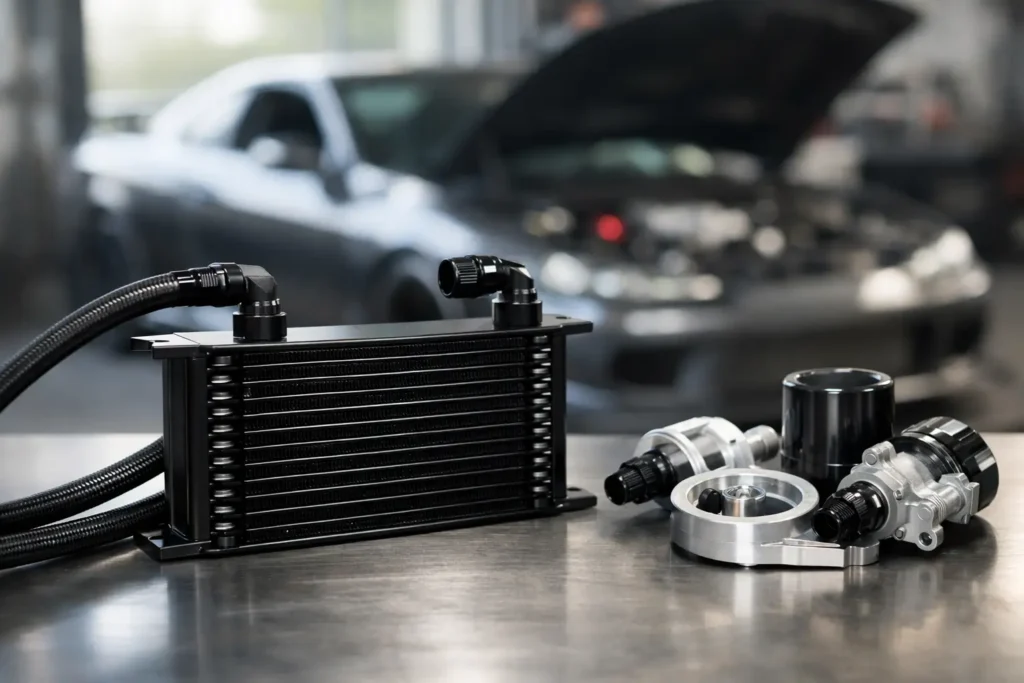
A performance oil cooler adds heat rejection capacity to the system. Oil leaves the engine, passes through a thermostatic take-off or sandwich plate, moves through hose and fittings to the cooler core, then returns to the engine after shedding heat into airflow. That sounds simple, but the details matter. Core size, hose bore, fitting choice, mounting position and thermostat strategy all affect how well it works.
Not every car needs one. A mildly modified street car with short spirited use may be fine on the factory heat exchanger or standard system. A turbo conversion, high-compression build, track day car, drift car or endurance setup usually benefits far more because oil spends more time under sustained thermal load.
Performance oil cooler guide – when you actually need one
The usual trigger is not a single dyno pull. It is repeat heat. If oil temperatures keep climbing after a few laps, if the engine goes soft as temperatures rise, or if hot idle pressure becomes uncomfortable after hard use, the cooling system deserves attention.
There are trade-offs. Over-cooling oil is just as unhelpful as under-cooling it. Oil that stays too cold holds moisture longer, flows differently and may never reach the temperature range the engine was designed around. That is why a thermostatic control is not optional on most street-driven builds. For mixed-use cars, it is one of the smartest parts of the whole install.
As a rough guide, a dedicated drift or circuit car with sustained revs and limited recovery time has a stronger case for a larger cooler than a fast-road car used in short bursts. Turbo engines also tend to benefit earlier than naturally aspirated setups, especially where under-bonnet temperatures are high.
Choosing the right cooler size
This is where plenty of builds go wrong. Bigger is not always better, and smaller is rarely cheaper in the long run if it does not control temperature.
Coolers are often discussed by row count, but row count alone is not enough. You also need to look at core height, width, thickness and fin density. A compact 19-row core with good airflow may outperform a larger cooler buried behind a bumper support and half blocked by pipework.
For fast road use, a moderate-sized cooler is often the right answer. For track and drift use, a larger core with proper ducting makes more sense. Very large coolers can increase oil volume and pressure drop, and they can be hard to package cleanly. If the system becomes too restrictive, the gain in temperature control may come at the expense of pressure stability.
The sensible approach is to size for the car’s real use, not for forum bragging rights. If the vehicle is street registered, sees cold starts and road miles, and only gets occasional hard use, keep the setup balanced. If it is a dedicated competition car, prioritise sustained control and serviceability.
Plate and fin versus stacked plate
Stacked plate coolers are the preferred choice for most serious performance applications. They are typically stronger, more efficient and better suited to motorsport abuse than basic tube-and-fin designs. That does not mean every expensive core is automatically right, but it does mean the cooler itself should not be the weak point in a proper build.
Thermostats, sandwich plates and take-off points
If there is one part you should not cheap out on, it is the control side of the system. A quality thermostatic sandwich plate or take-off plate helps the oil warm up normally and only routes flow through the cooler when needed.
For road and dual-use cars, a thermostat is the default choice. On race cars, some teams run non-thermostatic systems depending on operating conditions and warm-up procedure, but that is application-specific and not where most buyers should start.
You also need to confirm thread type, seal arrangement and filter clearance. The sandwich plate has to suit the engine’s filter mount and leave enough room around manifolds, downpipes, chassis rails and steering components. Tight packaging around turbo manifolds often turns a simple install into a fabrication job.
Hose and fittings matter more than people think
A good cooler with poor plumbing is still a poor system. Hose size affects flow and restriction, while fitting quality affects reliability. In performance builds, oil leaks are not a minor annoyance. They can end a session, ruin an engine or put fluid under tyres at the worst possible moment.
AN-style hose and matching fittings are common for a reason. They are modular, strong and easy to service when correctly assembled. Hose routing should avoid sharp bends, hot exhaust areas, moving suspension parts and any point where vibration can wear through the outer layer. Use proper support, not cable ties as a permanent solution.
There is also no prize for the most complicated route. Shorter and cleaner is generally better, provided the hose is protected and the bends are sensible. If the cooler is mounted far from the engine for packaging reasons, account for the extra volume and potential pressure drop.
Mounting position and airflow
The cooler only works if air can get through it. Front-mounted positions are common, but not every spot behind the grille is equal. If the cooler sits behind an intercooler, condenser and bumper beam with no ducting, its real performance may be well below what the catalogue suggests.
Aim for clean airflow and a stable mount. The core should not be hanging off thin brackets that crack after a few heat cycles and kerb strikes. Isolation mounts can help, but the assembly still needs to be secure. On competition cars, think about debris exposure as well. A low-mounted cooler might get excellent airflow and terrible stone damage.
Ducting is often overlooked. Even simple shrouding can improve performance by forcing air through the core instead of letting it spill around the edges. On a well-sorted build, airflow management is worth nearly as much as cooler choice.
Common mistakes in a performance oil cooler guide
The biggest mistake is fitting a cooler to mask a deeper issue. If the engine has poor fuelling, excessive bearing clearance, inadequate radiator performance or a heat-soaked engine bay, the oil cooler may reduce symptoms without fixing the cause.
The second mistake is ignoring cold behaviour. A non-thermostatic setup on a road car can leave the oil too cool for too long, especially in the UK climate. The third is using mixed-quality parts – a decent core paired with unknown hose and fittings is false economy.
Another regular issue is poor placement near exhaust heat. If the return line runs past a glowing manifold or turbine housing, the system can pick up heat where it should be losing it. Heat shielding and routing are part of the solution, not optional extras.
Street, drift and race setups are not the same
Street cars need reliable warm-up, leak-free operation and sensible packaging. Drift cars need repeated thermal control, resistance to vibration and impact, and easy service access. Race cars need all of that, plus consistency over long sessions and a system designed around the full cooling package.
That is why buying by vehicle use is usually smarter than buying by generic row count alone. A street-driven turbo hatchback and a track-only time attack build may both use an external oil cooler, but the correct specification can be very different.
For buyers sourcing parts for customer builds, repeatability matters as much as outright performance. Proven fittings, known hose spec and quality cores save time in the workshop and reduce comeback risk. That is exactly why specialists such as ProSpeed Parts focus on motorsport-grade fluid and cooling hardware rather than general motor factor stock.
Before you order, be honest about power level, oil temperature trend, intended use and available space. If those four points are clear, cooler selection becomes far more straightforward.
The best oil cooler setup is not the largest one on the shelf. It is the one that keeps temperatures under control, maintains pressure, fits the car properly and survives real use. Build it like the engine depends on it, because it does.