

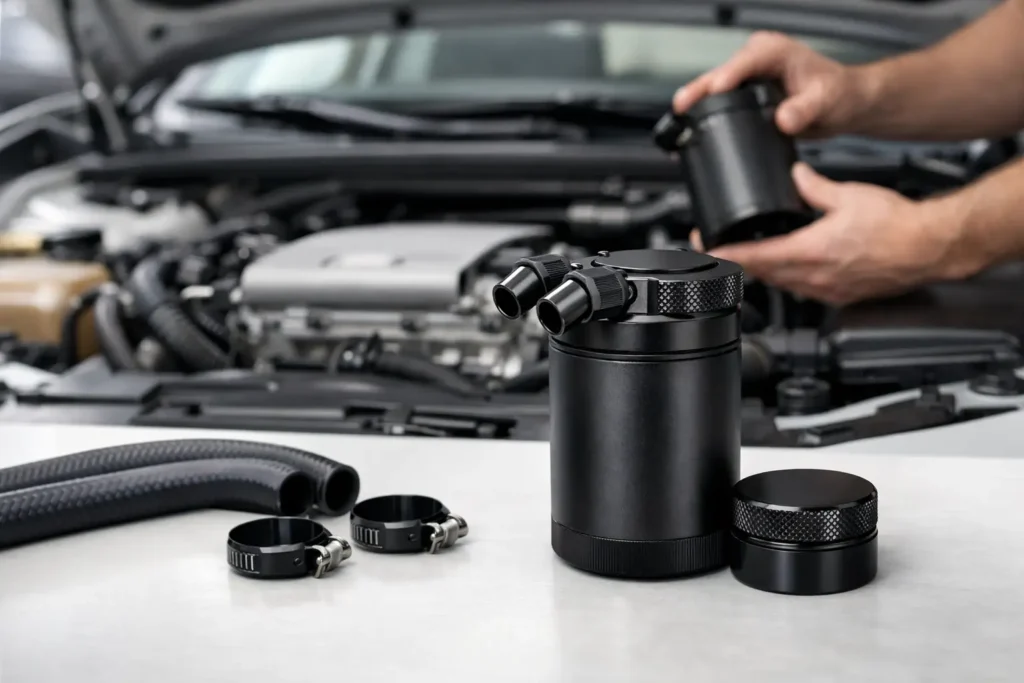
A cheap catch can that looks good in the bay but does nothing for crankcase control is worse than no upgrade at all. If you are working out how to choose oil catch can hardware for a street build, drift car or track setup, the right answer comes down to engine type, blow-by level, PCV layout and how the can is built internally.
A catch can is not just a small tank with two fittings. On a hard-used turbo car especially, it is part of the engine’s breathing system. Choose badly and you can end up with poor oil separation, pressure issues, inconsistent idle, oil mist coating your intake piping, or a setup that is awkward to drain and service. Choose properly and you get cleaner intake charge pipes, less contamination in the intercooler, and better control over crankcase vapour under load.
What an oil catch can actually needs to do
The job is simple on paper. Crankcase vapours carrying oil mist leave the engine, pass through the can, and the oil is separated before the gases are returned to the intake or vented depending on the system. In practice, the can only works well if vapour speed slows down enough for separation to happen and if the internal design gives the oil somewhere to drop out of suspension.
That is why capacity alone is not the main buying point. A large empty can with no baffling is often less effective than a properly designed smaller can. Internal control matters more than polished finish, branded laser etching or billet appearance.
How to choose oil catch can for your engine layout
Start with the engine, not the catalogue photo. A mild naturally aspirated road car with standard boost control and low blow-by does not need the same setup as a forged turbo build running high cylinder pressure. The more crankcase pressure and oil mist your engine produces, the more serious the can needs to be.
On most road cars, a closed-loop system is the sensible option. That means vapours are routed through the catch can and back into the intake system, keeping things tidy and generally more road-friendly. On drift and race applications, especially where emissions compliance is not the priority, some owners run vent-to-atmosphere systems. These can work well in competition use, but they are not automatically better. They can smell, they can leave residue, and they may not suit every regulations package.
If your engine still uses the factory PCV valve arrangement, make sure the catch can you choose is compatible with that style of plumbing. Some engines benefit from a can placed on the dirty side, between crankcase and intake manifold. Others need a more complete dual-can approach, covering both PCV and cam cover breather lines. There is no universal best setup. It depends on how the engine breathes under vacuum and boost.
Turbocharged vs naturally aspirated applications
Turbo engines usually need more attention. Boost increases cylinder pressure, which generally means more blow-by and more oil vapour moving through the system. A turbo car with upgraded boost, worn piston rings, or regular hard use will overwhelm a basic decorative catch can quickly.
Naturally aspirated engines can still benefit, particularly in motorsport use where sustained high rpm creates plenty of crankcase vapour. But for these builds, packaging and plumbing simplicity may matter more than going oversized.
Internal baffling is the feature that matters most
If there is one thing to prioritise, it is internal separation design. When people ask how to choose oil catch can products, this is usually where the difference between a proper functional part and generic hardware shows up.
Look for baffling, filtration media, multi-stage chambers, or directional flow paths that force vapour to change speed and direction. That gives suspended oil droplets a chance to condense and fall into the reservoir. A completely empty can with straight-through ports does very little beyond acting as a temporary expansion chamber.
You also want sensible port positioning. An inlet and outlet placed directly opposite each other can let vapour pass through too quickly. Better designs route flow through internal baffles before it reaches the exit.
This is also where cheap units often fail. They may copy the shape of a quality motorsport can but skip the internal engineering entirely. From the outside, both look similar. In use, they are not close.
Choose the right size without going silly
Bigger is not always better, but too small is a problem. Capacity should match the engine and how the car is used. A compact can may be fine for a mildly modified fast road car that sees occasional spirited driving. A drift or circuit car that lives at high load for long sessions will usually benefit from more volume and better internal control.
Space in the engine bay matters as well. If the can is too large to mount securely, or forces awkward hose routing near heat sources, you are creating new problems. The best setup is one you can package cleanly, mount solidly and service easily.
As a rule, choose enough capacity to avoid constant draining, but do not chase size at the expense of function or fitment. A properly baffled medium-size can is often the smarter buy than a huge basic tank.
Port size, hose size and flow capacity
A catch can should never become a restriction in the crankcase ventilation system. If the ports are too small, or the internal passages are narrow, you can create pressure build-up instead of relieving it. That is the opposite of what you want on a performance engine.
Match the port size to the engine’s breather hose size and expected vapour volume. Higher-output turbo builds often need larger ports and hoses than standard road applications. If you are fabricating a custom system, check the fitting threads, hose compatibility and whether reducers are actually appropriate or just a compromise because the can you bought was underspecified.
This is especially important for workshops and repeat build customers. Standardising around quality cans with sensible port options makes future service and parts replacement much easier.
Drainage, servicing and real-world use
A catch can is a service item. That means the drain arrangement matters more than many buyers think. If the drain is awkward to reach, or the can has to be removed to empty it, servicing often gets ignored. Then the can fills up and stops doing its job properly.
A bottom drain valve or plug is the practical option for most builds. Sight tubes can help, but they are not essential if the can is easy to inspect and drain. For cold climates and short-trip road use, expect more water condensation mixed with oil residue. That means more frequent emptying.
If the car sees mainly track use, service intervals should be tied to event mileage and engine condition. A tired engine with more blow-by will fill a can much faster than a healthy one.
Build quality and materials
Aluminium is the usual choice and for good reason. It is light, corrosion resistant and easy to package. The key is not just material, but welding quality, thread quality, sealing and bracket strength. A catch can that vibrates loose, seeps from poor threads or cracks around the mount is not fit for a hard-driven car.
Check whether the supplied fittings, O-rings and brackets are actually up to the job. Motorsport use exposes weak points quickly. Heat, vibration and repeated service cycles will punish budget hardware.
For street and race customers alike, this is where buying from a performance-focused supplier such as ProSpeed Parts makes more sense than gambling on generic parts with no clear spec behind them.
Closed-loop or vented
This decision depends on use case, regulations and how clean you want the installation. Closed-loop systems are generally the better choice for fast road builds because they keep the engine bay cleaner and integrate with the car’s existing ventilation strategy. Vented systems can be useful on dedicated competition cars, particularly where maximum crankcase breathing is required, but they need proper filtering and sensible placement.
Do not assume venting to atmosphere is a shortcut to performance. If the rest of the breather setup is poorly designed, it will still be poor with a vented can.
Common buying mistakes
The most common mistake is buying on appearance alone. After that, it is choosing a can with the wrong port size, ignoring baffling, mounting it too far from the breather source, or treating every engine as if it needs the same plumbing layout.
Another mistake is expecting the catch can to fix underlying engine wear. If ring seal is poor and blow-by is excessive, a catch can helps manage vapour and oil mist, but it does not cure the cause.
The smart way to buy
If you want a catch can that actually works, buy by function. Start with engine output, induction type and intended use. Then check internal baffling, port size, mounting options, drainage and whether the can suits a closed or vented system. That approach gets you a part that supports the build instead of just filling space in the bay.
The right catch can is not the flashiest one on the shelf. It is the one that matches the breathing demands of your engine, fits the car properly, and can be serviced without hassle. Get that right and the rest of the system has a much better chance of staying clean and controlled when the car is driven as intended.