

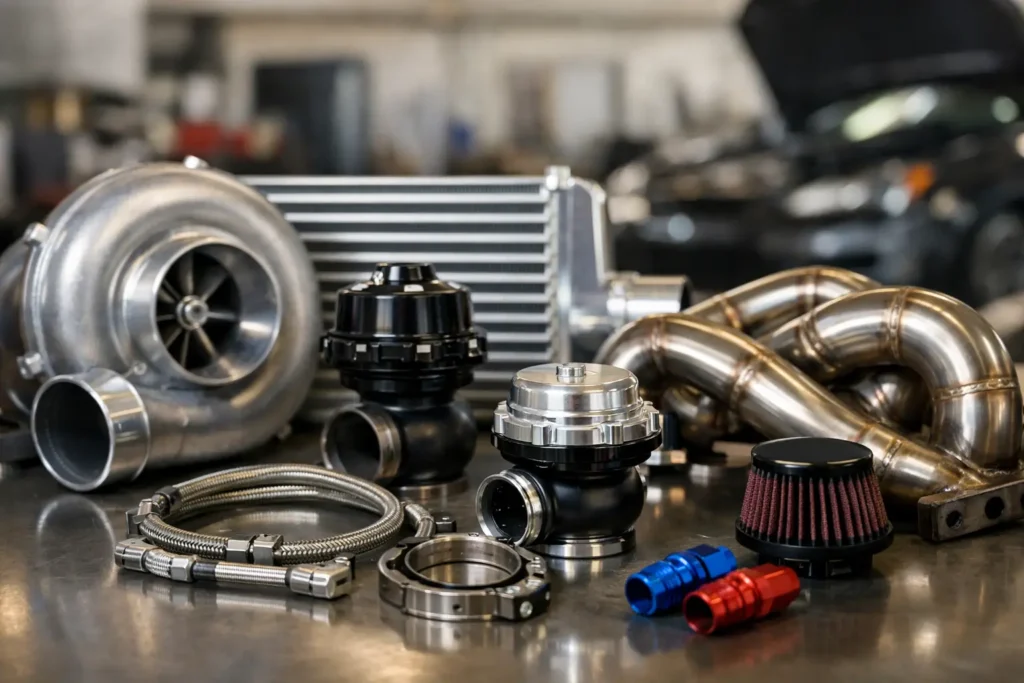
A turbo setup usually fails at the edges, not at the core. The turbocharger gets the attention, but turbo accessories are what decide whether the car holds boost cleanly, controls heat properly and survives repeated hard use on the road, strip or circuit.
That matters whether you are refreshing a fast road car, building a drift project or finishing a time attack engine bay where every hose route and clamp choice counts. The right supporting parts make the difference between a setup that looks complete and a setup that actually stays reliable under load.
What counts as turbo accessories?
In performance terms, turbo accessories cover the hardware around the turbo system rather than the turbo itself. That includes oil feed and return lines, coolant lines where applicable, gaskets, studs, V-band clamps, vacuum hose, boost control solenoids, wastegate fittings, dump valves, heat wrap, turbo blankets and intake or charge pipe joining hardware.
Some buyers treat these as add-ons. Experienced builders do not. If the oil drain angle is poor, the wastegate reference is unstable or the hot side radiates heat into everything around it, the rest of the package suffers. A strong parts list is built from the supporting hardware outwards.
Why turbo accessories matter more than most buyers expect
Boost pressure exposes weak decisions quickly. A cheap clamp that relaxes after heat cycles, a thin gasket that does not seal properly or a generic hose that softens next to the manifold can turn a sorted car into a constant troubleshooting job.
Reliability is the first reason to buy properly. Turbo systems deal with heat, pressure and vibration at the same time, and each one works against fittings and hoses. Street cars feel this over months of use. Drift and race cars feel it in a single weekend.
The second reason is control. Good turbo accessories keep the system predictable. Wastegate plumbing, boost reference routing and dump valve choice all affect how boost comes in and how repeatable the setup is. If your tune is solid but the hardware is inconsistent, the car will still feel inconsistent.
The third reason is packaging. Most modified cars are not working with ideal factory space. Once you fit an aftermarket manifold, larger turbo, external wastegate or custom intercooler pipework, you are solving fitment problems as much as performance ones. The right fittings, joiners and clamps give you proper routing without forcing compromises.
Turbo accessories for oil and coolant control
Oil and coolant hardware is where many builds either stay clean or become a mess. Turbochargers need stable oil supply, unrestricted drain-back and, on water-cooled units, dependable coolant flow. That sounds basic, but this is where a lot of poor installations start.
Oil feed line choice should match the turbo’s requirements, not just whatever fitting is easiest to source. Some turbos need restriction, some do not, and getting that wrong can lead to smoking, poor bearing life or both. The return side matters just as much. A drain line that is too small, routed badly or forced into a poor angle will never behave properly, especially once the engine sees sustained load.
Coolant lines are less dramatic until they fail. On compact engine bays, routing close to the turbine housing can cook lines and fittings over time. Heat shielding and sensible pathing are not cosmetic extras here. They are part of keeping the system serviceable.
Boost control and vacuum routing
If you want stable boost, do not treat vacuum hose and boost control plumbing as an afterthought. A quality boost control solenoid can only work properly if the hose routing is short, secure and free from leaks or kinks.
This is especially relevant on external wastegate setups. Reference source, hose diameter and fitting security all influence response. On a street car, poor routing might show up as mild boost fluctuation. On a race or drift car, it can mean inconsistent power delivery corner to corner or run to run.
Dump valves fall into the same category. The right valve needs to match airflow, pressure level and intended use. Some owners prioritise noise. Serious builds prioritise control and sealing. A valve that leaks under boost or responds lazily is not adding character. It is costing performance.
Clamps, V-bands and joiners
Ask any workshop what causes repeated call-backs on turbo cars and loose connections will be high on the list. Joiners and clamps are small-ticket items, but they hold together the entire pressure side of the system.
For charge pipework, decent clamps and properly matched silicone joiners are non-negotiable. Cheap hardware often looks fine during assembly, then starts to shift once boost and temperature rise. T-bolt clamps, quality joiners and bead-rolled pipe ends are a far better long-term answer than over-tightening inferior clips and hoping for the best.
On the hot side, V-band hardware has obvious advantages for packaging and serviceability, but quality matters. Poorly machined flanges and weak clamps create sealing issues and make repeated disassembly frustrating. A good V-band setup saves time in fabrication and later maintenance. A bad one does the opposite.
Heat management is part of performance
Heat is one of the main reasons turbo systems lose reliability. Under-bonnet temperatures affect hoses, wiring, brake components, intake temperatures and even how easy the car is to work on after a session.
Turbo blankets, exhaust wrap and heat shielding all have a place, but there is no one answer for every build. A road car that sees occasional spirited use may only need localised shielding and sensible line routing. A drift or circuit car with sustained high exhaust temperature will usually need a more deliberate heat management plan.
There are trade-offs. Exhaust wrap can reduce radiant heat, but on some applications it may trap moisture or accelerate fatigue on lower-grade manifolds. Turbo blankets are effective, but they need proper fitment and enough surrounding clearance. Heat management should be chosen around the whole setup, not copied from another build because it looked tidy online.
Choosing turbo accessories for your application
The right parts depend on how the car is used. A fast road build needs reliability, low maintenance and clean fitment. A drift car needs hardware that can tolerate repeated heat cycles, vibration and quick repairs between sessions. A race car needs consistency and service access as much as outright performance.
That is why buying by specification matters more than buying by appearance. Hose material, fitting thread, temperature rating, pressure rating and sealing method all matter. If you are fabricating a custom system, the parts list should be built around actual dimensions and routing constraints, not rough assumptions.
Brand choice matters too, especially for control components and sealing hardware. There is a reason serious builders stick with proven motorsport and performance brands for valves, solenoids and thermal products, while using dependable fittings and lines throughout the rest of the system. Saving money on the wrong item usually becomes expensive later.
Common mistakes when buying turbo accessories
The most common mistake is mixing random parts from different standards and expecting them to seal first time. Thread compatibility, flange style and hose sizing need to be confirmed before the order is placed, not when the car is on stands.
Another mistake is underestimating serviceability. Tight engine bays tempt people to route lines through impossible spaces, only to find that basic maintenance becomes awkward. If a fitting cannot be reached or a clamp cannot be checked easily, that matters.
The last one is choosing parts for headline boost figures rather than real operating conditions. A road car with frequent stop-start heat soak may punish components differently from a drag car that sees short bursts. The best setup is not always the most extreme one. It is the one that suits the car and keeps working.
Building a cleaner, more reliable turbo system
A strong turbo package is not just about the compressor map or turbine size. It is the sum of the supporting parts – the lines that feed it, the clamps that hold pressure, the valves that control it and the heat protection that stops the whole area cooking itself.
That is why turbo accessories deserve the same attention as the headline components. At ProSpeed Parts, the buyers who get the best results are usually the ones who spec the full system properly from the start, rather than chasing fixes after the first leak, split hose or boost issue. Build it once with the right hardware, and the car is faster to finish, easier to maintain and far more likely to deliver when it matters.
If you are planning the next stage of a build, start with the details around the turbo, because that is where dependable performance is usually won or lost.